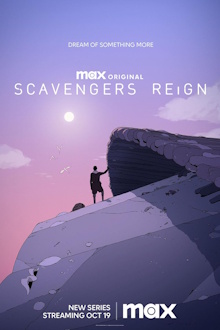
Amidst all the much more well-known animated shows, this one seems to have fallen under the radar and ultimately failed. I was drawn to it both by its sci-fi setting of survivors trapped on an alien planet and its art design. Its visuals are reminiscent of Western graphic novels and indeed the immediate inspiration is the work of French artist Jean Giraud. I’m always keen on animated speculative fiction shows that are made for adults and this certainly counts. Unfortunately this is a show about vibes, not cerebral ideas, and once it became obvious that it has no interest in offering grounded explanations for anything, my opinion of it dropped by a few notches.
Three groups of survivors are stranded on Vesta, a lush planet brimming with strange, alien life. Originally from the cargo freighter Demeter 227, they were separated when their escape pods landed in different locations. The commander Sam and the horticulturalist Ursula end up together. Azi, a cargo handler, lands with Levi and a bike. Kamen is alone and starves as his pod is entangled in a tree high above the ground. Working together Sam and Ursula use some of the local plants as tools and after recovering a battery manage to send a command to the still orbiting ship to get it to land. Azi has been trying to grow crops with Levi’s help until the local wildlife destroy their homestead. She notices that Levi has been behaving oddly after his internals are smeared with a strange goo from a local plant. Finally Kamen is freed by a creature with telekinetic and telepathic powers. The creature nourishes him with a black substance that appears to have hypnotic properties and controls him with visions of his estranged wife Fiona. When the Demeter descends onto the planet, all three groups head towards it.
I’m a big fan of the clean, line art-based style used here and the orchestral score it uses reinforces the impression of this as being classic science-fiction. The characters are all adults with the exception of one teenager who might be autistic, and there’s no attempt to be cute or funny in this life or death situation. The alien life on Vesta is truly alien instead of just dressed up versions of Earth species. There’s a terrific sense of wonder and endless possibility once we see the full extent of this incredibly fecund and biologically complex ecosystem. Nausicaä of the Valley of the Wind is a natural point of comparison that many have made due to the richness of the alien life and how it can both hinder and help the characters. On paper, I should like this show and yet I don’t because all the characters ever do is move towards the crashed Demeter and all its makers ever want to do is to impress us with how imaginative they are in coming up with weird aliens. So it’s just one obstacle or hazard after another from the first episode to the last.
It’s frustrating because the attitude that the show predominantly wants to espouse when confronted with the alien life on Vesta is that of wonder and only wonder. It has no interest in exploring the evolutionary underpinnings of how life on Vesta developed the way it has. Ursula draws sketches of the strange plants she encounters but never forms any theories about their development or biology. At one point she tries to Sam about a danger they barely escaped from only to be dismissed with a curt, “Does it matter?” Yes, it does because the characters don’t seem to learn from what they experience and plan ahead. Instead the series prefers to adopt a “take things as they come” attitude to preserve the sense of wonder. Perhaps one reason for that is that the lifeforms on the planet don’t make much sense in terms of conventional biology. They are oddly compatible with Earth life though they must have evolved separately yet the characters seemingly have no fear of local microbes and viruses. They can somehow interface and interact with human technology. The creature Kamen meets must be an apex predator due to its psionic powers and one wonders why it needs to suborn others at all. That’s even discounting the logical loopholes. Why did they even abandon the Demeter when it seems perfectly safe and intact in orbit?
So to me, this counts as space fantasy rather than science-fiction. The prevailing sentiment is that we’re meant to open our eyes and accept the weirdness for what it is, rather than attempt to rationalize and understand. It’s not much of a surprise that the ones who fare the best are those able to adapt to Vesta rather than those who struggle against it. A visually beautiful, vibes-based show about an exotic alien planet has its place. But it goes on a little too long to remain satisfying with just that formula and at some point, the viewer will want more of a plot and actual worldbuilding.