
Someone posted this in QT3 in a thread to discuss news of workers rioting at a factory in the U.S. after getting news of being laid off. It looks more like an environmentalist revolution than a socialist one to me though. Enjoy!
Someone posted this in QT3 in a thread to discuss news of workers rioting at a factory in the U.S. after getting news of being laid off. It looks more like an environmentalist revolution than a socialist one to me though. Enjoy!
One blog that I’ve recently added to my regular reading list is De Minimis. I have no idea who the blog author is, but on general business and economic matters, I happily concede that he (I assume that the author is a “he”) is far more learned and well read that I am. He even appears to be a Star Trek fan, what a nice coincidence!
I’m pretty unhapppy about a post he made however. It’s an interview with PBB group chairman Datuk Oh Siew Nam about what measures Malaysia should take in the face of the current economic downturn. What upsets me is that in addition to the expected suggestion of a generously funded and carefully targeted stimulus plan, there are also two proposals that are explicitly protectionist in nature, and De Minimis appears to agree with both of them.
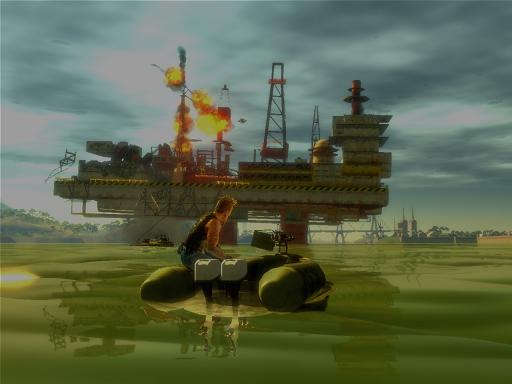
Due to the sparse information available in the official manual and the glitchy nature of the game, I thought that it might be useful to write a post on some useful tips for Mercenaries 2. Besides, it gives me an excuse to post some more screenshots!
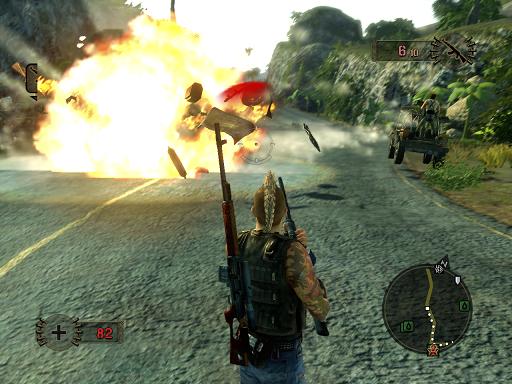
There’s really only one word to describe Pandemic Studios’ Mercenaries 2: World in Flames: explosions. Just about every gripe that you might have about this game can be rebutted with that one word. Are your eyes bleeding from the crappy graphics? Blow some stuff up and enjoy all the pretty explosions. Do you find the AI-controlled soldiers comically stupid? Fire a rocket-propelled grenade into their midst and watch the explosions toss them every which way. Are you cringing from the lame story and dialog? Call down a few airstrikes randomly to make yourself feel better.
Like its predecessor, Mercenaries 2 is a Grand Theft Auto clone, except that you’re not a two-bit hood but a grizzled mercenary and the open-world environment you’ll be gallivanting around in isn’t a metropolis, but a warzone. The game is set in a near future Venezuela (a fact which pisses off Hugo Chavez to no end) that is being fought over by various factions for its oil resources. Early on, the player is brought in to help a businessman mount a coup to take control of the country but is subsequently betrayed without being paid. This sets the stage for the player to exact his revenge, while earning a tidy profit by performing missions for the various factions vying for control of the country of course.
My wife and I are currently working our way through all five seasons of Babylon 5. It’s one of the most highly acclaimed science-fiction shows ever produced for television, so not having watched it was seriously hurting my street cred as an sci-fi geek. Anyway, in one of the first season episodes, The Geometry of Shadows, the command crew of the station is presented with an odd problem.
Members of one the minor races, the Drazi, have begun fighting one another for no apparent reason, and the escalating level of violence is threatening the security of the station, so the newly promoted Commander Ivanova needs to find a solution to the problem. To do that, she needs to find out why they are fighting. As it turns out, every once in a while, the Drazis put a number of sashes in a gigantic barrel, one for each Drazi. Half of the sashes are dyed purple, the other half green, so whichever colour of sash a Drazi draws out of the barrel determines which group he belongs in. As the Drazis explain, “Where there was one Drazi people, now there are two. The two fight until there are one.”
Continue reading Why unity through enforced assimilation doesn’t work

The latest Hollywood blockbuster right now is this year’s remake of the science-fiction classic The Day the Earth Stood Still starring Keanu Reeves. In one of the odder publicity moves, the producers have decided to beam the film into outer space just in case any extraterrestrials want to watch it. The transmission is being directed at the star system closest to our own, Alpha Centauri, which is about 4.37 light years away from our Sun, though the studio notes that it is a wide beam transmission so that any aliens who happen to be travelling within the cone of the transmission or even beyond Alpha Centauri should be able to tune in as well.
More seriously, it’s pretty unlikely that any aliens will be close enough to catch it, and it’s a big question whether or not the signal will remain coherent enough to be watchable at any reasonable quality 4.37 light years away. In any case, since Earth has been leaking radio transmissions into space for decades by now, if any aliens are in Alpha Centauri and wanted to send a reply, we’d have heard from them by now.
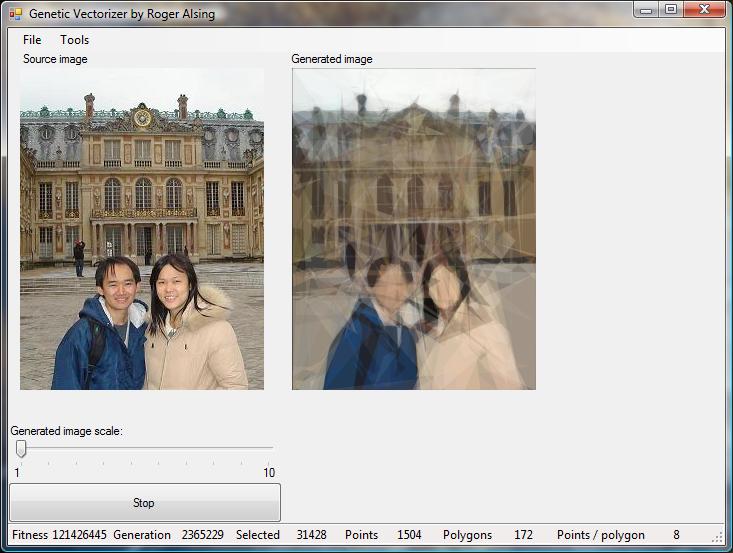
Okay, this is really nothing more than a cool toy, but it is still really cool! This is made using a simple application by Roger Alsing that starts with a blank slate and then adds some random polygons to it. The result is compared to the source image and if it looks closer then it is kept, otherwise it is discarded. The kept result is then further mutated and compared again and so forth. After a while, it gets pretty close to the original source.
There was a bit of skeptism about this when this was first spread over the Internet, but the creator has since made his source code and binaries available via Google, so go download it and play with it if you’re so inclined. The author originally used the program to generate an image of the Mona Lisa and he managed to get a very good representation after about 900,000 generations and using 50 polygons. Unfortunately I happened to pick a rather more complex photo, and this is what I got after having the computer working at it whole night. As you can see, it’s up to 2.3 million generations and 172 polygons.
The author calls this an example of genetic programming, but I’m not sure if the term is appropriate because usually these things involve a population pool of multiple competitors in each generation while there is only ever one instance in each generation in this program. People have been using this as an example to implement their own versions that do involve competition between multiple mutations though, and it will be interesting to see if they are more efficient at arriving at the source image.