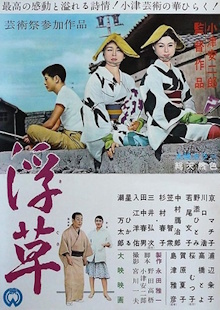
Yasujirō Ozu’s films keep being great and so I keep watching them. This one is actually a remake of his own earlier black-and-white silent film and I’m sure that the improved production values make a difference. It features bigger names as stars as well so it’s the preferred version over the original. As usual with Ozu, this is a film about family and human relationships, but it’s noticeably more salacious and lurid than most of his body of work. It’s centered around a travelling theatre troupe which seems glamorous at first but they all turn out to be a bunch of scoundrels, truly the floating weeds of the film’s title.
One hot summer, the residents of a small seaside town anticipate the arrival of a troupe of travelling Kabuki performers. Led and owned by their lead actor Komajuro, they set up residence at the local community hall. Komajuro has an ulterior reason for habitually visiting this town as his old mistress Oyoshi lives there and her son Kiyoshi is actually his own. While the other performers complain about staying so long in a small town without enough of an audience to sustain them, Komajuro takes the opportunity to spend time with Kiyoshi who knows him only as his uncle. Sumiko, the lead actress of the troupe and Komajuro’s current girlfriend, becomes jealous and confronts them but he warns her off. So she pays the younger actress in the same troupe Kayo to seduce Kiyoshi to ruin the promising young man’s life. Meanwhile the other male performers in the troupe are no better as they spend their own free time carousing with the prostitutes in town and chasing after girls.
Right from the beginning when a local resident bemoans the departure of the striptease act that previously occupied the hall, you’ll realize that this film isn’t as straight-laced as Ozu’s other works. In fact, those of us outside of Japan may be inclined to accord a certain respect to traditional Kabuki theatre but Ozu here practically oozes with contempt at this troupe. When one member is distributing flyers about town, he angrily dismisses the little kids who follow him around and is interested only in knowing about attractive local girls. They really are the proverbial sailors with girls in every port, leaving behind broken promises and fatherless children everywhere they go. I got a nice chuckle when even Kiyoshi remarks that their old-fashioned and rigid performances can no longer satisfy modern audiences. Komajuro is shown actually beating the women who disobey his orders so I can’t imagine anyone sympathizing with the character. I did rather enjoy this portrayal of a seamier side of Japan.
Despite the tawdry themes in this film, there is no course nothing even close to nudity. That doesn’t prevent it from being erotically charged. Machiko Kyō who plays Sumiko was considered one of Japan’s earliest sex symbols and you can see why here. With just a bit of exposed collarbone and a pouting lip, she can look amazingly sultry. Similarly, the passion between Kiyoshi and Kayo is portrayed by having her grip his broad back. It’s so great. I wonder if Ozu intended to make a statement about these more modern forms of storytelling compared to traditional theatre. Less gratifying is that despite Komajuro’s overt abuse of the women in his life, all ultimately forgive him or even seek his forgiveness later. The respect he is accorded as the master of the troupe never wavers and it seems it is his prerogative to treat the troupe members like this as he wishes. I suppose this too is authentic to the state of Japanese society at the time but it’s still very ugly.
Ozu’s films pretty much always aim to convey a sense of bittersweetness and so does this one. There’s a sense of a cycle in the story of Komajuro and Kiyoshi and then life just goes on. This surprised me with its more sordid turn but in a very good way and it’s good to see his perspective applied to less traditional families and lifestyles. This doesn’t seem to be as well known as his other work but I think it’s no less great.