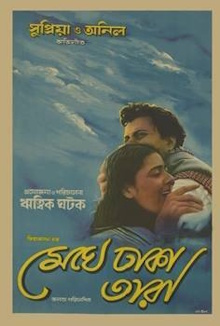
Here’s another masterpiece from classic Indian cinema and this time it is not by Satyajit Ray. It does cover similar thematic territory however in being what I would call misery porn. It was made by Ritwik Ghatak and is believed to be his best known and most watched film. There’s supposed to be some political backdrop to this but I don’t think it matters much as the Partition of Bengal is not directly mentioned. All we need to know is that this is about a miserably poor family and a self-sacrificing daughter who bear everyone’s burden. It’s such a superbly made film that one instantly recognizes why it is a masterpiece. Yet it also advances a morality that I find execrable.
Nita is the eldest sister in an impoverished family with multiple siblings. Despite being educated and their father being a schoolteacher, they are finding it difficult to make ends meet. Nita helps out by juggling her postgraduate studies with tutoring. The eldest brother Shankar is in training to be a singer and his maestro has forbidden him from performing until his training is complete. Despite him being a burden, Nita has a encouraging attitude to him and is the closest to him. Nita also has a boyfriend Sanat who used to be a student of her father. He too is living in poverty while he completes his research and occasionally needs money from Nita. Things take a turn for the worse when her father gets sick and is unable to work. Nita is forced to suspend her studies and take up full time employment. Meanwhile Shankar approaches her about marriage and she asks him to wait until he completes his own studies. Her mother is alarmed by the relationship, fearing that Nita getting married would mean that the family will be left without a breadwinner. So she encourages the younger sister Geeta to get close to Sanat instead.
Like many other dramas from the era, this is the kind of film that piles misfortune upon misfortune upon the protagonist. Nita never gets to have a single moment of happiness and is portrayed as the ideal, self-sacrificing Madonna-like figure who happily takes on everyone’s burdens with a smile. To the film’s credit, in the end this does break her and she ends up wailing piteously at the entire world. But we do have to spend the entire film watching her endure endless hardship. Her mother is incredibly cruel and unsympathetic even when she falls ill from overwork, yet her behavior is excused as her spirit being broken by a lifetime of poverty. Arguably her father is worse, an intellectual who endlessly wrings in hands in consternation at the responsibilities that they are pushing onto Nita and quotes from English literature as if he were wise, yet is powerless to actually do anything. Shankar is infuriating at the beginning when he begs for money saying that as an artiste, he shouldn’t work. He does later call out the behavior of the others and come back to save her when his singing career takes off, but it’s far too late then.
This would be an awful film if not for how gorgeously made it was. Right from the opening wide-angled shot of a huge banyan tree with Shankar practicing his singing by the river nearby, this is a breathtakingly beautiful film. It isn’t afraid to fill practically the entire frame in darkness either, leaving only enough light to highlight faces. Shankar’s singing is the only musical accompaniment and it perfectly complements the shifting emotions. This is truly a case of me not agreeing at all with what the film is trying to say yet having to acknowledge that it says it perfectly well. There are also layers of meaning that I can only scratch at the surface of. For example I was mystified when the father is disappointed at the younger brother taking up a factory job and downright horrified at his comment that this was the expected result when the brother has a work accident. I can only guess that this is due to their family belonging to a genteel caste who should be above such work. I suppose that to the Indian audiences this was made for, this must be an imperative that makes sense and makes Nita’s trials even more affecting.
I’ve seen plenty of films like this back in the day and never liked the ideal of elevating self-sacrifice to be the height of virtue. I’m also irked in that Nita’s trials in particular feel a little contrived in that her family members feel so little urgency about being poor while she takes on the entire burden. To be fair, Shankar does castigate her in that it is because she keeps giving that the others keep taking without guilt, but she is still unmistakably held up as the heroine. Still, this is a masterpiece of Indian cinema that is absolutely worth seeing and it’s good to watch at least one film by Ghatak.