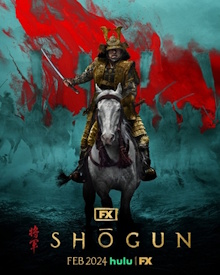
I actually do have vague memories of the earlier 1984 adaptation of the James Clavell novel even though I was far too young then to understand any of it. This new version is by all accounts far better especially as rather than framing John Blackthorne as the protagonist, it really only puts him in the position of a witness to the rise of Yoshii Toranaga. Production quality and especially the performances are all excellent. This is faithful to the novel so it uses the fictionalized versions of the historical characters. But part of me so wishes it used the original names instead as it would have been so cool.
In 1600, the Dutch vessel Erasmus arrive in Japan after a grueling voyage that has left most of the crew dead. The survivors including the English pilot John Blackthorne are taken prisoner by the local samurai. They immediately become pawns in multiple conflicts. The Portuguese Jesuit priests want him dead, claiming that he is a pirate, as they wish to maintain their trade monopoly with Japan. The local ruler Kashigi Yabushige plans to use the Erasmus and its guns and cannons for his own interests, but his own liege lord Yoshii Toranaga hears about it and asserts control. Toranaga himself is embroiled in a power struggle with his fellow regents of Japan, following the recent death of the ruling Taikō. Blackthorne is brought to Osaka Castle where Toranaga himself is effectively a prisoner and introduced to the lady Toda Mariko. As she speaks Portuguese and is also Catholic, she is to be his translator. That night after Blackthorne explains how the Portuguese intend to take over all of Japan, shinobi arrive to assassinate him. Toranaga himself dispatches the assassin, having hidden himself, and embroils Blackthorne in his own plans against the other regents.
Remarkably for an American show, this series mostly uses Japanese and visibly takes great pains to be as authentic as possible. I was concerned for a while that it might exaggerate the aspects of Japanese culture associated with the samurai class. Many of the characters here do seem very eager to offer to commit suicide. But as Blackthorne slowly learns to speak Japanese and assimilates into their culture, he along with us, comes to understand how their society works and how suicide is a way of asserting power. As I noted, while it looks like Blackthorne is the protagonist at first, as the plot progresses, the focus soon falls squarely on Toranaga and his machinations. Toranaga himself notes that Blackthorne is both entertainment and distraction for his enemies. He is certainly that and so this show is a fantastic deep dive into the world the samurai live in as well as a passable representation of what the real Tokugawa Ieyasu did to secure control over Japan.
I’m sure that there are many fans who are enamored by the romance between Mariko and Blackthorne but to me it’s the show’s portrayal of Toranaga that is the highlight. This is by far one of the best versions of the Machiavellian leader archetype I’ve seen in any media. His military assets aren’t particularly powerful but he does have a top-rate spy and information network. He spends the lives of his retainers with shocking ease, exploits the hell out of both formal laws and the informal codes of conduct and keeps his plans to himself, trusting no one. While the younger samurai are hot-headed and eager to prove themselves in battle, Toranaga does everything possible to avoid open battle, knowing that it will be unpredictably chaotic and involve grievous losses. There’s even something shameless in how there is no trick too petty for him to resort to, even if it’s just to buy time. Yet there’s no denying that they are effective. This isn’t the sort of character who would conventionally be seen as heroic but as he says, in the end it is victory that counts. I think it’s amazing for the show to have a lead with such a noble demeanor, knowing that in history he does win in the end, and have him behave so underhandedly.
I do note that structurally the series is a little repetitive. The characters effectively travel from the village of Ajiro to Osaka, escape, then do it all over again! Plus it might be disappointing that despite all of the teasing, there are no grand battles. Still, I wouldn’t trade those for what we get here: an unflinching look at what it takes to win without fighting, no matter the cost. This series was made to stand on its own, without any plan for further seasons as Toranaga lays out his vision for the future. Its success however means there are now plans for more seasons. I will be on the lookout for them but I have no confidence that they will be able to replicate their success. Still we’ll always have this first season. It’s great so do watch it.