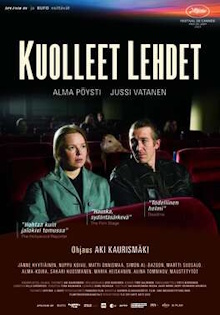
Aki Kaurismäki is said to be Finland’s best known director but this is the first I’ve seen of his work, proving once again how incomprehensibly vast the world of cinema is. This one is a deceptively basic and straightforward romantic comedy with its minimalistic setup and sparse dialogue. But with its portrayal of the quietly desperate lives of the working class of Finland and the absurdly wrong time period it is set in, it effortlessly draws us into its world. I’m not certain that Finland is as poor a society as this film makes it out to be but I can’t deny the expressive power of this film.
Ansa is a single woman who lives in a small flat in Helsinki and works in a supermarket. Meanwhile Holappa is a construction worker who is equally lonely and so alcoholic that he drinks on the job. One Friday night, Holappa’s friend and colleague Huotari persuades him to go to a karaoke bar. There they meet Ansa who is also there with her own colleague. Huotari sings on stage and makes a pass at Ansa’s friend who turns him down, saying he is too old, and that is the end of the encounter. Another night she notices him passed out drunk at a bus stop. Ansa is eventually fired for taking expired food from the supermarket home. Her next job as a bar whose owner also sells drugs doesn’t last long either. But Holappa runs into her outside the bar and they hit it off, eventually going to the cinema to watch a film. Afterwards, he tells her that he doesn’t even know her name so she says that she will only tell him the next time. She writes her number down on a piece of paper and he puts it in his pocket but it immediately drops and flies away while he is fumbling for a cigarette.
It’s a classic story about missed connections involving working class people just barely getting by in life. Ansa and Holappa are neither young nor particularly attractive. They’re meant to be ordinary people starved of meaningful human contact amidst the drudgery of daily life. Kaurismäki mixes things up however by setting it in a strange, paradoxical time. The vibes suggest sometime in the 1980s perhaps but every time they turn on the radio, they hear depressing news of Ukraine being attacked by Russia, recalling the time when Finland was itself invaded. They watch a modern film in the cinema but the posters outside are all of the great classics from the past. After a screening, two random passersby hilariously compare what they have seen to French New Wave films from the 1960s. Perhaps this is meant to demonstrate that theirs is a universal story could take place anywhere, anytime so the particular setting isn’t that important. But I suspect it’s also because this is a story that would be easier to tell if it were set in the past.
The impassiveness of the characters, the minimalistic dialogue and the absurdity of the setting all contribute to making this a funnier film than you might expect. Plus though this is a rather old-fashioned love story, the downtrodden state of the characters and the curveballs life throws their way make their romance feel earned. That said, I’m more skeptical of its deeper messaging. From what I can tell, Kaurismäki has made a career out of directing films about what he himself calls the proletariat. Today Finland is a reasonably prosperous and while I don’t doubt that there are plenty of hard up working-class people, this film goes out of its way to evoke an older, poorer version of the country. It feels something closer to the Soviet-era and while that certainly works better for the story this film wants to tell, it doesn’t feel like a fair representation of the country as it is today.
I’d still recommend this as a good film to watch and there are few films from Finland that manage to win this level of international acclaim. But it seems to me that Kaurismäki is still fighting the last generation’s war. A film that depicts the lives of the working-class in Finland would probably have to focus on the immigrants.