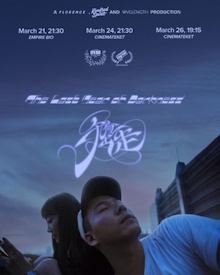
A documentary made by an American director about the underground nightlife scene in China sounds exactly like something the Chinese government would frown on and that I’d love. The vibes, the images and the sound are all incredible, adding up to a powerful portrayal of a side of Chinese society we rarely get to see. Yet while there is no doubt that director Benjamin Mullinkosson is a friend of the queer community, I sense a certain wistfulness in it. The people in it don’t seem so much to be enjoying life to the fullest than using the nightclub as a way to cope with depression and the stresses of life. It doesn’t seem healthy at all and so this documentary isn’t an altogether sympathetic view of their lifestyle as I would expect.
A series of disconnected shots depict a group of youngsters preparing themselves for an exciting night out on the town. They put on makeup, primp their hair and put on fashionable outfits. One in particular, a gangly, tattooed young man named Yihao, does far more. He has on an elaborate wig, feminine makeup and a gown, excited to perform as a drag queen. They are all headed to Funky Town, a small nightclub in Chengdu whose patrons are mainly from the queer community. The camera shows certain details of their lives while they are not partying. One is a humble food delivery worker on his electric scooter. Kimberly performs the traditional guzheng instrument for an upscale audience but suffers from depression. The Russian Gennady is exploring his sexuality and seems to be having the time of his life as he easily attracts attention for being a good-looking white man in China. Outside the club, the camera frequently cuts to the heavy construction going on to improve the city’s infrastructure as workers in uniforms and hard hats work on through the night.
There’s no narration in this documentary so Mullinkosson lets the images and the people in it speak for themselves. The nightclub scenes are frenetic and colorful, full of young people determined to live their lives to fullest, unrestrained and raw in the moment of doing whatever they enjoy. Yet even here there’s a kind of desperation in the way that they have fun. A young woman is shown being in discomfort after drinking too much and throws up into a plastic cup. A drunk Yihao gloms onto Gennady who encourages him to throw up as he takes the former home while drinking from his own cup. Partying out late at night, Kimberley is irate by her boyfriend’s text messages and so turns off her phone. I’ve never been the clubbing type in my life even if I’m as curious and fascinated by this scene as anyone else. So it’s noteworthy that while this film was undoubtedly made from a place of love as Mullinkosson was certainly a friend to all these people and laments the closure Funky Town, there’s still a pervading sense that this lifestyle is both unhealthy and unsustainable. We can see them literally ruining their bodies before our eyes.
Yihao is easily the most flamboyant of the friends featured here. He pulls off his drag queen performances with aplomb, wears some genuinely great costumes and enthuses about it in public. But in conversation, he casually speaks about first being sexually molested as a 7-year old boy, is a school drop out and seems to have AIDS at the age of 20. Despite a seemingly solid career, Kimberley too is something of a head case, having threatened or attempted suicide multiple times. I’m aware that we know very little about these people as we get only a tiny glimpse of their lives. Yet what Mullinkosson chooses to show us here suggests that many of them are people with deep traumas, extremely stressful lives and are still struggling to find their place in society. Seen in that light, Funky Town isn’t so much a positive source of joy in their lives as a temporary coping mechanism to make life bearable. It’s understandable why the nightclub was such an important part of their lives and why they bemoan its loss. To the rest of us however, it’s difficult to see this as being healthy or something worth celebrating.
Given that this does take place in China which has taken a harsher stance against the queer community, perhaps such this kind of party scene is already the best that they can get. Then there’s people like Gennady who seems to be having the time of his light, both at the club and outside of it as he tries to learn Mandarin. This is of course too narrow a view of the queer community in China for us to generalize from, providing little in the way of information. I do still think that it’s fascinating, emotive and beautifully shot. But I am surprised that it’s far from a flattering portrayal.