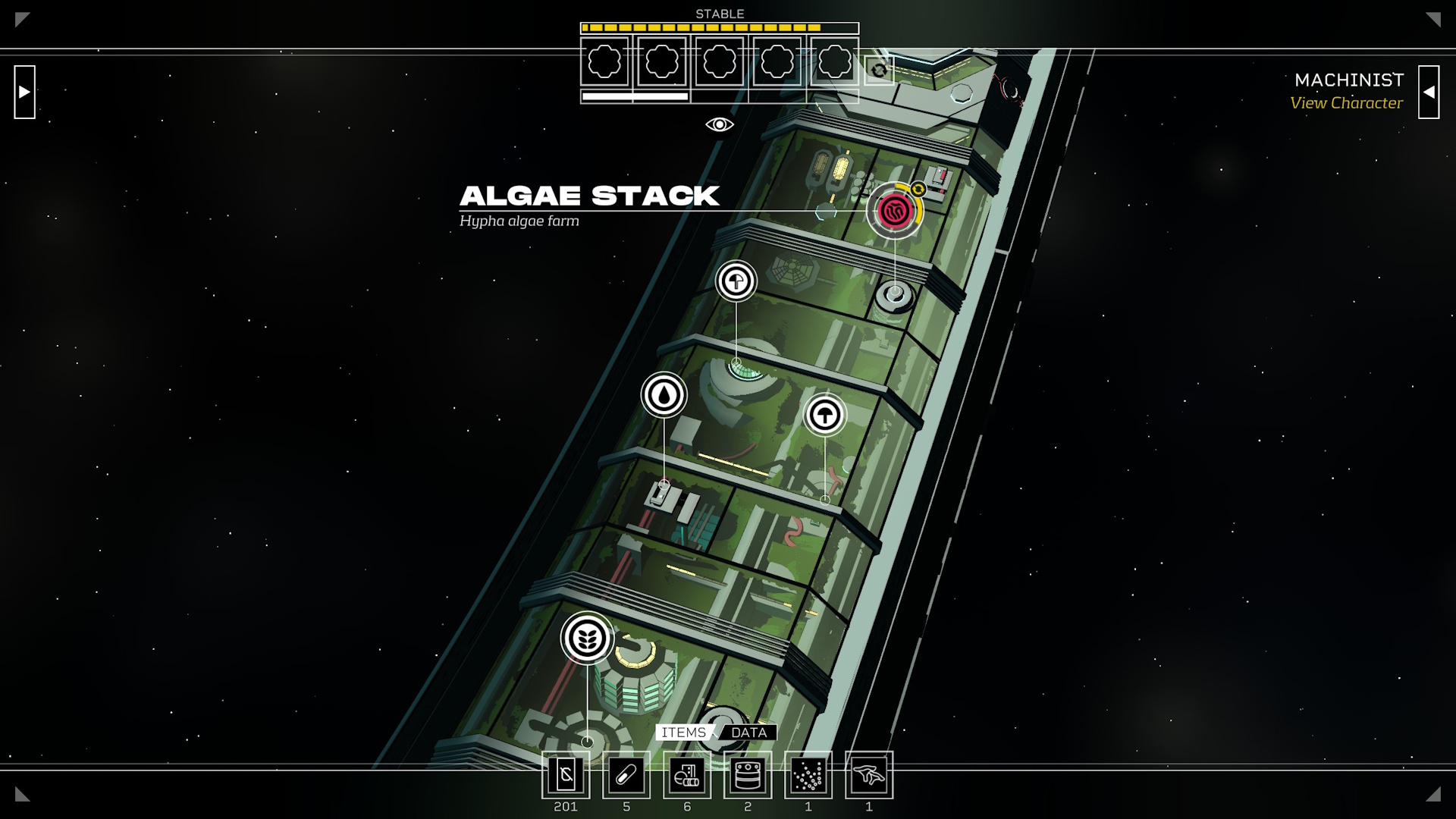
I came upon this game because this has a fair number of recommendations and indeed a mostly text-based adventure game is something I’d normally love. The setting aboard a decrepit space station and the player being a sort of slave within a robot body make for an intriguing and the writing is mostly solid. However I soured on it pretty fast once I realized that the desperation of the setting is mostly narrative fluff as it’s actually a rather safe game. Furthermore all of the stories in it stand alone so it’s not so much a world but simply a loose collection of independent stories.
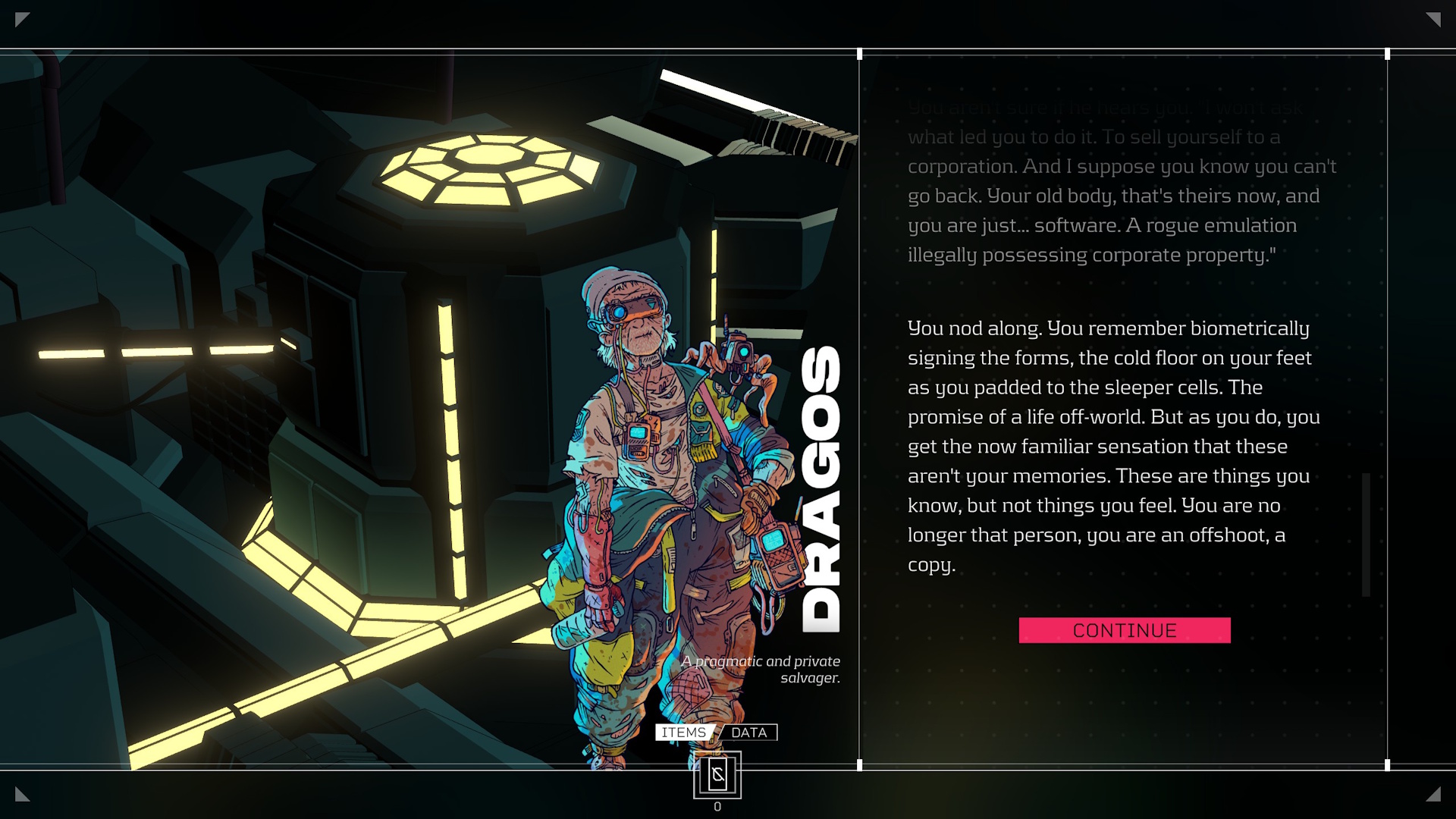
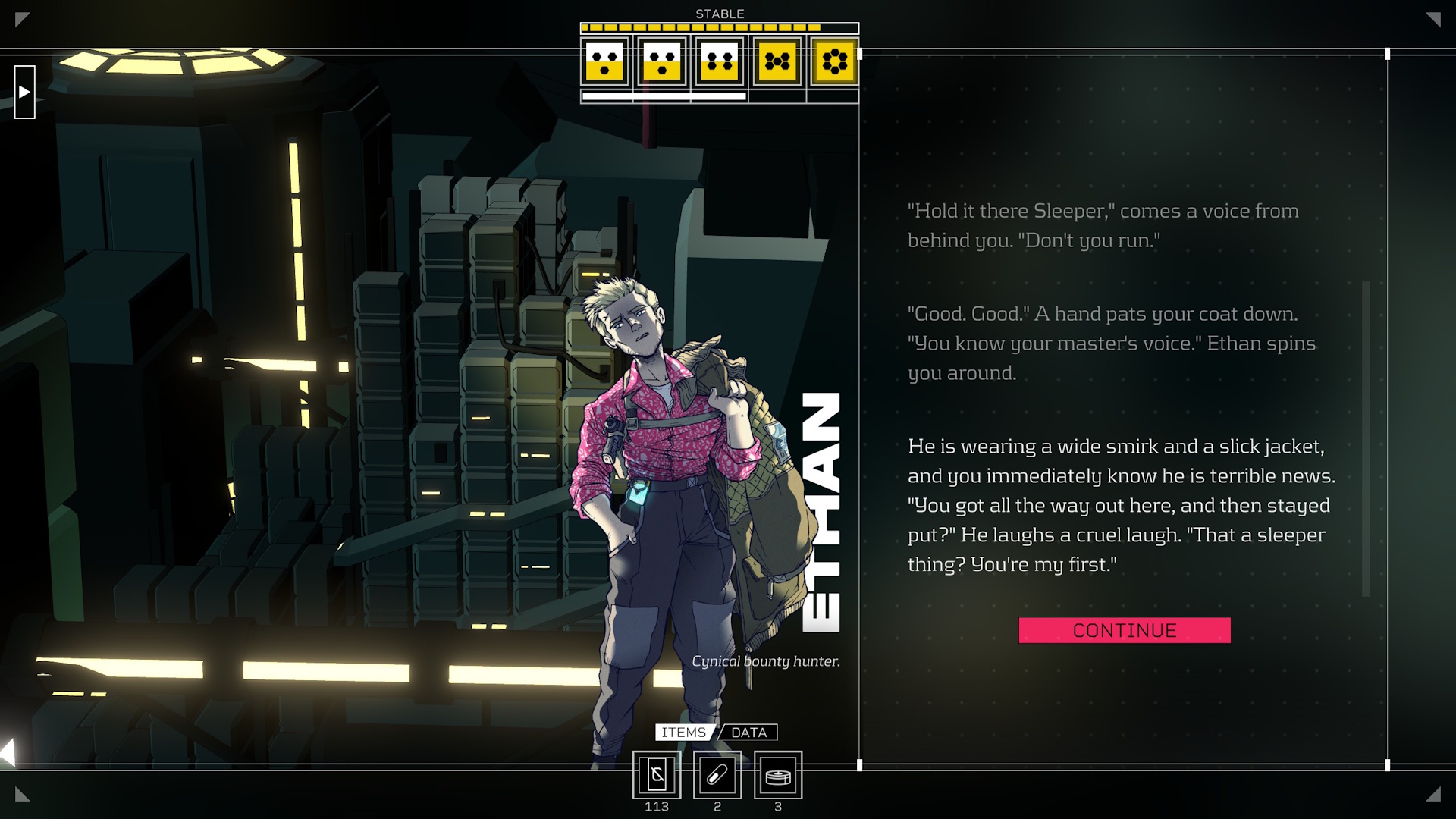
The player awakens as a Sleeper, someone whose real human body has been put into storage and the mind digitized and put into a synthetic body. You are the property of the Essen-Arp corporation, meant to be used as slave labor. But you have escaped aboard a freighter and made your way to the Eye, a crumbling space station inhabited by refugees, outlaws and other sleepers. Essen-Arp doesn’t let its property go easily however as your body is designed to break down without a regular dose of its proprietary stabilizing treatment. A kindly salvager offers you an empty shipping container and some work dissecting the hulls of old ships. With no resources and no friends, you’re forced to quickly learn how what passes for society works in the Eye. You must scramble for the Cryos that are used as currency here, find a way to repair your slowly decaying body and figure out what you want to do. Soon you must also contend with the hunter Essen-Arp has sent out to either retrieve or terminate their property.
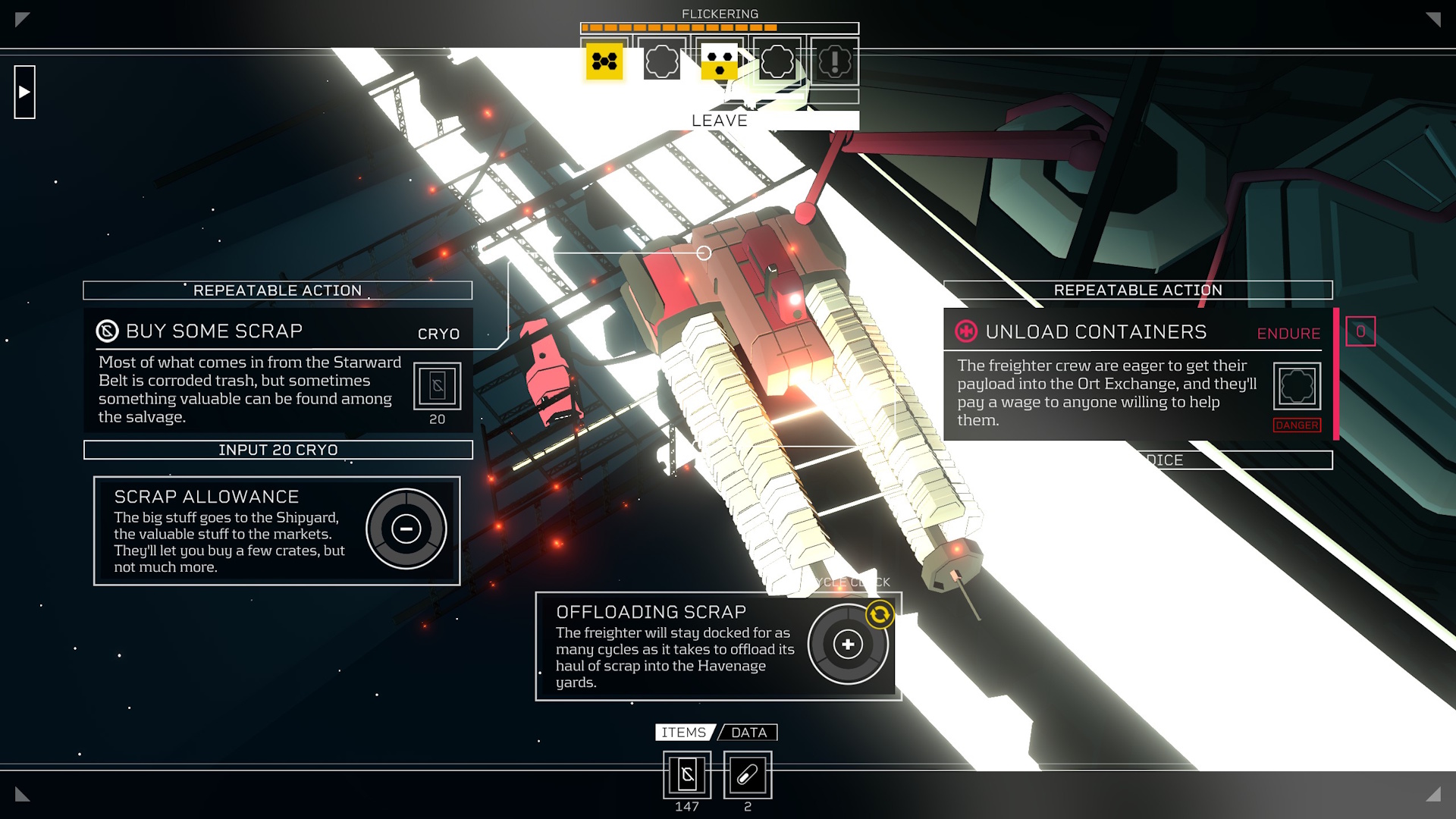
The story is told through text but you can navigate to different locations on board the Eye using a map. You’re in a desperate situation and that’s reflected in the game mechanics as well. Every day, or cycle, you roll a certain number of 6-sided dice. These represent the effort that you can put towards significant tasks, with higher numbers meaning better chances of success. But as the condition of your body worsens, the number of dice that you receive drop, so you get fewer actions per cycle. With every cycle that passes, your body continues to degrade, you need to find food to keep your energy up and the clock ticks down for important events. Many quests run on a timer and will fail if left alone for too long. So there’s a constant sense of having too much to do and never enough time to do it. Or at least that’s what it’s supposed to feel like.
It does feel like a desperate scramble for survival at first. You’re new to the station, you have no idea where to get money or food or the stabilizer you need to repair your body. All the while the timer keeps ticking down and every bad move threatens to drop you off the edge of a cliff. Except after a while you realize that the threat is really smoke and mirrors. Even when the chips fall, you’re handed a lifeline. You do need resources to survive but at predictable intervals that you can plan for. While there are many, many options on how to spend your limited time, they all follow a similar pattern. Different options grant you money, energy or more often your standing with a faction or a friend. More importantly, the world often doesn’t move until you make it move. You can take on as much or as little burden as you want. It won’t be long before you can not only survive but thrive so long as you can tolerate the slow, steady grind.
My issue is how very videogame-like all this is. Every inhabitant on the station live separate lives, waiting for you to interact with them. Questlines never intersect so even if you effect a change of leadership in Havenage, the authority that runs the part of the station you wake up in, nothing else is affected. There’s no illusion of this being a living world, it’s all just dials and levers for you to twist and pull. I’m also frustrated that despite the profusion of storylines to explore, the game often wants you to commit to specific ones that can lead to an ending. You get no warning when you happen to step upon such a path and its conclusion closes off all other questlines that might lead to other endings. If you want to explore other storylines, the game wants to restart from the beginning, a daunting prospect.
The writing is solid and it is impressive how the game explores different avenues of freedom for the Sleeper. But I’ve noticed one irritating thing about it. The theme is all corporate dystopia and desperate masses clawing for survival. But almost none of the people you actually meet in the game are evil. Pretty much everyone is friendly and doing their part against the corporate overlords. The story makes it out as if you’re alone and totally friendless on the station. The truth turns out to be that you’re surrounded by friends, everyone hates the evil corporations and are willing to look past the fact that you’re a synthetic Sleeper. The questlines almost all have positive outcomes and directly contradict the dystopian theme. You shouldn’t get a happy ending in a cyberpunk story but you do here, many times over.
Playing this reminded me of Roadwarden, which was also a text adventure game. To me, that was the perfect example of what this game should have been like. The peninsula in it actually felt like a real place and though the quests are mostly standalone, what you do in one settlement can affect the other ones. It similarly has time and resource constraints but here they’re real and the game definitely will kill you if you recklessly push past these limits. Citizen Sleeper is not terrible and its boardgame-like mechanics are interesting. I’d even readily admit that it has better art. But I think it’s overhyped for the acclaim that it has won and Roadwarden is just vastly superior in every respect.