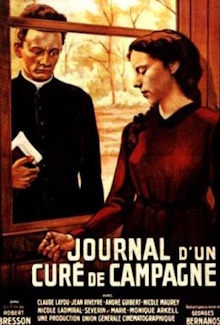
The films of Robert Bresson haven’t disappointed me so far but I must confess that this one is tough to swallow. As it is literally showing snippets from the diary of a priest, the scenes are very episodic, not allowing us to dwell in the moment. Then there is the cultural and religious gulf and indeed the film probably has little meaning for those who have no religious faith at all. I’m pretty sure I’ve more or less understood what it wants to say but that’s not at all the same as being moved by it. I can see how ahead of its time it is and how it must speak to those who are religious but it’s not for me.
A young priest is assigned to the parish of the village of Ambricourt. He is inexperienced, in poor health and struggles to connect with the villagers. He keeps a diary to detail his myriad troubles including his stomach ailment causes him to subsist on a diet of bread, fruits and wine, his flagging faith and inability to pray. Only one person, Miss Louise, attends his daily mass. She is a governess in the service of local Count. The priest attempts to solicit funds from the Count to start a youth club but is denied. He later discovers that the Count is having an affair with Miss Louise. The Count’s aged wife who is still grieving her deceased son passively acquiesces while the surviving daughter Chantal is incensed. The more experienced priest of neighboring Tory advises him not to be so forceful in his faith and refers him to his friend, the doctor Delbende for his health troubles. The doctor suggests that his problems stem from his mother possibly being an alcoholic. But then the doctor dies, seemingly of suicide. The priest is further embroiled in the family affairs of the Count when Chantal complains about being sent away to boarding school. He goes to visit the aged Countess to persuade her to reconcile with God.
It’s clear that this not only was this made for Catholics but that it’s deeply rooted in the religious environment of France of that time. The background to this is the decline of religious faith in general in the countryside and the difficulty the clergy are experiencing at asserting their moral authority. The priest, who remains unnamed through the film, is described as having a very simple faith. I interpret that to mean that his faith is too by the book and straightforward. This offends the Count who expects him to turn a blind eye to his adultery. He lacks the social skills to soften the edges of his teachings and while he is soft-spoken and gentle in demeanor, this uncompromising view is uncomfortable to his parishioners. At the same time, we also see the other members of the clergy being flexible. The priest of Tory is reluctant to condemn his friend the doctor Delbende for the mortal sin of suicide. None condemn the Count’s infidelity. The central tension here is that the priest is asked to compromise on religious principles to cater to the preferences of the villagers, yet it is this readiness to compromise that drives the decline of genuine faith and belief.
Underpinning all this is the conviction that religious faith does matter and its loss is to be bemoaned. The film emphasizes that it is the faith itself that matters, not the rules, the rituals or knowledge of scripture. One amusing scene has the priest being enchanted by a beautiful and clever young girl Séraphita who is able to perfectly retell stories from the Bible. Yet she uses her knowledge only to mock and tease the priest with her friends. The most powerful moment is when the priest confronts the Countess who no longer cares about the fate of her daughter as she believes God has already forsaken her by taking away her son. The priest points out that she might have been separated from her son on Earth but by abandoning God, she will be separated from him forever. This is truly an incredible claim to make and even the priest of Tory rebukes him. As he puts it, priests are not in the business of blackmailing people into believing in God. Yet for those who do take God seriously, how could it possibly be otherwise? To the young priest of Ambricourt, it is truly so simple and straightforward.
Obviously I remain an atheist and so the logic behind this film does not apply to me. Neither am I particularly moved by the travails of this one priest. This film reminds me of Ordet which has similar themes but is much more direct. Here the message is tightly bound up into its setting of a rural countryside in the far north of France and the people there where Bresson himself grew up. That might have it more authentic in some ways and resonate more for some people. But it’s a milieu that I am unfamiliar with and so much of its power is lost.