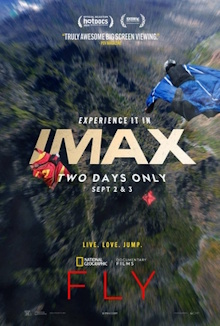
Based on its premise, I expected this to be a visual extravaganza, especially since this is a documentary made by National Geographic. What I did not expect was how brutal it is in showing how closely death stalks the community of base jumpers. This film was shot over a period of seven years, enough time for there to be big changes in the lives of the participants featured here. As the directors were astute enough to focus on three romantic couples in particular, it’s the human aspect that is so gripping as we watch them grapple with fears, injuries and death.
The participants featured here start with Jimmy and Marta, an older couple who act as the widely respected mom and pop of the community and organizers of a popular annual get together. Marta had already lost a boyfriend to the sport earlier and was the one who taught Jimmy. There’s also Espen Fadnes, a Norwegian whose love of the mountains was fostered by his father who was a free climber. He is married to Amber Forte, a British woman who is probably considered the best female wingsuiter in the world. Finally there’s Scotty Bob Morgan, an American marine who felt listless after completing deployments in Iraq and started BASE jumping. He is introduced as someone who is happy to sleep on the couch in a friend’s house to spend as much of his time and money on the sport as possible. He claims to have no plans to marry or settle down to a normal life. Then he meets and falls in love with Julia Botelho, a Frenchwoman who has given up a lucrative career as a lawyer in pursuit of her true passion. They marry and get a house of their own like everyone else, yet neither will give up the sport.
This film provides no introduction on what BASE jumping actually is nor technical information of any sort. I suspect that this was intentional to deter the casually curious from taking up the sport. It is so likely to kill you that recommending it to anyone would be irresponsible. Instead it very convincingly shows how deadly BASE jumping is and how wingsuiting is an order of magnitude even more dangerous. One scene shows a group of enthusiasts in a bus on their to jump off a cliff in Greece, as cheerful and noisy as any other group of tourists. But then as they jump one by one, a gust of wind pushes one of them against the side of the cliff. It’s only a scrape, resulting in minor injuries but that one heart-stopping moment is enough to demonstrate how death really can strike them at any given moment. I’m not going to spoil things but even among the core group featured here, there are horrendous injuries and death, and these are people who might be considered among the best and most experienced in the sport. When Jimmy and Marta speak about how significant their annual gatherings are, you believe them because they most certainly will lose people every year.
Fly certainly takes you to some wonderfully scenic locations and the visuals are certainly a delight. Yet the viewer will soon realize that the typical flight time achieved by BASE jumpers is woefully short. They’re not up there to look at the scenery and can’t spare the attention anyway. Instead once they jump, every moment is spent fighting to survive. It’s striking that when they land their first instinct is to announce that they lived and are alright. It’s hard not to see in it the same kind of mindset already explored in Free Solo but perhaps even more extreme if transitory. These are people who in their own words live hard, play hard and make a point of not judging one another for their choices. They claim not to be suicidal and that this is their way of exhilarating in life itself. But I can’t help but notice that there’s a tendency in them to push the envelope, to keep testing the limits as it is seemingly unsatisfying if the jumps become too safe and too routine. While the members of their community refuse to judge one another, it seems truly irresponsible to me that one couple goes and ahead to have a child while still actively being engaged in the sport.
By covering such a long slice of these couples’ lives, this film ends up being much more emotionally engaging than I’d expected. It’s enough time for us to see them age before our eyes and also have the trajectories of their drastically altered from when they are first introduced to us. It’s also a shocking documentary in that the rate of deaths and injuries are significantly higher than I’d believed. We’ve seen plenty of the glamorized videos of their amazing wingsuiting feats but of course these leave out the risks and the costs. Finally my wife observes that the community shown here appear to be composed almost entirely of white people. This is mainly a North American community and I’m sure that there are similar communities elsewhere across the world. Still, Americans should be a more diverse lot than what we see here, so the observation that white people be crazy seems apt.