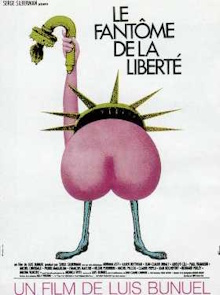
This was Luis Buñuel penultimate film and also one of his most highly regarded ones so it naturally belongs on my list. I have neither liked all of Buñuel’s work that I’ve seen nor can claim to understand them all. But I’m confident that just about everyone will find this black comedy hilarious even if you don’t much care for making sense of it. Since it has an episodic structure, there’s no overall story to track and you can take in the absurdity of each situation on its own. But if you do put your mind to it, you can try to discern a deeper meaning to it and that’s why Buñuel is such a genius of cinema.
The film opens with a scene of French troops executing Spanish rebels in Toledo, Spain in 1808. While celebrating, the captain caresses the statue of a woman in a church but the statue of the husband inexplicably knocks him out. Furious, he exhumes the corpse intent on necrophilia. This turns out to be an extract from a book being read by a nanny in a modern day Parisian park. The two little girls she is supposed to be watching is approached by a suspicious-looking man who pulls them aside and offers them a gift in an envelope. When they arrive back home, they report the encounter to their parents. Inside the envelope, the parents are appalled to find that it contains postcards depicting French landmarks which they appear to find arousing. That night, the husband has insomnia. So while his wife sleeps soundly next to him, he lies awake in bed as a succession of bizarre visitors pass through the room: a rooster, a postman delivering a letter and then a curious ostrich. In this way, the film offers one vignette after another, never staying with the same set of characters with seemingly no connecting logic between them.
Comedies usually have at least one straight man character who maintains composure in the face of the most eccentric or outrageous antics. Here however every single character plays that role. Even as the stories grow increasingly weird, operating by some warped logic, everyone behaves as if it were perfectly ordinary and expected. To enforce the sense of everyday life as usual, the film is very patient. It doesn’t keep throwing jokes and absurdities at you. Instead large parts of it are humdrum, especially the transitions when it switches focus from one character to another. The familiarity lulls you so that when the next bit of outrageousness arrives, it makes a bigger impact. The finest example of this for me is when the law professor recounts a story of attending a dinner party at a friend’s house with his wife in the middle of giving a lecture about customs and laws differ from place to place and era to era. It seems like any other party with well-dressed, cultured guests conversing about learned topics, until you notice that they’re sitting down on toilets around the dinner table.
Also worth noting is that while the humor seems weird and harmless at the beginning, it gets steadily darker. There is nothing at all funny about the assassin sniping random pedestrians from the top of a skyscraper and the ending is positively horrific. Many of the scenarios seem to have been directly inspired by real events from Buñuel’s life so one could choose not to look deeper into why they were included and what they might mean. But to me by opening the film with the famous painting of The Third of May 1808, Buñuel seems to be protesting against an upside down world order that right and wrong are all mixed up and objective truth doesn’t exist. The film itself might be hilarious but I don’t think the message in here is very depressing.
As it is, I’d absolutely consider it among my favorites of Buñuel’s work. It’s so very different from his early films and yet isn’t as cryptic as the rest of his late career work. There is so much originality and provocative boldness in here but it’s also so funny that most people should be able to find it entertaining, making it a rare masterpiece that is accessible to all.