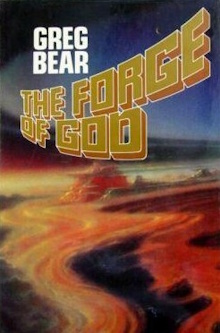
Going back to the well of great science-fiction novels I should have read long ago but didn’t, here’s one that I now believe is the single best depiction of the literal end of the world. This book is singularly focused on a slow and detailed description of exactly how the Earth is destroyed and has little else. Even the identity and motivations of the alien attackers are left as mere guesses. The aliens are simply so much more powerful than humans that they don’t even need to explain themselves and there is no question of fighting back. The downsides are that it’s very USA-centric so we have little idea of what is happening in the rest of the world and there are no women point of view characters. But I admire its audacity and like it a lot.
The novel follows the perspectives of a handful of characters who each encounter an anomalous event that when pieced together suggests that the Earth is in grave danger. Astronomer Arthur Gordon is informed by a colleague that Europa, the moon of Jupiter. A geologist Edward Shaw and his colleagues are hiking in the Death Valley when they come across a rock formation that doesn’t exist on any maps. Investigating further, they find an extraterrestrial who appears to be dying in the desert sun and tells them in perfect English that the Earth is doomed. They deliver the alien to the authorities and the entire group is sequestered by the government for fear of biological contamination and to preserve secrecy. Popular British science writer Trevor Hicks gets wind of something going on in the Air Force base there and decides to investigate. The sitting US president William Crockerman arrives to speak with the alien himself and comes away convinced that the impending destruction of the Earth is inevitable and is a punishment from God. Meanwhile oceanographer Walt Samshow is conducting a survey in the Pacific Ocean when he receives a hint of the weapon that kills the Earth might be. His team spots a meteor crashing into the ocean. It throws up a decently-sized storm but is soon lost to sight. But his gravimeters suggest the comparatively small meteor is impossibly dense.
The book very slowly builds up to the complete and utter destruction of the Earth and there’s no point in trying to treat this as a spoiler. The scientists piece together the first clues, the recovery of the alien proves that this is really happening and the doing of extraterrestrials, and we see how the US government responds. We’re exposed to the inner thoughts and feelings of those in the know who realize what is truly happening as they work through the calculations of the vast energies of the phenomena they observe and the implications. The science is grounded, detailed and all too plausible. The characters are intelligent, act rationally for the most part and yet not above admitting that they simply don’t know because it’s just the truth. The thing is that as the aliens never explain themselves so all that is left to humanity is guesswork and speculation. It’s a little odd to me then that a theory proposed during a talk show is subsequently treated by everyone else and even the novel itself as ground truth. I’m guessing that this is the best way that Greg Bear could think of to present information while preserving the mystery behind the aliens and not bloating the book up too much.
The result feels less like the usual science-fiction novels than a very grand-scale disaster movie in book form. It’s a pity that we only see what happens in the US, a little glimpse of parallel events in Australia and nothing whatsoever from the rest of the world. I really appreciated how the aliens are portrayed as being overwhelmingly powerful. Not just in being capable of wielding physical forces beyond our comprehension but that they have fully analyzed human society and so are able to effortlessly manipulate us. Everyone including the reader are flabbergasted when the US president uncharacteristically turns to religion upon meeting the supposed alien. As a result he urges Americans to accept their fate and effectively surrenders without firing a shot. What we have to realize is that the president was the sole intended target of the aliens’ entire effort of landing a fake disguised spacecraft, allowing Americans to find the alien and passing on the message. It was a memetic attack to forestall any attempt by the United States to defend itself. That, more than blowing the Earth itself up, is a chilling demonstration of just how far above humanity the aliens are.
The book does have some issues, some of which I’ve recognized seem characteristic of Bear’s writing. For one thing, it uses multiple point of view characters to give readers a broader perspective. Yet not one of these characters is a woman. The novel invariably describes the wives of the men who are “in the room where it happens” as being smart, emotionally composed and capable. Yet it never considers that they might directly contribute to understanding and possibly resolving the crisis, beyond acting as support for their husbands. Even the men are mostly cut from the same cloth, being scientists and engineer types of strong moral fiber. I did like that there is one young black man from a working class background who is roped in by the aliens to work for them against his will. He barely understands what is going on and simply carries out instructions that are beamed into his brain. But it is very conspicuous that we never get to look inside the heads of any women as they react to the impending end of practically all life on Earth or show them to have any agency in responding to the crisis.
There are many more aspects of Bear’s version of an end of the world scenario that I find implausible. I think in real life civilization would break down much sooner, crime would be rampant and many people would go crazy. Here most of them stoically stay at home to await the end with their families and many even keep doing their regular jobs out of a sense of routine or duty. There are aspects that I do like as well. The characters cite how the Hawaiians succeeded in killing James Cook despite their technology being far inferior. It didn’t prevent the Hawaiians from being subsumed by European colonizers but perhaps striking that blow itself matters. So some of the American conspire against their President to strike against the aliens, ineffectual as they know the result will be. I’m also amused that this book proposes that civilizations that announce themselves to the wider universe only invite destruction from other, more powerful civilizations. It’s very similar to the Dark Forest theory popularized by Liu Cixin. Judging by how these lines were highlighted by many readers in my Kindle edition of the book, it seems like others noticed the similarity as well, in a book that came out decades earlier.
The book ends on a strand of hope such that it’s the end of Earth but not that of humanity. I’m more ambivalent about that as it seems more like wishful thinking. Besides, the book is equally silent about the motivations and identity of the second alien faction. The ending is why there even is a second book in the series. I might pick that up at some point but I might not. I expect it will be necessarily different from this one and much more like conventional science-fiction. This book however I would recommend without reservation. Sometimes you feel like watching the Earth in all its glory be destroyed, completely and utterly, with no last second saves. It delivers exactly that.