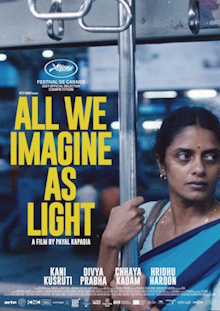
Give India’s size and cultural heft, the underperformance of its modern cinematic greats is noticeable. So here is one recent film that won major plaudits at Cannes but some controversy arose in India when the country’s film federation declined to nominate it for the Academy Awards. The stated reason was that the jury felt that they were watching a European film set in India. It’s an awful reason to reject this film but watching it, I can totally understand why they felt this way. I suspect though that the real reason is that it challenges the current moral orthodoxy in ways that are uncomfortable. I think it’s too insubstantial to be truly good but it does provide an invaluable look at contemporary life in a big city in India.
Prabha, a senior nurse working in a hospital in Mumbai, is a responsible professional who is careful to maintain propriety. She shares a house with Anu, a younger junior nurse who is less responsible. Prabha is actually married but she has never lived with her husband as it was an arranged marriage and he works in Germany. One day they receive a rice cooker from Germany from an anonymous sender, causing mixed emotions in Prabha who is being courted by a doctor. Meanwhile Anu is in a relationship with Shiaz but has to hide the affair as he is a Muslim even as her family is sending her profiles of Hindu candidates for marriage. Also at the hospital, Prabha helps a cook Parvaty who is being evicted from her chawl as she has no documents to prove that she owns her unit. She is unwilling to be a burden to her son in the city and in the end decides to leave the city and return to her home village.
With its woman-centric focus and its somber color grading, it’s no wonder that this feels like an European film. Since it opens with testimonies of migrants who have moved to Mumbai for work and are miserable for it, I even confused it for a documentary at first. Director Payal Kapadia makes it very obvious what it is she wants to express. Mumbai is always portrayed here either at night or under heavy rain, its noisy and dirty streets packed with frustrated people. The only time we see clear sunlight is when Parvaty moves back to her village when suddenly there is not only vibrant greenery but also a pleasant beach. Even if Mumbai isn’t a very nice city, the contempt that the director holds for it is palpable as she apparently sees nothing redeeming it at all. The cinematography is excellent and it was eye-opening to see this less than flattering portrayal of the city that is after all India’s commercial capital. It feels like something from perhaps thirty years ago if you compared it to Malaysia and is a sobering reminder of how unequal India’s development has been.
It’s a standard enough message for an artsy film to champion and I really do like its focus on the female perspective in India. But I was taken aback at the vehemence of the director’s hatred of Mumbai and note that there is a dissonance here. As awful as living in Mumbai might be for the average person, it’s the still the land of opportunity both economically and socially. It is only by being able to find work there that both Prabha and Anu are able to establish themselves as independent women and it is there that Anu is able to meet Shiaz, the man who she loves. Being forced to remain in their home villages would be oppressive to both of them as they very much are not happy living according to the customs dictated by their elders. To me, this feels like an immature work that wants to hit all the right artistic notes but is too poorly thought out to be a cohesive whole. Is Mumbai really so awful? Is capitalism evil? Is the director taking a stand against the anti-Muslim prejudice in India? Is India conservatism holding back women? It feels too much like a little bit of everything.
To my mind, aspiring to be a European-style art film is not a bad thing at all and portraying the darker side of living in Mumbai would indeed be a worthy subject. But I’d rate this as a decent attempt at best as it’s too obviously bait for winning international awards without enough of a distinctive auteur voice. The director should figure out what she really wants to say and say it boldly without reservation.