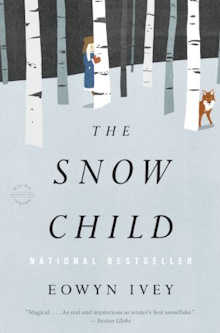
Here’s another fiction book that is closer to mainstream literature than genre and I expect I’ll be doing this more often. I first heard of this as a a recommendation from Broken Forum and liked the premise of an older childless couple in Alaska making a child out of snow that comes alive. It’s a familiar story as it was adapted from a Russian folk tale and feels like it might be the stuff of a Disney animated film. The challenge here is that as it needs to be true to fairy tale logic, we can already guess how it will end, so how could this be an interesting, engrossing read? Yet it truly is a wonderful book as it is the path to get to that ending that matters.
After their child is stillborn, Jack and Mabel moves from Pennsylvania to settle a homestead in Alaska, hoping that starting a new life from scratch will help them overcome their grief. But they underestimate the harshness of the land and the difficulty of eking out a living as a couple in their early 50s. Jack’s insistence that he alone work the land while Mabel takes care of the house further deepens the rift between them. Jack befriends their immediate neighbors, the Benson family, but the socialization only causes Mabel to resent him as she believed they are there to get away from it all. One night while it is snowing, Mabel impulsively starts a snowball fight with Jack. They then decide to build a child snowman with Mabel giving her a pair of mittens and a scarf and Jack using strands of yellow straw for hair, making it a girl. The next morning, Jack wakes to find the snowman reduced to a pile of snow, the mittens and scarf gone and a child’s footprints leading into the woods. Thereafter they start catching rare glimpses of the child and Mabel is reminded of a fairy tale she once read in a book.
You can guess the general shape of the story from there and it’s pretty much as you’d expect. The little girl Faina is apparently real and becomes something of a daughter for Jack and Mabel. At the same time, there’s an otherworldly quality to her that never quite goes away as she is able to flit lightly across the snow, is unbothered by the freezing cold of the night and survives effortlessly in the wild by herself through hunting and foraging. A nice touch is that Mabel and Jack perceives Faina in different ways. With the Russian fairy tale in her mind, Mabel sees her as an almost supernatural being and fears that she will melt in the sun. Jack on the other hand discovers clues about her mortal origins, learning that she might be an orphan left behind after her the death of her alcoholic father. This central tension never goes away and so drives the narrative even as Faina becomes a regular part of the lives of the couple though it does eventually turn into a question of just how far the seemingly wild child of the frozen north can be tamed.
The writing is excellent and I have to concede that the quality of the prose in mainstream literature will generally be better than genre fiction. Much like On the Marble Cliffs, it is dense with detail of the Alaskan wilderness that author Eowyn Ivey lives in and clearly so loves. The descriptions of the snow, the ice, the color of the sky, the plants, the animals all conjure into being an alien milieu that is hostile and unforgiving to newcomers. I love that the novel doesn’t flinch from the savagery needed to survive in such harsh conditions. Beautiful and ethereal as Faina is, she still hunts for sustenance, trapping animals and killing them, drenching her bare hands in their blood. Jack all but breaks his back in toiling the land. The first year for the couple is especially difficult as they wonder how they will make through the winter. The book even opens with a scene of Mabel deliberately walking on a frozen over river hoping that it will be thin enough to kill her, such is her despair of starting over in Alaska. Over and over again the couple are beaten down by circumstances and their own grief. Though there are moments of joy and love, this is a book full of profound sadness, loss and pain.
There are times however when I feel that Mabel and Jack create their own problems by not talking to each other. I get that depressed people often know exactly what it is that they need to do to fix their lives but actually being able to do it is another thing entirely. Mabel is afraid of telling Jack that Faina is a fairy tale come to life either because she’ll come across as being crazy or that this will end the magic. She certainly doesn’t want him to know that she is suicidal. Jack holds back what he knows about Faina’s past because he fears the truth will be too much for her. But it also feels to me that as there are so few characters in this novel, the only way to generate conflict is for them to keep things from one another. Jack feels guilty about failing as a man to provide for his wife and for taking Mabel away from a comfortable life as the daughter of a professor in Pennsylvania. He doesn’t know however that it is Mabel who blames herself for wanting them to move to Alaska in the first place. All of this is very human and understandable behavior given the circumstances as described but it’s so painful to watch them so at odds with one another when it’s just the two of them in the cabin.
This isn’t an overly sophisticated book and as I noted, most people will probably be able to guess how it ends as it needs to feel true to the spirit of the folk tale. But I’d say that it more than earns its bittersweet ending and the emotions it aroused in me stayed with me for some time long after I’d finished the book. It’s a wonderful confluence of the writer’s love for her homeland, the fortuitous encounter with the Russian folk tale and strong writing skill. I found it thoroughly enjoyable and would love to see an animated version of it.