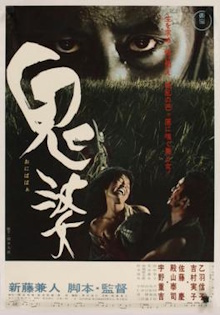
Based on the title and the poster, I’d thought that this was a supernatural horror film. But I should have known better, given that it was directed by Kaneto Shindō who was responsible for the excellent and very grounded The Naked Island. It is indeed horror but the evil is born from the hearts of people themselves. It’s a powerful retelling of a classic Buddhist parable set in so dystopic a world that it’s almost hell on Earth. My only complaint would be that it drags on a little with too many repetitive shots but it truly is a unique film with few contemporary peers.
One samurai is supporting an injured comrade through a sea of tall grasses when they are ambushed and killed. Their weapons and armor are stripped from them and their bodies dumped into a deep hole in the field. The killers are an older woman and her daughter-in-law. Since the outbreak of war, they have been supporting themselves in this way, killing stray soldiers and selling their equipment to a merchant. One day their neighbor Ushi returns from the war. He reveals that his friend Kishi, the son of the older woman is dead and tells stories about the senseless battles they have been involved in. He discovers how the two have been killing soldiers and happily joins in. Ushi is sexually attracted to the younger girl and she returns his interest, eventually going to his hut at night to have sex. The mother-in-law worries that left alone she will starve and tries to dissuade her in vain. One night a samurai wearing a Hannya mask happens about her and demands that she show him the way to Kyoto. She tricks him into falling down the pit and uses the mask to scare her daughter-in-law into obeying her wishes.
As my wife notes, art tends to romanticize or ennoble peasants which is sort of what The Naked Island does as well. That’s very not the case here as war and desperation has driven them to become vicious monsters. There’s even a scene in which the two women gleefully chase down a terrified puppy, bash it to death and roast it over a spit. Nor are the two women kind with each other. Worried about being abandoned, the older woman even offers to have sex with Ushi if he would leave the daughter-in-law alone and seems to get aroused when she spies on them having sex. It’s true that it is the war being fought by the nobles that started it all, with two emperors squabbling against each other proving that they are just men after all. But Shindō shows that the rot trickles all the way down to the lowest levels of society until there is no innocence left. Still, it is the mother-in-law who is the worst of the lot and so she is punished by being transformed into a real demon hag.
The black-and-white visuals are stark and unflinchingly depicts the rawness of both gory violence and sex. The performances are so good that it’s impossible to recognize that the actress in both this and The Naked Island is the same person, the director’s own wife Nobuko Otowa. The setting of a vast field of tall reeds with a deep hole hidden in it makes for a highly original version of a hellscape. The two women stalking through the reeds to hunt stray samurai reminded me of something from The Children of the Corn though this of course far predates it. The issue is that there are so few characters and the locale is so limited that they inevitably reuse similar shots. How many times do they have to show the younger girl running through the grass at night to go to Ushi’s hut? I think the film spends too much time establishing an obvious pattern and there’s just not enough variation in the daily routines of their lives.
I believe that Shindō deliberately intended to mislead the audience that supernatural elements are involved by playing up the horror of the hidden hole. His point though is that man-made atrocities are real and so much more terrifying that any ghost or demon. That’s how I feel about many horror films these days as I don’t find them scary at all. This film is a little one-note as it really only has one thing to say. But it conveys that message very powerfully and that makes this a great classic.