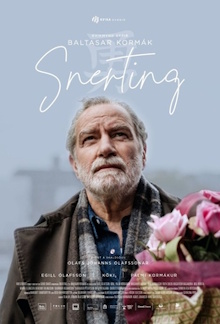
A Icelandic-Japanese film feels like an odd combination to me but it must have been natural for Ólafur Jóhann Ólafsson. This film was adapted from a novel by Ólafur and he in turn is an Icelandic businessman who helped create the original PlayStation while serving as the CEO of Sony Computer Entertainment. So this film spans both cultures across a gulf of some fifty years. It’s a heartfelt romance with an ending that is perhaps a little too perfect but it’s executed with so much finesse that I found myself being very much a fan.
Kristófer is now aged Icelander whose wife has passed away and whose doctor advises him that he may have Alzheimer’s. Just as the COVID-19 pandemic is beginning, he closes his restaurant and travels to London. Fifty years ago, he was a student at the London School of Economics but dropped out due to his left-wing idealism. On a whim, he applies for a dishwasher job at a Japanese restaurant in London and falls in love with Miko, the daughter of the owner Takahashi. Kristófer takes the initiative to learn both the Japanese and cooking. He also witnesses Takahashi having a talk with Miko’s Japanese boyfriend which breaks them up but doesn’t understand why. After that, he and Miko start a relationship, keeping it a secret from her father. In the present, Kristófer finds the location of the restaurant is now a tattoo parlor but does manage to track down Hitomi, a former waitress, to a retirement home. She tells him that both Takahashi and Miko moved back to Hiroshima in Japan where they came from fifty years ago. He then travels to Japan hoping to find Miko.
It’s fairly easy to see where the film is building towards and even its twist is guessable. But Baltasar Kormákur directs it with a very light touch which prevents it from turning into a sappy romance. Kristófer murmurs a quiet apology to the portrait of his deceased wife before setting off from Iceland. When he arrives at a nice house in Hiroshima, he only has to fiddle with the lock himself for us to know that he has rented an Airbnb. Instances of casual prejudice against Asians on the part of Kristófer’s former classmates and landlady are noted but not dwelled upon. I also liked how it authentically portrays their early infatuation. Having Kristófer being lovestruck by Miko when he first steps into the restaurant and her being pleased about it when he tells her much latter is shallow and us older viewers will roll our eyes at such a relationship being able to last. Yet this is exactly what young love is like as silly and superficial as it is. That Kristófer was a long-haired hippie Communist is so on point for the 1970s. It’s therefore natural and funny for Miko to cheekily ask Kristófer if he is a musician and what he thinks about the relationship between John Lennon and Yoko Ono. All of these little pieces of characterization are what makes the film work so well for me.
Rounding out the distinctiveness of the film is that the scenes in the present are set at the onset of the COVID-19 pandemic while both Takahashi and Miko are atomic bomb survivors. The latter not only provides a plausible motive for Takahashi to move to London, telling Kristófer that it was the cheapest one-way flight from Tokyo, but affects the relationship between him and Miko. The former, on top of Kristófer’s likely Alzheimer’s diagnosis, reminds him that death is close and he has little time to close out his unresolved matters. I think it’s kind of genius for Ólafur to put together these disparate elements that reinforce the themes of the film. But the ending is entirely too conventional and sweet. There are specific choices about how their lives developed independently of each other that make a happy ending too pat, undermining the authenticity of the setup. I should think that both characters in their old age should have much more acrimony towards Takahashi for how everything turned out.
All in all, this film was probably underrated by critics as a light romance, but I loved how smoothly it glides in between multiple cultures. The different eras and the ages of the characters are depicted realistically and the visuals and details are just perfect. There’s no great artistic statement here and no powerful insight that we haven’t already seen elsewhere, but it’s a fine, thoroughly enjoyable film and a solid example of how to get romance right.