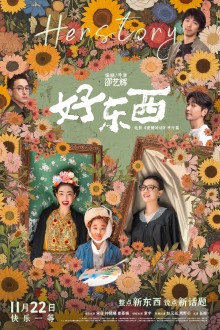
This film is said to be representative of the new kind of feminism in China, championing women who are strong enough to take charge and live their own lives as they please. With its rapid fire dialogue and dominant woman characters, it reminds me of the American screwball comedies of the early 20th-century but adapted for China and with both partners of the duo being women. I found it modern, smart and very funny. Unfortunately I’m not hip with Chinese culture and the language often moves too quickly for me to follow, so much of its cleverness is lost on me but I do so admire this film.
After getting a divorce, Wang Tiemei moves with her daughter Moli to another apartment in a more run-down building, determined to make life as a single mother work. She gets to know her neighbor Xiao Ye when she boldly confronts a man following the younger woman down a dark alley. They immediately become good friends and Xiao Ye resolves to be a second mother to Moli. Tiemei starts a new job as the editor of an online magazine while Xiao Ye is a musician. The latter is also romantically involved with a good-looking doctor Xiao Hu who appears to be something of a playboy. Meanwhile Tiemei’s ex-husband continues to be in and out of their lives, promising that he has turned over a new leaf and learned to respect women more. Xiao Ye introduces her band’s drummer Xiao Ma to Tiemei in order to spark a musical interest in Moli. As he and Tiemei tentatively starts a relationship, her ex-husband becomes jealous and sees the new man as a rival.
The characters here, especially Tiemei, speak very fast, retorting so instantly to every line that it doesn’t seem quite possible. I had a hard time following along even with the help of subtitles so I’m sure I missed out on a lot of the subtext, especially since there is a very real cultural gulf here for me. But I absolutely love the relationships here that I could understand and admire what director Shao Yihui is trying to do. He wants to paint a happy portrait of a single mother being able to raise a child by herself in modern China and build a fulfilling life without the support of a man. In this instance, Tiemei is fortunate enough to meet Xiao Ye and they are stronger together. The younger woman is more of an elder sister to Moli than a second mother. Having grown up neglected by her own parents, she craves parental affection and validation which Tiemei provides. It’s a fun variation of the usual dynamic between a confident, headstrong woman and a more passive man, save that in this case they’re both women.
This however is very much not an LGBT film as both women are attracted to men. In fact, they make fun of it when Xiao Hu mistakes the two as being a lesbian couple and appears to find it alluring. Tiemei misses the company of men but arguably overcompensates for her failed marriage by attempting to completely dominate Xiao Ma. I get that this being China, there are still lines that they can’t cross which might be why this is mostly a wholesome film. But I do like Tiemei’s insistence that it’s wrong to only ever see the lives of single mothers as being pitiful. It’s so funny to watch her two suitors compete with each other in petty ways and overcompensate in presenting themselves as enlightened men who support women. It’s also great that they get Moli to play drums but also assert that it’s just one of the many things that she might do. She has her whole life ahead of her and doesn’t have to pigeonhole herself into any particular niche yet.
I’m limited in my appreciation of this film due to the language barrier so I’d bet there are so many more gags and references that I missed. It’s also probably not very representative of most layers of Chinese society even now and is psychologically a bit too simplistic. But I like the direction that it’s aspiring towards. It’s a genre-savvy that could only have been written by someone very familiar with Western media and I love that Chinese artists are experimenting with works like this.