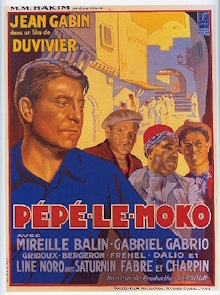
This very old French film is so influential that it has been remade several times and even inspired a Looney Tunes character. Its setting of the Casbah of Algeria is exotically attractive thought unfortunately it’s mostly shot on sets made up to look like the real thing. It’s a rather simple plot but the setting as well as the sleazy charm of the Pépé character who actually longs after Paris all along, both make it work.
Irritated by the string of crimes committed by the notorious gangster Pépé le Moko, a team of police from France arrives to apprehend him in the Casbah. The local police explain that it is not easy as the Casbah is a labyrinth and its inhabitants will rally to hide and protect him. That night, the newcomers flood the Casbah with police to flush him out but it predictably ends in failure as multiple police officers are injured in the shootouts and Pépé evades them. One local police inspector Slimane is the exception and he freely goes in and out of the area and even amicably interacts with Pépé. He has won the trust of the locals as he does nothing to disturb the peace but warns Pépé that he will arrest him if he ever steps out of the Casbah. Another attempt to catch him by luring his underling out ends in the death of an informant. Then a group of rich tourists arrive in Algeria and express curiosity about the Casbah. Slimane warns them of the danger and offers to be their tour guide. While there, they meet Pépé who instantly falls with love with Gaby, the mistress of a wealthy banker. Though she is richly adorned with jewelry, it is her Parisian identity that draws him the most. Seeing this, Slimane uses Gaby as the centerpiece of his plan to finally catch Pépé.
I love the idea of a French noir film set in the Casbah and the opening shots showing both its narrow cobblestoned streets and the roof terraces with a view of the sea are great at establishing the location. Unfortunately it was all filmed in sets with only the exterior shots being authentic. This being the 1930s, it offers the illusion of exoticism rather than the real deal but I still appreciated the attempt. Algeria was a huge part of being French at one point and in my opinion there aren’t enough films set there. Also notable is that this was made when sound films were still quite new and so it positively delights in it. The pitter patter of the fast dialogue between Pépé and Slimane is part of its charm and at times Pépé breaks out into song, enthralling the denizens of the Casbah much like a Disney movie. The result is a film that visually looks like a noir but is actually quite light-hearted in tone. The audience is meant to like Pépé, scoundrel though he is, so the camera even shies away from showing the violence that he inflicts. Slimane on the other hand may be police, but he’s slimy as he smilingly tells Pépé that he will be patient and already knows when and where he will arrest him. The conceit of Pépé hiding in plain sight where the police can’t reach him while Slimane slithers in and out as if they were friends makes it funny and entertaining.
Finally the film is delightful, for Francophiles at least, because of how powerfully it evokes nostalgia for France. There’s even a whole song about it in here. The Casbah is as much prison as refuge for Pépé and he wants nothing more than to be able to go home to France. Though Gaby is the honeypot that successfully lures him out of his hiding place, even Slimane fails to grasp that what attracts Pépé is the allure of Paris that he associates with her. As he amusingly puts it, he can even smell the Parisian Metro on her. It’s sad for the Algerians, especially his local girlfriend Inès, as they all seem to love him so much when he so obviously does not love him back. It probably says something about the condescending French colonial attitudes at the time, that Algeria may be part of France and exotically attractive, but it is still France itself that is home and the heart of civilization. It’s a dated and ignoble sentiment but one can still appreciate how well this film expresses it.
This film doesn’t quite rise to the level of the great classics. Its age and the poor quality of the version I watched work against it and of course we know that this isn’t the real Casbah. But watching this is enough to understand why it captured the imagination of the French public for a time and why it inspired Hollywood remakes. I probably won’t ever get around to watching them but I must admit that I’m curious about them.