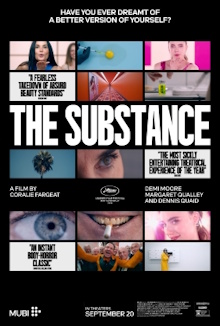
It’s hardly possible not to have heard of this film given how blatantly it sexualizes the bodies of its female stars. But that’s alright, because it was made by a female feminist director Coralie Fargeat and all that titillation soon turns to disgust as this is after all body horror at its goriest. The imagery is striking in a very visceral way and setting in a strange hyperreal world was certainly the right choice. Yet it’s psychologically very simple with the character having no backstory at all and drags on long past the point that we get all that the director has to say.
Elizabeth Sparkle was once one of Hollywood’s greatest stars but now at the age of 50, she is reduced to running an aerobics show on television. Yet even that is to be taken away as she overhears her producer Harvey planning to replace her with a younger star. While driving home, she is distracted by her billboard being taken down and crashes her car. At the hospital, the doctor dismisses her injuries as minor but a young male nurse surreptitiously passes her a flash drive. It’s an advertisement for a black market drug called the Substance that promises a younger, more perfect version of herself. She picks up the kit from a shady building and following the instructions, injects it in her own home. What happens is a split in her flesh opens along her spine and from it emerges a younger woman who names herself Sue. Elizabeth becomes comatose while the Sue is active. The instructions say they must switch every seven days, Sue must stabilize herself with fluid from Elizabeth every day and the comatose body is fed intravenously. Sue goes to audition to be Elizabeth’s replacement and easily succeeds, becoming an overnight hit. When they switch, Elizabeth turns into a recluse who gorges herself on food while Sue lives a glamorous lifestyle and becomes tempted to never switch back.
In films like this, we’re meant to go along with the plot device and just accept that it works. In this instance though, Fargeat is cagey over whether or not the two women share the same mind across the two bodies even as the instructions insist that they are one. There’s very little dialogue so the women never get to verbally express their thoughts and emotions. From context, we infer that while Sue is created with Elizabeth’s memories, she is her own person thereafter. The central tragedy then is that Elizabeth is so narcissistic, so addicted to fame and public adulation, that she would rather get it even vicariously through Sue than live quietly as an ordinary aging woman. Meanwhile Sue as another copy of the same person, so revels in her recaptured youth and beauty that she loses all sense of restraint and compassion for her older self. According to the simple rules, it should be possible for them to keep up this double life for a good long while. Yet if Elizabeth were the kind of person inclined to follow such rules, she wouldn’t have been tempted by this kind of poisoned chalice in the first place.
The visuals are garishly over-the-top with loud colors and plenty of bloody gore. For maximum shock value, Fargeat first showcases the sexy naked bodies of the female leads using perhaps the crudest male gaze yet seen in film, and then distorts and mutilates the same bodies in the worst ways she can imagine. I must confess that it worked because I found myself wincing more than once at what I saw on the screen. Yet I was also annoyed at how simplistic and unrealistic the setup is. For all her wealth and fame, Elizabeth has no one in her life at all, not even personal assistants or paid hangers-on. It makes no zero sense that she would attempt to remodel her home on her own, much less do such a clean job of it. An aerobics TV show is also so far from the glamor of Hollywood that I hardly think it would be a desirable role for someone like her. There’s zero subtlety as Elizabeth/Sue are wholly incapable of self-reflection so once the film gets the message across of just how self-destructively narcissistic she is, there’s just nothing else to say. The final third or so of the film is therefore excessive and unnecessary. I liked Revenge when it bathed practically the entire screen in blood and Fargeat does it again here for no good reason. I can only guess that she likes the effect too much.
It’s easy to see why this film grabbed so much attention and its powerful visuals make an immediate impact. Unfortunately it’s also a shallower film than it pretends to be. It has one single great idea and exploits it for all it’s worth but fails to expand on it with any particular insight. So it makes a great impression but gets worse the longer it goes on. I think this is one instance in which the director would have benefited from a bit more restraint, much like her characters.