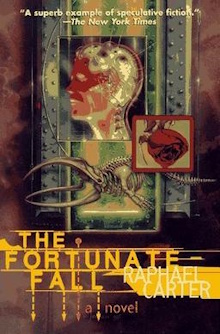
I’ve had this novel on my list of books that I want to read for so long that I’d given up all hope of finding it. Many writers and critics loved it when it was published but it seemingly never found commercial success, few copies were printed and no ebook version was made. Now nearly 30 years later, it has finally been made available in electronic form. Naturally I’m among the first in line for it and like everyone else I am awed by how ahead of its time it was as a masterpiece. Even so, I can also see why it might have struggle to find success back then. Almost all of its grand revelations are from interviews by the protagonist, so it’s very much a case of telling instead of showing. This isn’t a good science-fiction novel in the conventionally marketable sense but it is breathtakingly original and unique.
Maya Andreyeva is a so-called camera working for a news service in Russia. This means that she is wired with cybernetic implants that capture all of her sensations, whatever she sees, feels, hears, and much more and transmits them to whoever cares to experience them across the net. The novel opens with her reporting from a site in Kazakhstan where the Guardians, the now dethroned world superpower, once ran one of many concentration camps. She is remotely assisted by a new screener Keishi Mirabara, whose job it is to filter out unwanted sensations from the audience such as Maya feeling the need to pee and add contextual information to the broadcast. To do her job, Keishi must intimately know Maya’s mind and it soon becomes obvious that she is obsessively in love with Maya. Keishi arranges for Maya to interview Voskresenye, the author of a book about the camps and as it turns out, one of the survivors. The mysterious man is elusive and hiding from the authorities but what he has to reveal will both rock the foundations of the world Maya knows and her own personal life.
This is a comparatively short novel, but it not only manages to pack in so much worldbuilding that I’m overawed, it also delivers a powerful message on totalitarianism, the nature of being human and perhaps even the nature of sin. This new edition includes a new introduction by Jo Walton which lays out just why this is such an incredible piece of writing. It plunges the reader straight into a world that is drastically different from our own yet is familiar enough for us to recognize that it’s a continuation of ours. It freely invents all kinds of new terminology whose meaning we must infer from the context. There’s no explicit exposition as we stay only within Maya’s mind for whom this world is an everyday reality but we can read between the lines to fill out the details. Mediocre science-fiction stretch out a handful of ideas across an entire book. Here we have something new leap out of practically every page: how Maya drinks alcohol at the bar of a trainport to feed the nano-robots inside her, the fact that she has five holes drilled into her skull to accommodate sockets and hers are so old that she needs adapters for more modern connections, the very composition of the so-called Unanimous Army that broke the power of the Guardians, Grayspace and the feral intelligences who live there, a unified Africa as the current technological superpower of the world etc. It all adds up to a dystopian world that feels terrifyingly real and lived-in.
The title itself refers to the Christian concept of felix culpa, which justifies or even glorifies the fall as something that leads to a greater good. In the context of the novel, this most obviously parallels the evils that the characters here perpetrate to break the power of the oppressive regime they live under. Voskresenye in particular is under no illusions about what a monster he has transformed into. More easily overlooked is the same dynamic applies to the relationship between Maya and Keishi, though I won’t elaborate on that as it goes into spoiler territory. It was once I noticed this dual track that I realized how masterfully Reed planned it out.
In short this novel has pretty much everything: incredible world-building, horrifying massacres that make the Holocaust seem pale in comparison, an all-consuming love affair, all set in a post-cyberpunk world. It is anachronistic in some small ways, for example in treating homosexuality as such a taboo when we’re so used to it now. As for its technology, it’s odd how bandwidth-limited the net is or that data is seemingly transferred as sound. Reed also did not foresee the advent of influencers who have no need of the intermediary of an established channel to reach audiences directly. This is after all a book that was originally written nearly 30 years ago. In most other respects however, it is frighteningly up to date and even prescient. One could for example interpret the way that the Weavers seek to protect humanity from harm by filtering thoughts out of their heads as an extreme form of wokism. Instead of self-driving cars, we have characters linking with cars and treating them as extensions of their bodies. It’s heady, mind-boggling stuff.
It isn’t perfect as the pacing is off and having all of the important revelations come from interviews feels unsatisfying. I was left with so many unanswered questions on what is happening in Africa and how it came to be how it is. There is no doubt however that this truly is one of the best modern science-fiction novels I’ve ever read and it’s such a shame that Reed didn’t write anything else of note after this failed to gain much traction. Well, better late than never and I hope that a whole new generation of readers will now get to discover this masterpiece.