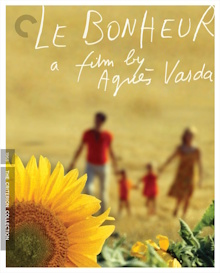
Agnès Varda’s work never stops astounding me and this very early and deceptively simple film is a case in point. It’s shot in cheerily bright colors, reminiscent of the work of her husband Jacques Demy, and presents a postcard perfect picture of a blissfully married life. What’s brilliant about this is that Varda plays it so straight that you could plausibly take it at face value and never see anything wrong in it at all. But it would be uncharacteristic of her make something like that so seen from a different perspective, we can only conclude that it is a horror film.
François is a carpenter who lives a seemingly charmed life in Fontenay-aux-Roses outside Paris. He has a beautiful wife Thérèse who works as a dressmaker from home and two children, Gisou and Pierrot. On his days off, he likes to take them on outings to the woods where they picnic, walk and enjoy naps. One day while doing work for a client in Vincennes, François pops into the local post office to make a telephone call. The woman at the counter Émilie, who looks somewhat similar to his wife, flirts with him and tells him that she will soon be transferring to Fontenay-aux-Roses. He is open about being happily married with children but when they out walking one day declares that he loves her as well. When he helps her move into her new flat, they begin an affair. The next time François is out with his family in the countryside, Thérèse notices that he is happier than usual. He tells her the truth about Émilie while explaining that this doesn’t diminish his love for his wife or his children in any way. Thérèse is upset at first but then seemingly accepts it as she wants her husband to be happy. They lie down to make love on the grass and François falls asleep. Yet when he wakes up Thérèse is missing and is found drowned by local anglers.
Given the idyllic tone of the film up to that point, the sudden death is incredibly shocking and what happens next is disconcerting to say the least. Everything hinges on why Thérèse dies and Varda is scrupulous about maintaining ambiguity. There is a single brief shot of her wading into the water and seemingly picking wildflowers from a branch as we’ve seen her do previously. So it’s plausible that it could just be a freak accident and indeed everyone around François reacts as if it were. If so, tragic as the death is, wouldn’t she want her husband and children to live on happily? Are we meant to interpret this as an assertion that happiness can persist even in the face of tragedy? Yet the circumstances suggest that it might be a suicide, Thérèse voluntarily opting out to make way for Émilie. That the new woman seamlessly replaces her, even with her children, after only a brief period of mourning, makes it horror movie material.
I confess that I was one of those who was suckered into the more positive interpretation at first, marveling at the boldness of the message and reasoning that François’ infidelity might be due to the French being more accepting of affairs. But there are too many clues that point in the opposite direction. Thérèse and the children are played by the real wife and children of actor Jean-Claude Drouot who plays François but are credited only as his wife and children rather than their own names. When Émilie is first introduced, she assets her own independence, yet magically slots into François’ life as if she belonged there all along. The children are suspiciously docile. They fall asleep on command and are never seen crying. Varda is constantly challenging the viewer, asking how much more of this male-centered fantasy life we can believe is real. This was only Varda’s third feature film so audiences at that time might well have been confused by her intentions. But now that we can review her entire career in retrospect, it’s impossible to believe that she would have intended a straightforward, positive interpretation for this film, given her feminist leanings.
Even with this being a deceptively simple film, I’m shocked that this isn’t a better known and more highly acclaimed work. It’s an incredibly clever and subversive film and since I’m a big fan of the musicals of Jacques Demy, that only makes it even better as it seems to be a direct counterpoint to his famous The Umbrellas of Cherbourg.