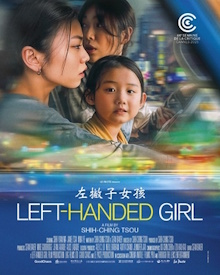
Shih-Ching Tsou is a long-time collaborator of Sean Baker and now she finally gets her own feature film, one that is set in Taiwan. Shot on an iPhone and featuring highly saturated colors, it’s stylistically similar to Baker’s work and is about the lives of a downtrodden family in Taipei. It’s fascinating to watch a Taiwanese framed in a more American style and it’s cathartic to watch the family crash headlong against traditional Chinese mores. But on the whole it’s a fairly conventional film that doesn’t break any new ground.
A family of three women, the single mother Shu Fen and two daughters, the college-aged I Ann and the five-year-old I Jing, return to Taipei after some time away. They set themselves up in a flat and Shu Fen rents a stall at a night market to sell noodles. Meanwhile I Ann works at a betel nut stand, a job that usually involves dressing provocatively. One day Shu Fen receives news that her estranged husband who abandoned the family ten years ago is seriously ill in the hospital. She visits him over I Ann’s objections and when he dies, spends all of her savings on his funeral expenses. I Jing is often left with the grandparents while Shu Fen is busy but the grandfather has old-fashioned views on the little girl’s left-handedness and teachers her that it is the devil’s hand. She dissociates from the hand, blaming it for any bad behavior and takes too shoplifting small trinkets at the night market with her left hand. I Ann has her own troubles as she is in a sexual relationship with her boss and is discovered by his wife after she gets pregnant.
Contrary to what its title suggests, this film gives more or less equal billing to all three members of the family. That’s a good decision in my view as while the young actress who plays I Jing is very photogenic and naturally draws most of the attention, that would have made the film too cutesy. Instead we have a smattering of stories about urban dwellers on the less fortunate end of the scale in Taiwan. It works well as a whirlwind tour of Taiwanese cultural touchstones such the night markets, betel nut sellers and so on and will no doubt be perceived as being exotic to Westerners. For my part, I’m amused that even the grandmother is engaged in illicit dealings, apparently helping to smuggle migrants into the US. None of this is particularly new or interesting to me however and there isn’t any single element pulls everything together. Even the secret revelation at the end seems underwhelming. As my wife observed, Shu Fen herself must have had I Ann at a young age and with the wrong man. Tsou could have leaned into that more to show that leads to a generational cycle that leaves them poor but I see that she doesn’t want to judge them so harshly.
The cinematography has the color saturation turned up so high that the images often look noisy. It’s an artistic choice that distinguishes it from other Taiwanese films but I’m not certain that it adds much here. Other Americanisms are in evidence, including working in the “It’s you and by a lot…” meme which I admit is funny. The performances are all excellent with the little girl Nina Ye being very impressive. All in all, this is a fine film but I feel that it errs on the side of being conventional and refrains from being really transgressive in any major way. Teenage pregnancies, petty theft and so on are neither new nor particularly topical. It’s as if Tsou had wanted to make this film for a while but now that her time has come, it feels passé. There’s some satisfaction in watching the family defying the grandparents but they all still anxious to conform to Confucian values enough to keep relations amicable. It’s a film that holds itself back over and over again from going too far.
Finally I note that while this family might be considered poor in Taiwan, they’re not actually rock bottom. It appears that Shu Fen relies heavily on the help of their hired maid Ann who I surmise might be Filipino to run her stall. Yet we know nothing about her and she’s not part of the story at all. If one were to make a film about the downtrodden in Taiwan, surely immigrants should be part of the picture too?