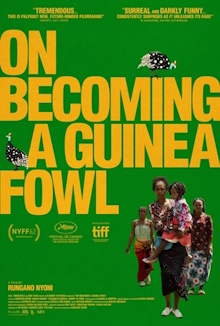
It’s a little petty of me but every time I watch a film from a new country, it’s like crossing off a number on my Bingo card. I’ve certainly never watched any film from Zambia before and this is a good one. Taking place against the backdrop of a funeral, it’s another film about how women are oppressed as we’ve just saw in The Great Indian Kitchen. But it’s even scarier here as the patriarchy is enforced by the elder women of the family. It starts out being funny in a very surreal way but towards the end, it’s just hopelessly depressing.
Driving a nice car, Shula is returning home one night from a fancy-dress party when she does a double-take and stops the car. She calls her father on her mobile phone to tell him that she has just dead her uncle Fred dead in the middle of the road. Her father tells her to wait for him to arrive after asking her for some money for the taxi. However it is instead her cousin Nsansa who shows up drunk. Together they call the police who ask them to wait by the roadside until the morning as they have no cars available. She returns home to find that relatives are already arriving in preparation for a large funeral ceremony. She tries to hide out at a hotel but a whole gaggle of aunts appear and shame her into helping out. When she picks up her mother at the airport, her mother falls down on the floor as an expression of grief. While running errands with Nsansa to cater for the large number of relatives, the younger cousin jokingly recounts the story of how uncle Fred once tried to rape her. They go to collect another cousin Bupe from her hostel at university only to find her unwell and she too has been abused by the same uncle. Meanwhile the male relatives do no work and wait to be served and the aunties only counsel the girls to endure for the sake of the family.
When Shula first appears on the screen, she is wearing a ridiculously puffy costume and sunglasses while driving at night. Then she nonchalantly calls up her relative to report finding her dead uncle Fred. It’s hard to decide how seriously to take this. Indeed there are multiple dream sequences and as the title suggests, at one point Shula and the other girls move and act like guinea fowl. But the scenario is absolutely serious, seems reasonably plausible in the context of Zambian society and when faced with the complete impossibility of changing things for the better, clucking like a bird seems to be all that they can do. Watching Shula’s mother throw herself on the ground crying is laugh out loud funny, but it’s impossible to laugh when the uncle’s widow who is forced to raise the many children by herself must prostrate herself and crawl along the floor before the relatives from the husband’s side of the family. Shula tries to convince the older generation that uncle Fred was not a good man only to be met with her shrug by her father while the older women gather to tell her how much they are loved and sing together. You don’t have to be a woman to understand how terrifyingly realistic this type of response is.
There are some parts of the film that I didn’t fully get. When Shula and Nsansa arrive at Bupe’s hostel, they find the floor flooded with water and the other girls mopping. Were they just cleaning their hostel in the middle of the night? Shula later has a dream of sleeping on the flooded floor. Is this just a simple metaphor for drowning in the midst of the family crisis or is it a more specific cultural reference? I also wish there were a little more information about the socioeconomics behind their customs. We can’t help but notice that Shula’s side of the family are all visibly more prosperous than that of the bereaved widow. To me, this suggests that their pretending that uncle Fred was a good man isn’t just about silencing the suffering of women or upholding the family’s good name. It’s also a tacit conspiracy to keep control of his financial assets and I wish the film were a little more informative about these nuances in their social dynamics.
As I noted, the opening scenes are surreal and funny as Shula, as a woman who is clearly educated and has a decently paying job, seems to be a good position to push back against these archaic practices. Yet while she has a great deal of sympathy for the widow, she doesn’t get a say at all in the end when the family elders make their decisions. This might well be realistic in the context of Zambian society and reduces Shula to a helpless fowl but it’s not very satisfying.