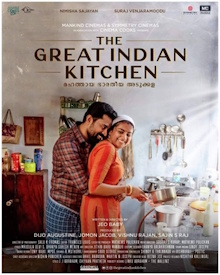
This immensely successful and popular Indian film has been remade multiple times in different languages. This original one is in Malayalam and was made by a director Jeo Baby and performers who were not that well-known at the time. I have little patience for misery porn these days and the great genius of this film is that while it highlights the continued oppression of women in India, it refrains from maximizing the wife’s plight in every way possible. The people around here are not deliberately cruel but merely acting how they believe to be right, as dictated by religious, gender and cultural norms. From this, a thousand small humiliations add up to an intolerably miserable existence for the wife that is all the more believable for how mundane it is.
An educated woman from a middle-class family is arranged to be married to a man who works as a teacher and comes from a high status family with strongly traditional and religious views. Under the guidance of the mother-in-law, the wife adapts to the daily routines of the household. Her duties include preparing all of the meals, tidying up afterwards, cleaning the house, washing the house and so on. The drudgery is tolerable until the mother-in-law has to move to the household of her own pregnant daughter. She learns that the father-in-law has very specific needs. His rice for example must be cooked in a wood fire and his clothes handwashed. Meanwhile at night, she has to endure painful sex with her husband. She is allowed some rest while she is on her period as a temporary maid is brought on to perform her duties. But her sister-in-law castigates her for not adhering to special rules, such as being required to sleep on the floor, to bathe separately in the river, to not touch anything in the house and so on. She is forbidden to seek employment outside and despite her repeated complaints about a leaking sink, her husband keeps neglecting to call a plumber.
The first good impression this film made on me is that it’s finally an Indian set in modern society about a solidly middle-class family. Telling yet another story about the bottom-most rung of society is low hanging fruit that I’m getting bored of. Equally astute is how the film refrains from having the in-laws being overtly cruel to the wife. The father-in-law is soft-spoken and always advises her on what to do in a kindly, patronizing manner. The husband is dismissive of her concerns and though it’s a close thing towards the end, we don’t actually see him physically striking her. Such dramatic extremes are unnecessary to portray the mundane yet authentic drudgery of her everyday existence. The husband and the father-in-law eat like pigs at home, leaving the dining table a mess for the wife and the mother-in-law. It’s notable how nice the living room looks but the kitchen is dilapidated as the men never have cause to step into it. While the husband performs his religious rituals and practices yoga, the wife is constantly slaving away in the background to make his leisurely daily routine possible. The most painful part of her experience is that it is impersonal. This is what counts as normal for so many in India such that even the wife’s relatives attempt to persuade her to get used to it.
The entire film is rich with details of ordinary life in an Indian household. The smorgasbord of dishes the wife prepares and the spices and ingredients she uses is sure to delight those who are themselves cooks. Then there are all of those customs observed by a religious family, with the implication that they are high status because they are so devout. Reading between the lines, it seems to me that the wife’s family may actually be richer and she has worked overseas in a Gulf country. This explains both why she is unfamiliar with some Indian customs and that it’s a coup for her to marry into a traditional family. That said, there are some odd developments that serve only to worsen the wife’s plight. The mother-in-law leaves to assist with her daughter’s pregnancy and seemingly never returns. We never get to see the wife shopping for groceries though she certainly must at some point given the volume of food that the household goes through. It gives the impression that she is a virtual prisoner in the house even if we know that it’s not strictly true.
This wife’s story ends on a hopeful, positive note which no doubt has helped to endear the film to audiences. But we know that in reality it’s isn’t so easy to just walk away from a marriage in India and it is all too easy to imagine that a man would rather kill his wife than allow himself to be humiliated. I’d judge that this film pulls its punches a little to make it more accessible but it remains a realistic and timely representation of unfair the traditional role for wives are in India.
One thought on “The Great Indian Kitchen (2021)”