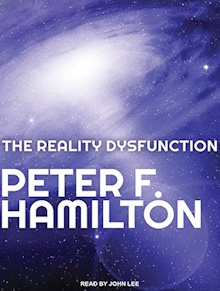
The name Peter F. Hamilton was not familiar to me and I thought I knew all of the big name science-fiction writers. While popular and commercially successful, this trilogy is closer to being space opera and so never won any major awards which could be why I never noticed it. The books are also notable for being huge doorstoppers. That kind of length isn’t that unusual for the current era of web series but present real logistical issues when printed on paper. The cast of characters is extensive and Hamilton takes his time to describe his setting so the plot doesn’t really get going until a few hundred pages in. For a long while, I enjoyed the action adventure story well enough but couldn’t see much point in it. Then the action got started and I must admit that I got hooked.
Set several hundred years in the future when humanity has spread out to settle hundreds of planets. There are two strands of humanity, the Adamists who employ conventional technology including starships with fusion drives and cybernetics and the Edenists. The latter have biologically engineered themselves to give themselves the telepathy-like affinity ability, allowing them to control living starships called voidhawks and biotechnological constructs. The main story follows several key characters: Quinn Dexter, a criminal from Earth who is sent to work on the frontier colony world of Lalonde as part of his sentence; Syrinx, a young Edenist captain of a voidhawk, Ione Saldana, the ruler of Tranquility, a living habitat founded to investigate why the extinct alien species the Laymil seemingly killed themselves; and Joshua Calvert, a resident of Tranquility who makes his fortune searching for Laymil artefacts to fund the restoration of his father’s starship. The multiple perspectives and plotlines eventually coalesce around a new threat that emerges on Lalonde, the very threat that genre-savvy readers will immediately recognize as the very one that doomed the Laymil: the return of the dead.
Apart from the sheer verbiage and the slowness of the main plot, I found myself annoyed by how it jumps between the perspectives of different characters. It’s not the third person omniscient view as we are given access to the inner thoughts of the characters. But it freely switches between characters even within a single scene which tends to disrupt my immersion. The prose is however solid, reminding me once more that the quality of writing in properly published work is higher than that of web fiction. The many worlds, ships, habitats, devices and even archaic locales shown here are all described in vivid detail. Hamilton’s weakness is in his characters. He seems content to work off of the standard archetypes with familiar development arcs so the women are all hot, the ground-pounding marines are battle mad, the reporter is nosy, and so on. I was pleased at first to see that he has a very large cast of varied characters, such that it’s difficult to discern that any single one of them could be the main character. But it soon becomes clear that Joshua Calvert is so far and away his favorite that he might as well be a self-insert. He’s so effortlessly charming that he beds all of the women, flies an Adamist starship so well that it is the equal of an Edenist living starship even though he shouldn’t have much flying experience, and intuitively just knows what to do in every situation. It’s off-putting and makes it harder to take the story as a whole seriously.
The setting is expansive, intricately detailed and feels properly lived in. It depicts an extremely advanced spacefaring civilization with a high degree of material abundance but there’s still plenty of wealth inequality and ideological conflict. The technology used is fairly grounded most of the time, there are no force fields, teleporters or FTL communications. The most powerful weapons are the banned antimatter bombs. Starship combat employes AI-controlled drones called wasps that are armed with munitions and energy weapons and can react much faster than human reflexes. The outlier here is the Edenists’ affinity which allows them to link minds, share memories and even live on after death in a sort of hive mind. There’s no explanation about how it works in terms of physics and it’s downright weird that the ability comes from genetic engineering, as if it were innate to the brain and just waiting to be unlocked. But then the main plot does establish that souls persist after death and genuine religious faith has power so the supernatural being explicitly real here would be a factor.
Detailed as it is, the setting wasn’t compelling enough on its own to draw me in. It’s all very well and good to read about the final, fatal flight of a voidhawk as part of its reproduction process, or the centuries-long process in which a primitive colony world is brought up to become a profitably industrial one. But they’re all over the place and there’s seemingly no connection between the individual stories for a very long time. The book is much more fun to read once the main threat rears up and starts rolling up whatever opposition the human Confederation can muster. One would think that the undead would fare poorly against gauss guns with explosive ammunition, cybernetic limbs and even nukes. Hamilton however evens the odds by giving them superhuman powers including strength, toughness and regeneration, energy and illusion projection, and the innate ability to interfere with electronics. Combined with an understandable sense of confusion and incredulity that they really are dealing with the returned dead, they make for a plausible and even terrifying adversary for a star-faring civilization.
One of my favorite aspects about Hamilton’s writing is that none of the characters do obviously stupid things. They plan and react intelligently to the new threat. They don’t hesitate to bring out the big guns once they understand the scale of what is going on. They know that the best way to win is to collect intelligence and pass it on. In military science-fiction or space opera, this is what makes violent conflict satisfying to read. Bad writers resort to one side making dumb mistakes, being overly arrogant or be unable to learn from setbacks. Here both sides learn and iterate after every confrontation. The dead are a threat on the scale that the Confederation has never encountered before and yet the living aren’t totally helpless against them. That makes it a riveting read for me.
My least favorite aspect is still Joshua Calvert being the author-ordained hero and even his character flaws are framed as being part of his charm. As for the world-building, it’s not as badly dated as I feared but it’s still too strongly rooted in the Anglo-Saxon perspective. The Confederation is made up of diverse cultures originating from Earth, yet in terms of names, culture and language, Americanisms are over-represented. The book also has a clear religious component as the afterlife explicitly exists in this universe. That’s fine but Hamilton seems personally partial to Christianity in particular. We have one instance of homosexuality and it’s depicted as one of the perversions of Quinn Dexter. Anyway, I’m engrossed enough in the story to want to know what happens next so I’m willing to look past these issues. This isn’t great science-fiction and arguably isn’t science-fiction at all, but it is a great page-turning read.
One thought on “The Reality Dysfunction”