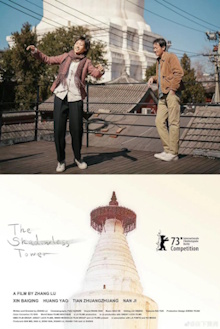
This film was made by Zhang Lü, a Chinese director of Korean ethnicity. Its title refers to the White Pagoda that is a landmark in Beijing, said to be shadowless as due to a combination of its white color and sheer size, its shadow is difficult to perceive. It’s definitely one of those arthouse films with depths that are difficult to perceive as said tower’s shadow. In this case, it’s both subtler than I’d prefer and even when I can work out what it’s trying to say, the stakes seem too small to support the weight of its presentation.
Having failed at being a poet, the middle-aged Gu Wentong now makes a precarious living as a food critic. Recently divorced, he has sent his daughter Xiao Xiao to live with his elder sister and her husband but visits them frequently. One day he accompanies them in paying their respects at the grave of his mother. His brother-in-law tells him that he has been in touch with their estranged father Gu Yunlai. Decades ago their mother drove him away after he was accused of molesting a woman on a bus and the two siblings were raised by the mother alone. Wentong learns where his father lives and that he travels to Beijing to look at his children from afar. At the same time he has an ambiguous relationship with Ouyang Wenhui, a photographer young enough to pass as his daughter. She flirts with him and has a carefree attitude yet seems wary of getting too close. Under her encouragement, Wentong makes the trip to see his father but only watches from a distance without initiating contact.
While there is a plot and things do happen in this film, it feels lethargic because Wentong himself is such a passive character. When asked why he divorced, he answers that the relationship between him and his wife eventually became so gracious and polite that they lost all passion for each other and stopped having sex. He often apologizes and excuses himself, being reluctant to impose himself on others in any way. So in his relationship with Wenhui, he lets her do as she wills without questioning what she really wants or telling her what he himself wants. From what I can see, some critics are sympathetic towards this ambiguity, perhaps being of the opinion that these are people who have been hurt in the past and so are wary of getting too close to others once more. Certainly I’d interpret the themes here as being those of isolation and lost connections between people. But I found their interactions simply bland and uninteresting.
The problem is that even after you peel away the layers of the characters, their issues seem so small stakes. Wenhui is traumatized by growing up in an orphanage. Wentong feels guilty that his father might have been falsely accused and so lost out on decades of a father-son relationship. To me, even if he did do it, the crime of molestation seems incommensurate with the punishment meted out to his father. I was puzzled by the significance of the White Pagoda which is constantly seen as part of the backdrop and had to read up on the explanation that Wentong is at a point where his past and his future are equally balanced, hence the lack of a shadow. Neat but maybe a little too obscure a reference. Another artsy flourish is how many elements keep recurring. Wentong witnesses his father flying a kite by himself at the beach and later bonds in the same way with Xiao Xiao. Both he and Wenhui separately explore the abandoned building that was once the orphanage she grew up in. It confers a liminal quality to the film and suggests that key events are destined to recur, a very religious attitude to take. But again, it’s not something that personally resonates with me.
This is plainly a work with real depth, has something substantial to say and cleverly references past films. Unfortunately it doesn’t really agree with me and I found it even a bit boring. The characters too plain, their issues too mundane. The one thing that I did enjoy is that it shows off Beijing in an expectedly flattering light. Not as the seat of government or a city of historic significance, but someone’s hometown, familiar, filled with happy memories and beloved. This isn’t a vision of Beijing that get to see often.