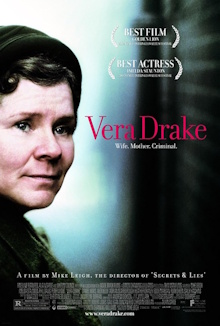
I haven’t seen enough of Mike Leigh’s work and after taking the time to watch this one, I continue to be wowed by his ability to depict the lives of the British working class. This is ostensibly a film about abortion, one so realistic that it feels like it should be based on a real person. But it’s also about the lives of the working class, their concerns and their problems and how they’re forced to solve them in their own way because the laws as written were made by and for the rich.
In 1950, Vera Drake is by all appearances a pillar of the community in her neighborhood. In addition to taking care of her husband and two children, she regularly pays home visits to her elderly mother and a disabled neighbor while making a living cleaning the houses of the rich. Noticing a neighbor, Reg, who lives alone, she invites him for tea, effectively matchmaking him with her daughter Ethel. Secretly, she also performs illegal abortions. She charges no money for this service, seeing it as helping women whose lives would otherwise be ruined by having unwanted child. A friend Lily frequently refers such women to her but Lily does charge them two guineas without Vera’s knowledge. Inevitably, Vera’s secret is discovered when one of the girls she tends to reacts badly and has to be hospitalized. The mother resists notifying the police but the doctors insist and so to her family’s shock, Vera is arrested just as they are celebrating the engagement of Reg and Ethel.
The film goes out of its way to depict what a kindly, harmless woman Vera is. It’s almost comical how she is constantly putting the kettle on to offer others a fresh, hot cup of tea. Leigh takes great care too to show the lives of the people around her. Her son Sid who tailors suits, Ethel testing lightbulbs in a factory. The neighbor who is too sick to work but too poor not to. The contrast between their living situation and the houses of the rich that Vera cleans is stark but Leigh emphasizes that poor as they are, theirs too is a life full of joyful moments. We are also shown who the women who need help from her are and why. Unmarried young girls too young to really understand what they are doing. Middle-aged wives who are already burdened by too many children. It’s a rich, textured portrayal of the working class geared to elicit our sympathy so that when Vera’s is arrested, it’s as much an outrage to us as to them.
It does work and the attention to detail is nothing short of astonishing. The economist in me is pleased that Leigh includes explicit figures so that we can compare prices. An upper-class woman is raped and nervously gets an abortion following the properly established, legal way. The doctor asks £150 from her. Lily charges two guineas, which the non-British might need to look up to understand is only a little more than two pounds. There are scenes of Vera’s sister-in-law asking for a washing machine and Sid fitting a customer for a suit, both of which include exact prices so that we can contextualize just how unaffordable a legal abortion was at that time. The film is very much on Vera’s side here as she offers an alternative to women who would otherwise be forced to raise children that they don’t want. A fair counterargument is that it understates the risks of such homemade abortions, claiming that Vera botched the procedure only once out of possibly hundreds of successful abortions. This is especially surprising since the method she uses is so simple. In reality, the procedure is extremely dangerous and Vera’s safety record is implausible, so the authorities are right to prosecute her.
I generally am not a fan of films that champion the working class by depicting them as being morally superior to the rich. Vera Drake doesn’t do this at all and succeeds by instead showing them as being people like any other with full lives of their own. It highlights the unfairness of them not having access to abortion because of poverty, making a strong case that all women should have the right to choose. I’m stoked that there’s no question at all that abortion is a net good, only that access to it should be universal.