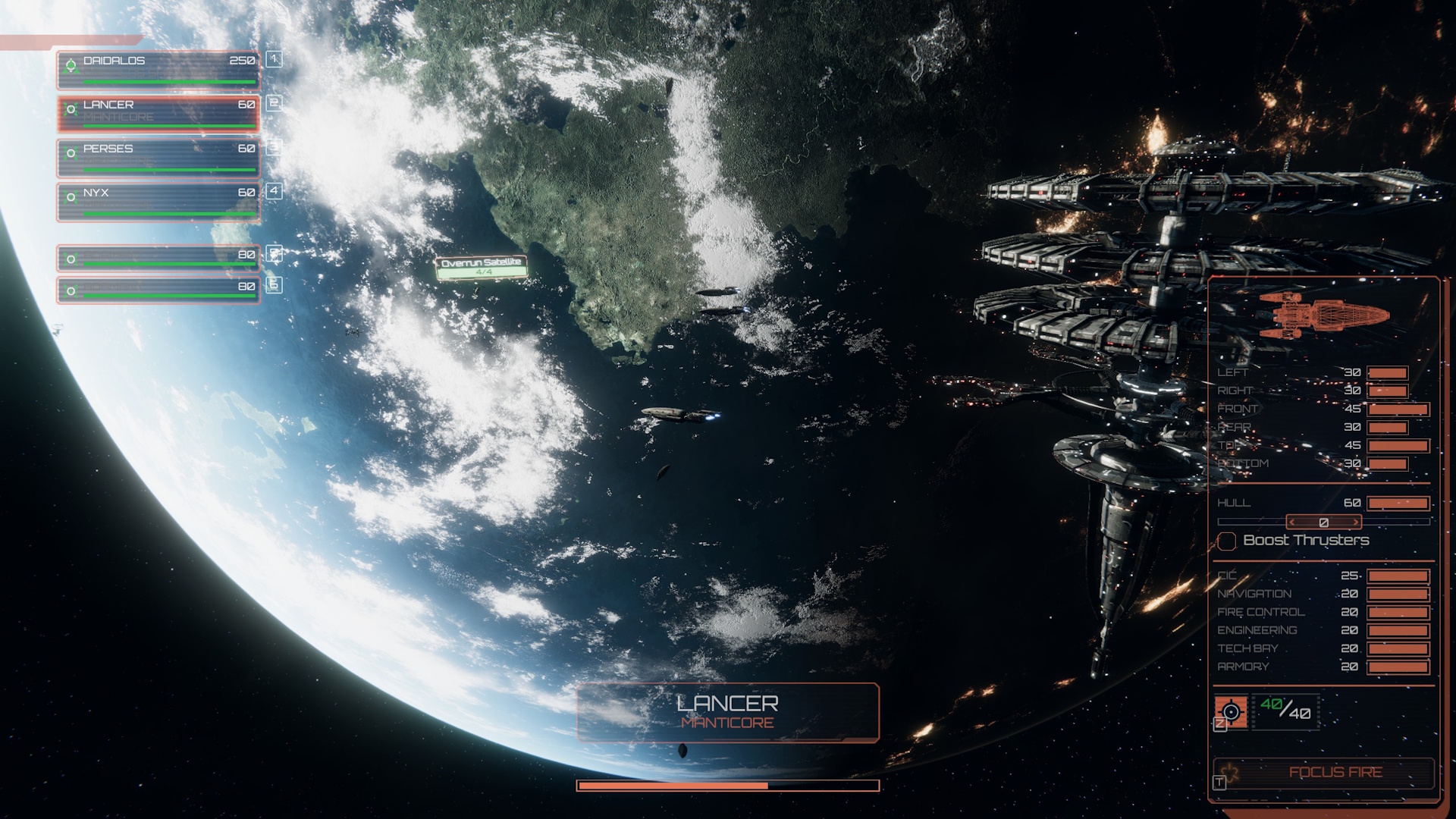
This was a free game, on Steam this time, and I’d never even heard of it before I saw the offer. It seems one reason why this was given away and then subsequently taken off the store is that the publisher lost the right to the IP. Unfortunately the offer was only for the base game and now you can’t even buy the many DLCs even if you wanted to. After playing this for a while, I very much wanted to because the prospect of having the extra ship types to experiment with is very enticing. The strategic layer is lacking and feels inconsequential. But the tactical layer is very strong and one of the best implementations of fleet-based starship combat I’ve seen.
The main campaign is set while the First Cylon War is already well underway so it doesn’t cover how the war started. What we do know is that the Twelve Colonies of humanity, each ruled by their respective governments, decide to form an alliance to fight the rebelling Cylons. They build large battleships, called battlestars, one for each of the colonies. However shortly after the launch of the first one, Galactica, it goes missing and a Cylon attack on the Colonial Fleet’s headquarters at Picon leaves Admiral Lucinda Cain in command. The Daedalus Mobile Shipyard then becomes the new headquarters. From there, the fleet must rebuild and relieve the worlds besieged by Cylon fleets. They must also solve the mystery of the missing Galactica, deal with planetary governments who consider the alliance as much an enemy as the Cylons and face a leader of the Cylons who has emerged from the shadows.
It’s honestly difficult to make much sense of the story unless you’re already a serious fan of the show and know most of the lore. There’s no briefing to get you up to speed and everything is conveyed through dialogue between the characters. Suffice to say that it is chock full of infighting among both the humans and Cylons, involves betrayals and has high drama, all very much in keeping with the themes of the series. I don’t really much care for it and I don’t know these characters but I can tell how seriously the writers delved into the lore. It is worth noting that this is indeed a story-based campaign. You win the game by completing the story missions in order. This also unlocks access to the blueprints for new ships and equipment. These missions require you to take very specific actions, not just win on the field, so it’s not purely a strategy game.
This is in fact my main beef with the game. From the map display that shows the position of the Cylon forces and your own fleets, one might conclude that this is a strategy not too dissimilar to something like the familiar X-Com games. There are twelve planets in the alliance and the game tracks how strongly they support the Colonial Fleet. If a planet is being menaced by a Cylon fleet for too long, their support can drop low enough that they decide to quit the alliance, taking their funding in the form of Tylium with them. This Tylium is what you need to build your ships and even spool up your drives to jump. From time to time, side missions appear, to escort a freighter say, or wipe out a Cylon patrol. This provide an extra opportunity to earn more Tylium as well as Requisition Points are which used to unlock blueprints and hire officers to lead your fleets. It makes total sense that you’d want to build up your fleets as much as possible, suppress the Cylons wherever they pop out and so control the playing board.
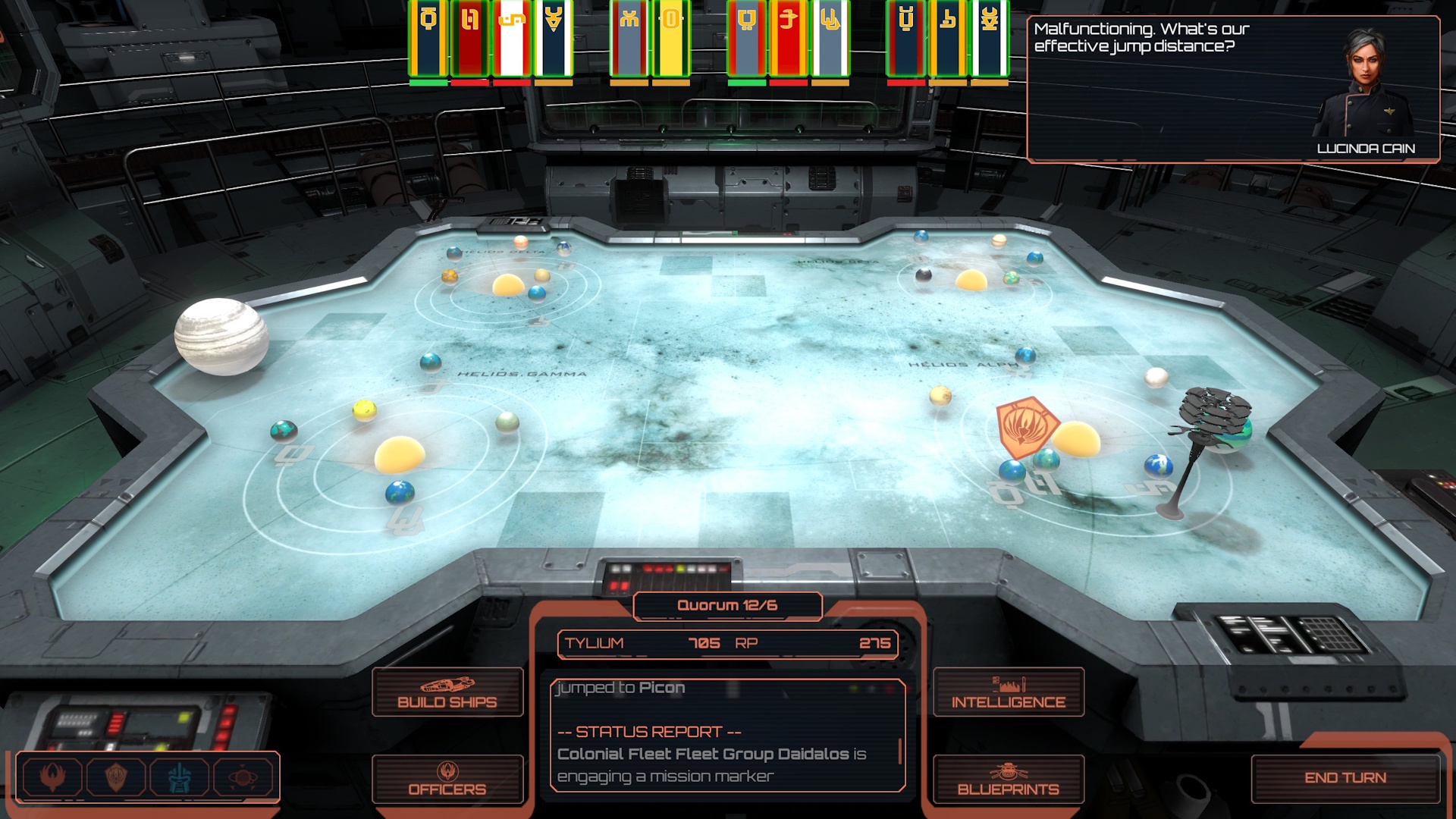
Except that’s not how it works here at all. As I mentioned earlier, winning the campaign means completing the story missions so it’s impossible to make any lasting changes on the map. Even if a colony planet quits the alliance, they rejoin the moment you defeat the Cylon forces orbiting them. The only way you can lose is if the Daedalus is destroyed which you can avoid by parking it at the gas giant of Ragnar where the Cylons will never go. Conversely the Cylons have no planets for you to attack. Cylon fleets seem to randomly appear in the system of Helios Alpha and can then jump elsewhere. It’s a never-ending game of whack a mole as there is no way to stop them permanently and no way of predicting where they will attack next. Fortunately there is a rather generous auto-resolve option once you get bored of the repetitive battles.
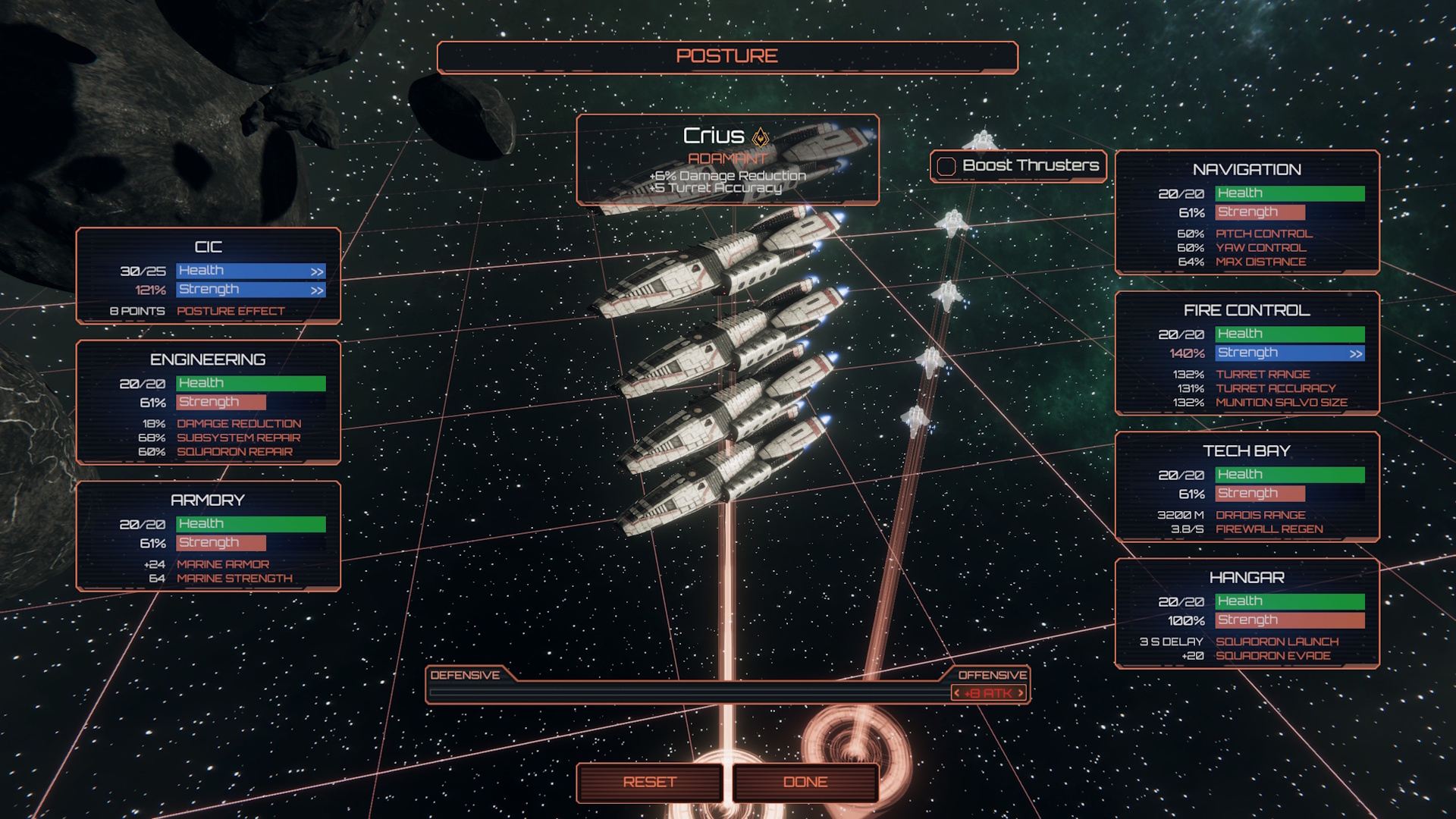
The tactical battles are really good however which redeems the game. It uses a WEGO turn-based system meaning both sides issue orders which are then executed simultaneously. In a traditional game of squad-based tactics, this can be frustrating as even guessing in which direction your soldiers should face is critical. Here the capital ships move slowly enough and in predictable enough paths that you can just focus on executing your chosen tactics. The battlespace is three-dimensional with a Z-axis, though all ships are oriented on the horizontal plane. The guns of the ships all point in particular directions so using them well means knowing where to place them. Ships can launch squads of fighters and salvos of munitions. A very cool mechanic is that your fighters can be assigned to defend against enemy missiles by shooting them down. By setting your ships’ posture to either offensive or defensive, you can greatly influence how much damage they inflict or how resilient they are.
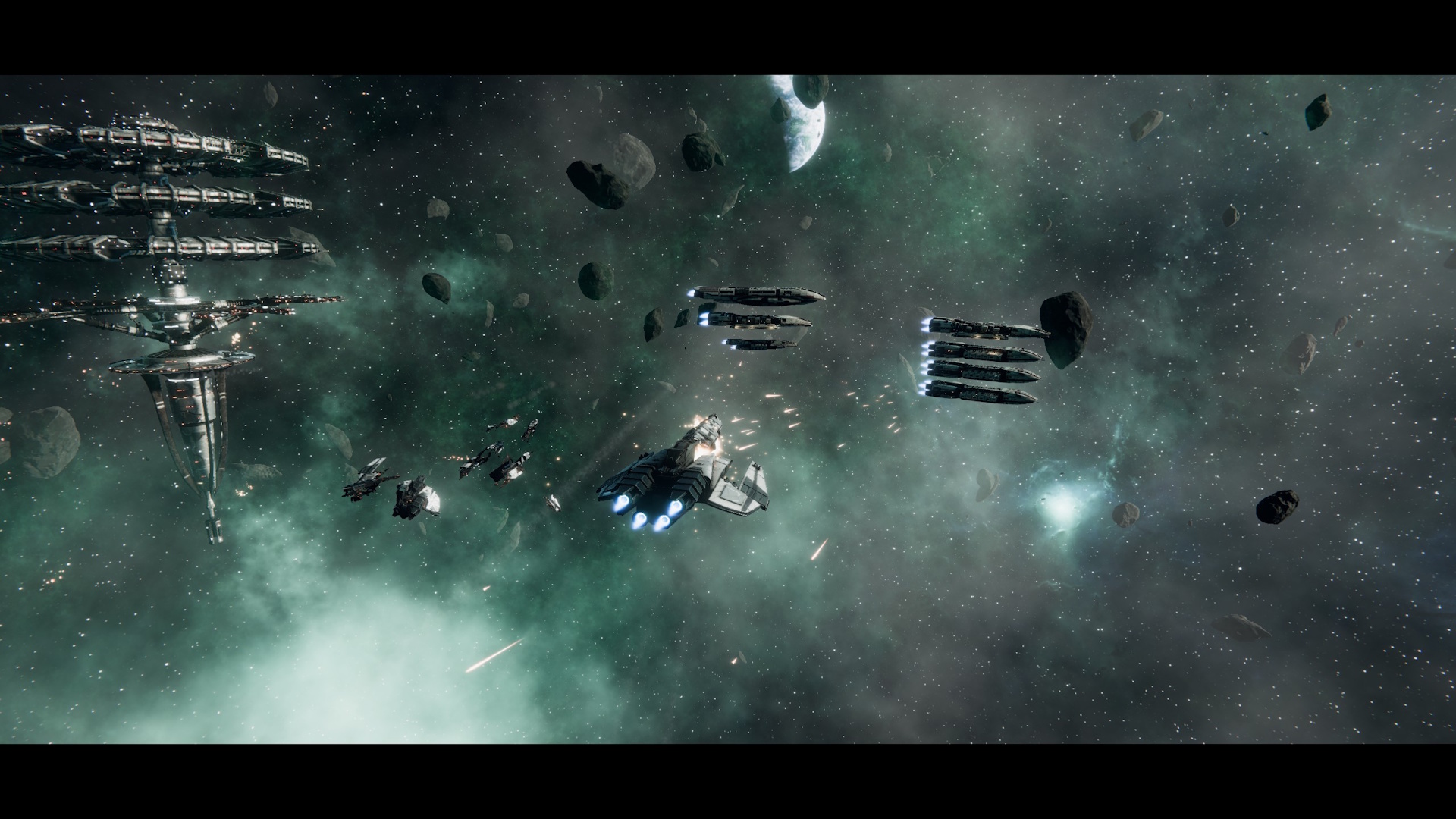
Taken together, the richness of these mechanics means that there is a tremendous difference in between a badly commanded fleet and a brilliantly led one. I still remember how awfully I did at the beginning when I tried to play this as a standard RTS by roping together ships and getting them to focus on enemies one at a time. By contrast, once you understand how to move your ships in a formation, micromanage their postures, use scouting to identify enemy ships before they get close and how to defend against enemy missiles, it’s ridiculous how you can defeat superior numbers without losing a single ship. You also need to learn about the different classes of Cylon ships and how best to counter each one. Naturally these dynamics change over the course of the campaign as you unlock new tools and new Cylon enemies appear. You start with the tiny Manticore corvettes and can get eventually work your way up to the large Jupiter-class battlestars, of which the Galactica is one, and even nuclear weapons.
That said, once you do work out an ideal strategy, it’s mostly a matter of repeating it over and over again, which is why the endless battles on the map can get boring. You always want to stack your ships vertically into a wall to concentrate their firepower and a battlestar in such a stack can also cover the other ships with their flak ability to defend against enemy munitions and fighters. You generally want to achieve fighter superiority since capital ships are rather bad at hitting them. Scouting is extremely important because you don’t want to identify a ship like the heavily armed Revenant only when it’s already within weapons range. You want to be start firing your munitions at them when they’re far, far away. It’s tense when you encounter every new tactical situation for the first time and need to figure out an efficient solution. Even so, once you’ve learned all the tricks, it’s just a matter of repeatedly executing them.
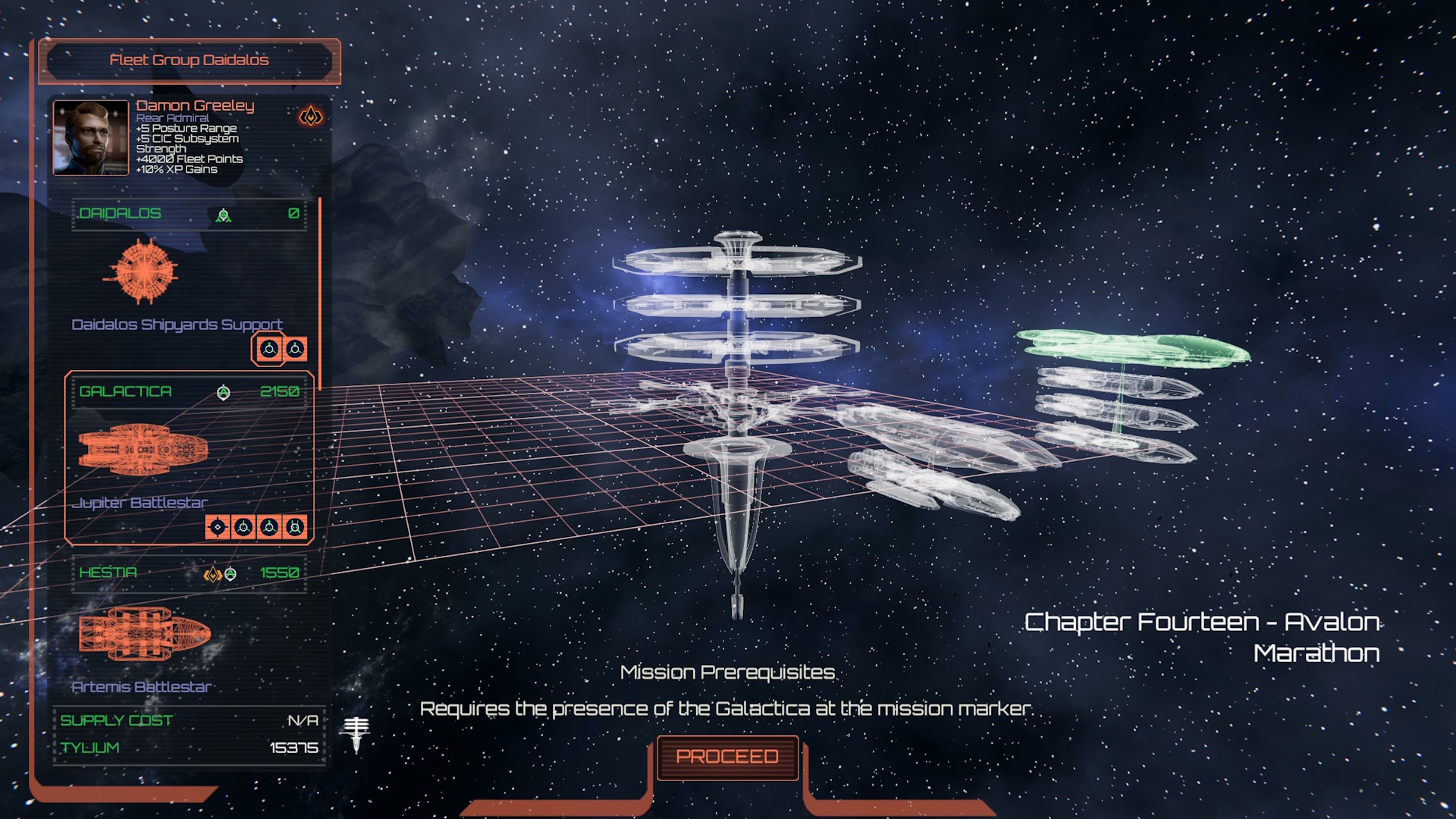
One issue I had is that there isn’t enough ships in just the base game. You’re stuck at maybe one or two classes for the early game and only slowly unlock more. There’s a hard cap of seven ships in a fleet and point value cap that rises depending on the seniority of the commanding officer. This means I frequently had unused points in a fleet because there was no good option that fit. There isn’t even a support ship class at all so the only fleet that gets a support ship is the one with the Daedalus itself. So you can understand how much I wanted the extra ship types from the DLCs. There are also annoying user interface issues. The pre-battle screen to set up your fleet is frustrating to use and you can’t change the direction your ships are facing. It’s a little silly that the main strategic map is implemented as a virtual room but there’s nothing around to look at apart from the map itself.
I probably wasted too much time in the campaign building up too many fleets and beat back the Cylons when I should have just concentrated on the story missions. This soured me a little on the experience. On the whole though I was pleasantly surprised by how very good the tactical ship battles are and no wonder, it was published by Slitherine, well known for its wargames. It’s too bad I never heard about it because it was shut down because I’d surely have bought it along with at least some of the DLCs.