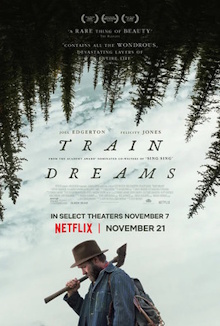
As many have observed, it is immediately obvious that this film was inspired by the work of Terence Malick. The quiet, still shots, the way it highlights the majesty of the nature, even its understated story about the life of an ordinary man are all reminiscent of the grandmaster. That’s admirable and this is fine work. Even so, it never manages to reach the sublime heights that Malick achieved at his best. The dialogue is flat at times and the third-person narration does too much work instead of trusting in the power of images alone to convey what is needed. This appears to only be director Clint Bentley’s second feature film so he’s someone worth watching out for.
An orphan who never knew his parents, Robert Grainier who was in 1886 and spends his entire life in the area around Bonners Ferry, Idaho. He drops out of school early to work, witnesses Chinese Americans being run out of the county and eventually settles into doing logging work. His life is aimless until a young woman, Gladys, introduces herself at the church. They fall in love and are quickly married, building a cabin next to the river to live in. Robert has to periodically leave to earn money during the logging season and misses his family especially after Gladys gives birth to a daughter Katie. On one trip while building the Spokane International Railway he witnesses a Chinese laborer being accosted and thrown to his death. He is unable to do anything to stop it and is thereafter haunted by visions of the man. Finally as he returns home on the train after another season, he is shocked to see that the surrounding forest has caught on fire. He struggles to reach home only to find that his cabin has been destroyed and his wife and daughter missing.
It’s quite a remarkable achievement to sketch out the entire course of a man’s life in less than two hours which is exactly what happens here. To be sure, this is aided by the fact that he is a perfectly ordinary man who is uninvolved in the great events of the day and stays out of any drama. For once however I would have preferred that the film be a little longer. Bentley cuts between shots too quickly instead of having the confidence to let moments linger and sink in. The narration makes for efficient storytelling but is less effective than allowing the images alone to tell the story. I perceive a dichotomy as well in that this is all about an unremarkable life who passes through life unnoticed, yet at the same time there is this omniscient narrator who does notice his life. The lines of dialogue are sparse and often mundane with only the illusion of depth. The overall effect is that it is visibly striving hard to be a Malick film and never quite getting there.
The film plainly wants to tug on your heart strings with the loss of Robert’s family and to me that’s too formulaic to work. Instead I’m more drawn to the portrait of a man who ultimately leaves the Earth after a full life as bewildered about his purpose in life as the day he was born. His family does grant him meaning and happiness for a time but it turns out that this is only a momentary respite. During his lifetime, he witnesses gross injustices, agonizes about the harm he might be causing in chopping down trees that are hundreds of years old, and sees old friends die or lose their minds. Meanwhile the world around him changes from the horse-drawn carts of the 19th-century to the beginning of the era of spaceflight. There’s an existentialist, absurdist theme in this that could have been the core of a deeper film if Bentley had chosen to lean into it.
I am impressed by his work and enjoyed the film well enough. But it’s another film that isn’t as good as it could have been and falls short of greatness. Skimming through information about the novella from which it was adapted from, this might actually be an improvement as the original had perhaps even lesser ambitions. I feel like Bentley has done well in learning Malick’s style but he needs to have something of his own that he wants to say using it.