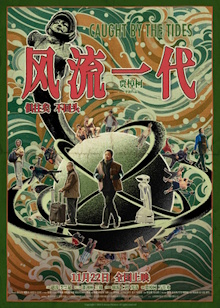
Jia Zhangke’s work hasn’t felt relevant for some time and a new film that recycles footage from his previous work seems even more dubious. This is something Jia can accomplish only because his wife Zhao Tao appears in all of his films so he can edit the old footage into a new story. Yet it surprisingly does work. I don’t care at all for the main story about the couple, but what entranced me is that it’s really also the story of the vast changes China has gone through over the past two decades or so. Returning to the city of Datong in Shanxi province which is Jia’s own hometown in the final sequence is a more powerful statement than what happens to the characters.
This film is divided into three parts with roughly a decade of time separating them. In 2001, Qiao is a young woman in the northern city of Datong, who like many others, attempt to make a living by being a stage performer and model. She becomes romantically entangled with her sleazy manager Bin and is disappointed when he decides to move south for the better opportunities there, promising to fetch her later once he is successful. In the next section, Qiao travels to Fenjie County which is due to be flooded as part of the Three Gorges Dam project in search of Bin who has dropped out of touch with her. There, Bin is working for a corrupt employer who is skimming money from a demolition project. The final sequence takes place during the last days of the COVID-19 pandemic. A much older Bin goes to Zhu Hai in search of work but is flummoxed by the shift to the digital economy. He finally returns to his home town of Datong and there runs into Qiao once more.
Watching this, I realized while the full names may be different, Zhao Tao always plays a character with the personal name of Qiao in Jia’s films and her love interest is always a man named Bin. That’s how this unusual project is even possible. I don’t believe she speaks a single line of dialogue here and intertitles are used to advance the plot. It’s clever even if the couple’s story is clichéd and not that interesting. I’d have liked it better if there were no plot at all, making this sort of a loose documentary. Jia is so skilled and his portrayal so authentic-seeming that even I, who have never been there before, can feel a certain sense of nostalgia for the dusty streets of Datong and the grimy faces of its people. The middle sequence was my least favorite as too many scenes are recognizably recycled from Still Life and the flooding of the county isn’t really on-theme with the couple’s story or the present film as a whole.
Taken together, all three sequences make for a fascinating portrait of how much and how quickly China has changed in a generation. In 2001, we can see the end of the era of state-owned enterprises, leaving the populace to make a living for themselves. Poverty is evident in the grittiness of the environment they live in, but there’s still a kind of Communist-era solidarity. The middle sequence represents the mad scramble for wealth. Cutting corners, corruption, outright extortion and more are all on the table. The existing order is overturned and everything is for sale. By 2022, China is rich, clean and modern. Society is orderly, perhaps excessively so as we can see from the overzealousness in enforcing COVID-era rules. Beginning and ending the film in the same city and even the same spot heightens how much of a difference the 20 odd years have made. Jia is astute enough a director to avoid concluding that the change is necessarily all for the better. All he does is point out how things have changed.
I don’t love every one of Jia’s films but I do this one. He takes what should be a very gimmicky trick and manages to make it work so well one might think he’d planned for this all along. His footage of the previous eras so perfectly capture China as it was that it drives my wife mad as she was there to see part of it at the time. I suspect however that he is less capable of representing the China of the modern era and he might be as bewildered as his characters here. That task will have to be left to a newer generation of directors.