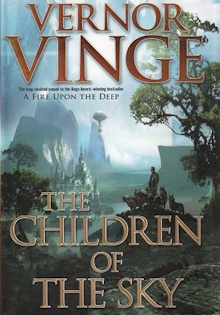
I read Vernor Vinge’s two Zones of Thought novels so long ago that no record of them exists on this blog. They’re fantastically good space opera stories and the fresh ideas in them inspired many other works including the Mass Effect games. The Children of the Sky was a sequel that was published much later and was more of a miss than a hit. It made so little impact that I wasn’t even aware it existed for a long time. I added it to my reading list around the time that Vinge passed away because I wanted to know how the series actually ends. Unfortunately it really is as underwhelming as most make it out to be and doesn’t even feel complete as an ending.
Following the events of A Fire Upon the Deep, Tine’s World remains deep in the Slow Zone. The human Children, woken up from their coldsleep caskets, and their Tinnish allies live in the Domain, jointly ruled by Woodcarver and Ravna Bergsndot. They are slowly raising the technological level of the Domain but Ravna is convinced that the Blighter fleet, though 30 light-years distant, is still a threat. As the Children grow up, Ravna becomes aware that many of them disagree with her. Most believe that she is paranoid and the Blighter fleet, if it is even real, is a far-off threat to be dealt with hundreds of years in the future. Some even believe that the Ravna and Pham Nuwen are the real villains as the Countermeasure destroyed thousands of civilizations and killed trillions. Ravna is ousted from power by the charismatic Nevil Storherte, which causes Johanna Olsndot to call off their engagement. Far outside the Domain, the Tines are modernizing as well. Vendacious provides human technology to Tycoon, the richest businessman on the planet. They manage to communicate with the Choir, the mass of individual Tines in the tropics that in their millions appear to form a hive mind.
The action kicks off immediately on the heels of the ending of the first book without so much as a summary of what happened before. If it’s been a while since you last read it, things get confusing fast. You’re quickly introduced to new characters like Tycoon and his underlings, the Children and their Tinnish best friends. Cultural differences in between the humans due to the fact that the Children are Straumers but Ravna is from Sjandra Kei matter, even though we’ve never really seen either world. It’s honestly perplexing when Ravna is called out for her obsession for her world’s Age of Princesses, something we know nothing about. Much of the book, especially in the first half, is about politicking as Ravna is embroiled in a power struggle without actually realizing it. I tried to be charitable but it is tiresome. Ravna is constantly reacting to events, and doing so with bad information. It’s ridiculous how badly she and Johanna underestimate how evil Nevil and his gang are. It’s just not a very enjoyable read at all. I’d much rather experience the story from the perspective of the characters who are actually doing things, such as Tycoon and his plans in the Tropics.
The novel does present new and thought-provoking ideas. The Tines and how packs of them form a single sapient individual linked by mindsounds has been one of the most original aliens in science-fiction. This book expands on how their society works as their architecture must accommodate the fact that different packs are unable to get too close to one another as their mindsounds interfere with each other. But they can get close to humans, hence the rest of Tinnish-human partnerships. We also get a look at the so-called cuttlefish, which seem intelligent in a parrot-like way. Most intriguing of all is the Choir whose collective mindsounds can shred the minds of any Tine pack who gets too close. So it’s extremely frustrating that we only get a drip-feed of scenes with these new forms of intelligence. It’s Tycoon and Vendacious who figure out how to communicate with both and coordinate with them to create the largest industrial base on the planet. But all of that takes place off-screen as the characters the novel treats as the protagonists are caught totally off-guard by these developments. The prose is for the most part okay but Vinge is failing to write the scenes that actually matter and that readers want to read.
It’s very clear that Vinge intended to continue with the story before he passed away. The plot about the Blighter fleet is left unresolved and I suspect that it will have some connection with the Choir. Many fans have pointed out that Vinge should have used time skips to take us to the interesting parts of the story and I’m inclined to agree. What we get here is a shockingly mediocre novel highlighting a story with low stakes, weak plotting and bad characterization. The only germ of a good point here is that Nevil’s gaslighting of Ravna can be likened to the contemporary rise of Trump in the US. Yet even here the novel offers no clear response to misinformation and hate mongering so the protagonists win only through luck. It’s an unsatisfying novel that is unworthy of Vinge and should never have been published.