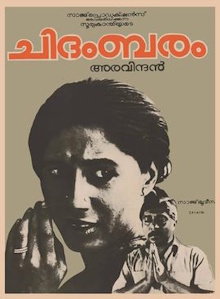
This is the first film I’ve watched by G. Aravindan who is a filmmaker of note in Malayalam cinema. The title refers to a town in India that is apparently famous for its temple. The imposing structure naturally makes an appearance and the film also features the region’s beauty. Unfortunately the imagery and even the sound are poor in quality, as if the film were much older than something made in the 1980s. Worst of all, I struggled to make sense of what the film wants to say despite the simple plot until I realized that it must be interpreted through a Hindu lens. I did not like that set of conclusions at all.
Muniyandi, a menial worker who tends the cows on a vast farm, asks for leave and money from the superintendent Shankaran. The latter agrees and casually has a drink with him despite the difference in status. The farm supervisor Jacob is more reticent and demands that Muniyandi return to work soon. Shankaran whose hobby is photography even travels to their village to take photos of the ceremony. The bride Shivakami arrives to live with Muniyandi at his quarters and proves to be a timid yet beautiful woman. With little to do at home, she explores the lush surroundings and loves the beautiful flowers in the garden. Muniyandi admonishes her, saying that the garden is not her place and discourages her from taking up a job at the farm. One day she comes across Shankaran and allows him to take photos of her despite her shyness. She later goes to him again when she needs help to write a letter back home and he offers to teach her English. It soon becomes clear that Shankaran is developing inappropriate feelings for her when he reacts violently to a passing remark by Jacob about her integrity.
The beauty of the farm and its surroundings are plain to see even if the quality of the photography here isn’t the best. There’s value too in the scenes of how they live and how the farm is run. The plot is so simple that there barely seems to be any story at all for a good long while. In fact I misread the director’s intention in thinking that the film is about Muniyandi and Shivakami when in fact it is entirely about Shankaran. There are copious hints of an affair between Shankaran and Shivakami but the film frustratingly refuses to show any actual impropriety. Strangely, we don’t even get a confirmation that she takes up Shankaran’s offer of lessons. When the crash comes, it’s a real shock given this barely visible build-up. Before this point, the film feels like a melodrama as Shivakami is unrealistically innocent and shy what with the exaggerated shots of her practically smearing her face with flowers. After that it seems to transform into a different film as Shankaran falls into a drunken stupor as he grapples with the consequences of what has happened. It becomes a more serious film then but the lessons it wants to impart is abominable.
Variations of this story have existed since time immemorial. Almost always however, they would cast Shankaran in the role of the villain while the hero and the heroine would be Muniyandi and Shivakami. Here Shankaran is the protagonist and the story is about his fall and eventual redemption. Muniyandi’s fate is callously unimportant. The only way this makes sense is that the film is trying to impart a very Hindu lesson. It was wrong of Shankaran to cross caste and class boundaries by trying to be friends with the couple. It was wrong of Shivakami to explore the garden on her own instead of staying at home as instructed by her husband and to casually accept aid from Shankaran. Jacob comes across as something of an asshole but his behavior is correct insofar as the precepts of Hinduism are concerned. The tragedy then is caused by both Shankaran and Shivakami failing to behave as they should. What’s worse is that Shankaran does eventually achieve redemption by repenting and praying in the temple. Shivakami does not and seemingly has to suffer the consequences throughout her life.
To most of us, this moral lens is abominable and impossible to accept. I must concede that someone who is always curious about art presenting alternative perspectives, this surely counts as something unexpected and different. Maybe if the cinematography were better or the setup less melodramatic, I’d think more highly of this film. But as it is, I found this to be too difficult a pill to swallow.