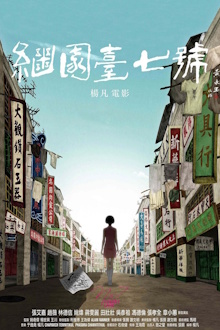
I can’t believe I’ve lived this long and call myself a cineaste and yet have never watched a single work by Yonfan. It’s strange too to think that it is this animated film that is my introduction to his filmography. Almost immediately upon watching this, I was struck by its almost comically languid pace and highly stylized visuals. This, I thought, is the work of an incredibly confident director who knows exactly what he wants. It’s a sumptuous and sensuous vision of Hong Kong in the 1960s and a fantastic nostalgia trip. The story starts promisingly but then veers into a bit of an odd direction. That doesn’t matter too much fortunately as No. 7 Cherry Lane is all about its atmosphere.
In the 1960s, Hong Kong is a bustling and cosmopolitan port city and yet still retains extensive forested areas. Fang Ziming is a student at the prestigious Hong Kong University in its Foreign Languages department. Tall, fit and good-looking, he draws attention from men and women alike. One day after playing tennis with his friends, he walks to the apartment at No. 7 Cherry Lane where he has been engaged to tutor a high school student in English. At first, he mistakenly goes to the wrong floor and has a strange encounter with a retired opera performer. When he arrives at the right apartment, he meets Mrs. Yu who welcomes him and apologizes for her daughter Meiling being late. Mrs. Yu is a single mother who was originally from Taiwan and runs an import-export business. Over tea, they have a conversation about the books they like, with Ziming describing his favorite book Proust’s In Search of Lost Time as similar to Dream of the Red Chamber. The two are seemingly attracted to each other despite the age disparity. Even as Ziming tutors Meiling in English, he starts inviting Mrs. Yu out to the cinema with him. He chooses films starring the French actress Simone Signoret and many have the theme of an older woman being in a romantic relationship with a younger man. This plays out against the backdrop of protests against the British administration.
By their very nature, animated films have more scope to differentiate themselves in how they look. Even so, this film looks and feels so unique that I can think of nothing remotely comparable. All of the characters move and speak at such a slow pace that it feels frustrating at first. Paradoxically animals move at a normal speed to show that this is deliberate choice to remind us that the pace of life in Hong Kong back then was slower. There’s so much greenery that you wonder if this is Hong Kong at all. Then we also have shots that are so characteristic of the port city: women in elegant cheongsams hurrying down steps, banyan roots embedded in stone retaining walls, the junks and modern ships filling the harbor etc. The pace is so slow that it ought to be boring yet it never is because everything is so dense with detail. Combined with the wonderfully chosen period music, the effect is pure nostalgia magic. Also shocking is how sensuous, even lewd Yonfan’s vision is. The camera joyfully sexualizes both male and female bodies. The nudity is so graphic this might scare off Westerners. Many scenes ooze with sexual tension. It feels deliciously profane and artistically bold, the work of a director who doesn’t care what anyone else thinks.
The May December romance isn’t subtle at all. Ziming is really overdoing it by taking Mrs. Yu to watch similarly themed films, capping it off with The Graduate. Watching the prim and proper Mrs. Yu come undone is probably the most erotic scene I’ve seen in a while. Yet the story goes nowhere from there. Ziming is less a real person than a living Adonis, so perfect that every man and woman is instantly smitten by him. By having even Meiling fall for him, Yonfan corners the plot into hole from which there is no honorable escape except pure fantasy. It’s possible that there are references that I’d missed. I don’t understand the point of the character Bookworm for example. They might have done more with the protests going on in the background but Ziming doesn’t even participate in it and seemingly has no reactions to it. This film really is more about the setting and the feeling of being immersed in the Hong Kong of that era.
Ziming being such an empty shell of a character and there being no real story are real faults. But I’m more than happy to look past them as this is such a unique, wonderfully idiosyncratic film. It’s truly an animated film made for adults as I doubt this vision could have been realized in live-action. It’s vibrant, creative and so alive. There’s a special frisson when hearing the characters talk about Et Dieu… créa la femme in contemporary terms because it is new to them at the time. Watching this prompted me to add several of the films featured here onto my watch list, a sure sign of how much I enjoyed this.