I read with some amusement today’s article in The Malaysian Insider on plans by the Royal Bank of Scotland to target rich women in Singapore as clients for its private banking arm. Granted, I’ll never have enough money to even be considered as a client for a private bank, so I’m open to charges of writing out of spite and envy, but in general, my impression is that private banking is getting a lot of bad press at the moment.
What makes a game fun?
As someone who has been a gamer since I first laid hands on the original IBM Personal Computer in primary school, the question of what actually makes a game “fun” is something that I often ponder. This recently popped on QT3 as a loosely related tangent in a discussion on whether or not gaming can be an addiction. One particular poster made an observation so insightful that I simply need to put it here:
What games actually do, imho, is give you sheer, unadulterated happiness.
How? The reason is simple. A psychologist called Mihaly Czikzhentmihalyi (sp?) discovered (I think in the 60s and 70s) through extensive questionnaires with statistically quite large samples, the secret of ordinary human happiness, and it’s laughably simple – basically, if you go through life setting measurable goals that are just outside your comfort zone to attain, and then attain those goals, and then move on to pick a new, slightly higher-level goal, etc., etc., etc., you will be happy.
It’s exactly this progression of increasing powers and ever-increasingly-difficult goals that games give you in a miniature, abstract form, and that make them so addictive – little jags of happiness as you set and attain mini-goals, constantly excelling yourself in skill, the attainment of lewt, the discovery of new stuff, etc., etc.
Of course, theoretically, we should all be getting that kind of happiness in real life, through our careers, family, etc., and most of us probably do, but sometimes life isn’t so forthcoming, things are difficult, and it’s nice to have a happiness-producing substitute.
In a response to a question from me, he posted a link to Wikipedia about the research he cited which is here. Pretty interesting stuff, no? I hope to expand on this later.
A Game: Empire Total War
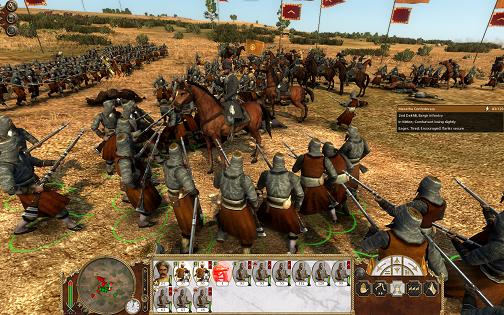
In a way, Empire is what Creative Assembly’s Total War series has always been building towards. Epic doesn’t even begin to describe its scope. Three distinct theatres, a dizzying multitude of major and minor factions, a greatly expanded strategic layer involving tech trees and multiple towns in each region, the ability to play naval battles in real-time mode for the first time and last but far from least, a spiffy new graphics engine so detailed and shiny that you can see the guns and buttons of your each of your soldiers gleaming in full HDR bloom.
Empire covers a relatively thin slice of history, but what glorious history it is! The French and American Revolutions, the rise of gunpowder and the apogee of the Age of Sail, the Age of Enlightenment and the beginnings of the globalized world. No one is ever going to mistake the Total War series as a replacement for a real history textbook, but this is as close as you’re going to get in a mass market video game. Total War fans already know the drill, but here it is anyway for those who have managed to miss out on it for the past 10 years.
Awesome collection of Michael Jackson’s possessions
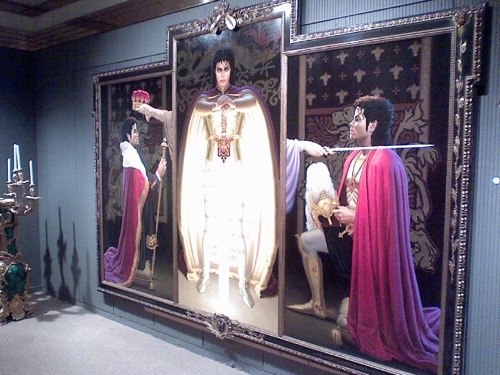
Everyone knows that Michael Jackson is crazy by now, but just how far his craziness extends can be seen in this collection of his possessions that was put for auction. Now we know what he spent his vast fortune on. This seriously has to be seen to be believed. It’s clear from all this that Jackson’s affection for fairy tales and all things child-like isn’t an act, but it just makes me feel pity for him. Also, probably a very good example of someone who literally had more money than he knew what to do with, and spent it on satisfying every little whim, no matter how frivolous or expensive.
The auction has now been cancelled, but as one commentator noted, that’s probably a good thing because otherwise all of this stuff will become scattered amongst many collectors, never to be seen in one place again.
Jackie Chan joins in the anti-democracy bandwagon
Just a bit of news that popped up over the weekend:
Action star Jackie Chan said Saturday he’s not sure if a free society is a good thing for China and that he’s starting to think “we Chinese need to be controlled.”
Chan’s comments drew applause from a predominantly Chinese audience of business leaders in China’s southern island province of Hainan.
The 55-year-old Hong Kong actor was participating in a panel at the annual Boao Forum when he was asked to discuss censorship and restrictions on filmmakers in China. He expanded his comments to include society.
“I’m not sure if it’s good to have freedom or not,” Chan said. “I’m really confused now. If you’re too free, you’re like the way Hong Kong is now. It’s very chaotic. Taiwan is also chaotic.”
Chan added: “I’m gradually beginning to feel that we Chinese need to be controlled. If we’re not being controlled, we’ll just do what we want.”
And of course the predictable backlash from Hong Kong and Taiwan:
“He’s insulted the Chinese people. Chinese people aren’t pets,” Hong Kong pro-democracy legislator Leung Kwok-hung told The Associated Press. “Chinese society needs a democratic system to protect human rights and rule of law.”
Another lawmaker, Albert Ho, called the comments “racist,” adding: “People around the world are running their own countries. Why can’t Chinese do the same?”
…
In democratically self-ruled Taiwan, which split from mainland China during a civil war in 1949, legislator Huang Wei-che said Chan himself “has enjoyed freedom and democracy and has reaped the economic benefits of capitalism. But he has yet to grasp the true meaning of freedom and democracy.”
My wife’s first reaction was to say that he’s an uneducated idiot prone to make shallow comments. Someone on QT3 commented that he’s actually illiterate and needs people to read his scripts to him, but I don’t know how true that it. Anyway it’s clear enough that he’s an airhead who only gets attention due to the gigantic soapbox he gets from his superstardom, but I still wish someone famous from the Chinese entertainment world would be brave enough to speak out on behalf of democracy and freedom.
Index funds in Malaysia
Since I got into, well, not exactly an argument, but at least a rather heated discussion over this topic on the LYN forums, I thought it might be interesting to write down a summary of my posts there and also what I’ve learned from that thread. Please note that all of this mostly applies only to Malaysia.
Now I’m just a neophyte investor and I don’t make any claims to exceptional knowledge or skill. But I do take care to read through the basics and try to educate myself in whatever it is I’m getting into. One of the most basic and well known ways to invest your money is through the stock market. You can either do it yourself, picking stocks that you personally believe will do well and pray, or you can entrust it to “professional” mutual fund managers and pray. I’m guessing that most working people don’t have the time or inclination to actually do their own research and will opt for the latter. That’s what I did and this is where things get interesting.
A Book: Incandescence
As for every human born since the Stone Age, as for the ancestors of every member of the Amalgam, there was nothing the universe was capable of doing that the Arkdwellers were not capable of comprehending. They were not mere clever-looking animals, with some hard-wired repertoire of impressive but inextensible skills. With sufficient motivation and freedom from distractions – and perhaps a modest boost in longevity – they could have grasped anything. Apart from the subjectivities of art or language, where everyone needed tweaking to cross the species barriers, there was nothing in the Amalgam’s million-year-old storehouse of knowledge that would have been beyond their reach. That was the ability, the potential in every one of them. There was, however, no drive to realize it: no curiosity, no joy in discovery, no restlessness, no dissatisfaction.
– Greg Egan in Incandescence
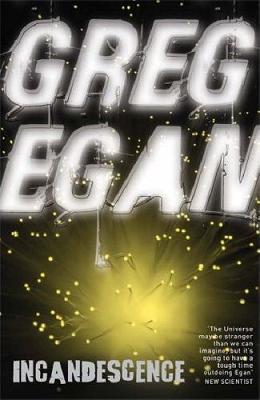
(After thinking about it for a while, I’ve decided to write a discussion of the novel rather than a review. There are already plenty of reviews on it available on the net, most of them probably better than anything I would be able to come up with. For a favourable review, check this out. For a dissenting opinion, read this and maybe Egan’s rather fierce rebuttal to same.)
Cracking open a new Greg Egan novel is always a momentous occasion for me and since Incandescence is the author’s first new novel in six years, you can imagine how great the anticipation must have been. At the end of it however, I’m left with mixed feelings. On the one hand, I can recognize the tremendous amount of work that must have gone into it and on a purely intellectual level, can’t help but be impressed by it. On the other hand, with not much to go on in the way of plot or characters, I had a hard time being emotionally engaged in the book. In that sense, it may be a work of fiction, but it’s more of an extended thought experiment than a novel.