Be careful when using percentages

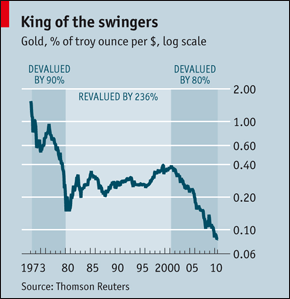
The above chart caught my eye while I was reading through an issue of The Economist. The article is available online here. It basically shows how much gold a US dollar can buy from 1973 to 2010 and uses this as a measure of the dollar’s devaluation. In 1973, we can see that one US dollar could buy slightly less than 2 troy ounces of gold while in 2010, a US dollar can buy less than 0.10 troy ounces of the stuff.

What’s interesting is that the chart is that it also divides the period of time under study into three separate phases and gives a percentage for the change of value in each period. So it notes that the US dollar was devalued by 90% from 1973 to 1980, that it was revalued by 236% from 1980 to 2000, and devalued again by 80% from 2000 to 2010.

The chart is impeccably correct of course, but intuitively if someone told you that something went down in value by 90%, then shot up 236% and then went down 80% again, would you understand that its current value is now about one twentieth of the original? Unless you took the trouble to actually work the maths out, I think most people would be surprised by the actual results.

Anyway, this isn’t really apropos of anything, but since investment returns tend to be stated in percentage terms, I thought it would be a good idea to demonstrate how important it is to actually chart out the real values instead of relying on percentages and using guesstimates. This also demonstrates how valuable a good chart is to help people understand what’s really going on.

Recent Interesting Science Articles (Jul ’10)

Four articles this month and it’s a pretty mixed bag. The most controversial article of the bunch is one that links autism with wealth, but the one drawing a link between human intelligence and disease rates in different countries comes a close second. Then, there’s the highly speculative paper that offers a new model of the universe that abandons the familiar Big Bang. Finally, just for fun, there’s one article talking about a cheap and effective way of deterring thieves from stealing your car.

Autism, disease of the rich?

The precise causes of autism is as yet unclear and it doesn’t help matters that there’s a major anti-intellectual movement that attempts to link the disease to vaccination. This post on Neuroskeptic points out that autism appears to be more common in rich countries than poor ones, which is odd, but might be explained by the fact that many cases of autism in poor countries might simply be undiagnosed. A new paper however attempts to correct for this ascertainment bias and it discovered that not only were incidences of autism more common in richer countries, they were also more common among richer people in rich countries, independent of ethnicity.

Continue reading Recent Interesting Science Articles (Jul ’10)

Inception is a disappointment

As usual, I don’t write film reviews, only critiques and analyses, so get the hell away from this post if you have yet to watch this film. Come back only after you’ve done so.

Anyone who reads this blog should know that Christopher Nolan is easily my favorite director and that I eagerly look forward to every film that he makes. This has been true ever since I first discovered Memento. Since then, I’ve watched every one of his films, except for The Following, which I understand is sort of a student film made on a shoestring budget. With the sole exception of Insomnia, which, being an adaptation of a Norwegian film, is competent but otherwise unremarkable, all have been stellar.

Continue reading Inception is a disappointment

Can you parallel park this well?

It’s been a while since I last posted a YouTube video as a post and since I’m busy at work today, here’s a video showing how well a modern computer equipped with suitable sensors can parallel park a car. Note that there’s a human driver in the car but he’s just there for safety reasons and is not driving the car in the maneuver shown in the video. Certainly few human drivers will be able to pull this off.

Originally seen on Marginal Revolution.

Inheritance taxes

This is something that I’ve touched on before, but I recently got involved in an extended discussion on the subject on the LYN, so I’ll post a summary here. To me, the argument in favor of inheritance taxes is painfully obvious. Unless you’re a tax-hating anarcho-capitalist, in which case I invite you to move to Somalia, everyone agrees that every country needs to raise taxes somehow to function. And for the sake of fairness, it is a given that taxes should be progressive. This not only means that folks who are better off needs to pay more taxes as an absolute figure, but that they need to pay more as a proportion of their total income and wealth.

This means that inheritance taxes need to be a part of any reasonable tax system as they’re probably the most progressive form of tax possible. True, you can make income taxes highly progressive by vastly increasing the marginal tax rates for the highest income tiers, but economists generally agree that this is inadvisable that extremely high income tax rates create a disincentive to work. Inheritance taxes have similar effects, but to a much lesser degree than income taxes. Given all this, what are the objections to them. The following is directly from one my posts on LYN:

Continue reading Inheritance taxes

Recent Interesting Science Articles (June ’10)

Four articles this month. Three of them are about humans the last one, about giraffes, is just something I threw in for fun. The three articles about people deal respectively with yet another mooted cause for schizophrenia, how our sense of touch affects our judgment and an unconventional, but very intuitive, way of determining whether or not someone is lying.

Schizophrenia

The first article is from The Economist and deliberately evokes a scenario that could have come right out of Invasion of the Body Snatchers. There have been many different causes mooted for schizophrenia over the years and some of the theories I’ve read even include pathogens. But this is the first time I’ve heard that it’s caused by one that explicitly causes behavioral changes in its host to ensure its own propagation.

Continue reading Recent Interesting Science Articles (June ’10)

More corruption in the Catholic church

If Pope Benedict XVI has been praying for a break from the endless criticisms against the Catholic church, it looks like he’s out of luck. Today’s news is about his statement condemning what he calls the deplorable actions of Belgian police who raided a cathedral in the country as part of their ongoing investigations on sexual abuse by Catholic priests. What’s especially shocking about this statement is his insistence that the Catholic church be allowed autonomy to investigate the sexual abuse allegations on their own.

So far, so bad but there’s nothing particularly new in all this. What’s more interesting is this extended expose published last week in Der Spiegel about a more conventional kind of corruption in the church’s organization in Germany. From the article:

The Catholic Church in Germany, already struggling to cope with the sex abuse scandal, has been hit by revelations of theft, opaque accounting and extravagance. While the grassroots faithful are being forced to make cutbacks, some bishops enjoy the trappings of the church’s considerable hidden wealth.

Shortly before Pentecost, Pastor S. received an unexpected early morning visit, not from the Holy Ghost, but from the police.

For the authorities, the words of the Gospel of Luke came true on that morning: He who seeks finds. More than €131,000 ($158,000) were hidden in various places in the rooms of the Catholic priest, tucked in between his laundry or attached to the bottom of drawers. The reverend was arrested on the spot. After several weeks in custody, Hans S., 76, is now back at the monastery, waiting for his trial.

And lo and behold, the proliferation of cash may have been even more miraculous than initially assumed. The public prosecutor’s office in the southern city of Würzburg now estimates that S. may have embezzled up to €1.5 million from collections and other church funds. The members of his flock in a wine-growing village in the northern Bavarian region of Franconia are stunned. They had blindly trusted their shepherd, who always seemed so humble and modest.

The Catholic Church is currently being shaken by a number of financial scandals, not only in Franconia but also in Augsburg, another Bavarian city, where Bishop Walter Mixa’s dip into funds from a foundation that runs children’s homes recently made headlines.

More than €40 million have gone missing in the Diocese of Magdeburg in eastern Germany, €5 million have disappeared in Limburg near Frankfurt, and it was recently discovered that a senior priest in the Diocese of Münster had 30 secret bank accounts. And while parishes throughout Germany are cutting jobs and funds for community work, many bishops are still living on the high horse. A brand-new residence? An ostentatious home for their retirement? Restoration of a Marian column to the tune of €120,000? None of these expenditures presents a problem to high-ranking church officials from Trier in the west to Passau in the southeastern corner of Bavaria, whose coffers are brimming with cash.

The behavior of the church is this regard is precisely the same as what one would expect to see from corrupt government officials: insistence that church accounts are secret and spending is totally at the discretion of church officials, refusal to open up the books to independent auditors, extravagant spending on residences for clerics while maintaining that all this is for the good of the church and even keeping large sums of money in cash instead of in a bank account. As the article notes, all this is made even more painful as the parishioners who actually use the church’s services face austerity cutbacks.

Extra chuckles at how the church continues to benefit from such frivolities as free firewood and altar wine due to centuries-old treaties between the church and the state that lawmakers in Germany never bothered to review and probably know nothing about.
The unexamined life is a life not worth living