Recent Interesting Science Articles (October 2012)

A mixed bag of articles for this month, ranging from the funny to the weird. Let’s get to it.

  •  Regenerative medicine, or growing replacement body parts from one’s own cells, will be the next frontier of medicine. This article from the admittedly skanky Global Post site demonstrates that it has the potential to covers external organs as well as the more commonly considered example of internal organs. In this instance, a woman had a replacement ear grown on her arm as a substitute for the original one which was removed due to cancer. The new ear was fashioned using cartilage from her rib.
  • The next article from the Wall Street Journal covers a paper that is cleverly titled “The Power of Kawaii”. The claim is that human test subjects perform assigned with greater care and precision after being exposed to pictures of cute things, such as puppies and kittens. The tasks ranged from the delicate, such as picking up small objects from a hole without brushing the sides, to the purely logical, such as finding a target from a sequence of random numbers. As a control, participants were also exposed to pictures of adult dogs and cats and food items, which did not result in the same improved performance.
  • As this next article from The Economist states, we’ve found so many extrasolar planets now that they’re no longer exciting. The difference with this one is that it’s orbiting Alpha Centauri B, one of the three gravitationally bound stars that form the trinary Alpha Centauri system. This is the nearest system from our own Sol system at a mere four light-years, close enough that we could conceivably launch an expeditionary probe to it. The bad news is that it is located far too close to its parent star to have any chance of harboring life with one of its “years” lasting 3.2 Earth days. But where we’ve found one planet, we’re more likely to find more. You can bet that astronomers all around the world are feverishly working on it.
  • Ever wonder if animals are capable of recognizing their own dead and responding to it? This post at the The Scorpion and the Frog blog talks about a research paper on just this topic. The animals in question are western scrub-jays and the researchers tested their responses towards both an actual scrub-jay carcass, complete with feathers, and a collection of painted wood pieces arranged vaguely to look like a dead scrub-jay. The live birds reacted furiously to the real carcass, hopping about and calling loudly, while taking far fewer peanuts strewn on the ground as usual. Testing further with a realistic mounted great horned owl, a predator of scrub-jays, led to similar reactions, leading the scientists to conclude that the reaction wasn’t about grief but about alarm and physical danger.
  • Finally, here’s a longer article about the evolution of lactose intolerance in humans from Slate. It’s not about a specific new discovery, more of an overview of the subject. Apparently the ability to digest lactose in adult humans spread very quickly once the mutation occurred, unreasonably quickly according to most scientists, and the reason why is still something of a mystery.

Nobel Prizes 2012

Oops, almost forgot to do this feature. Every year I try to highlight the results of the Nobel Prizes that actually matter and aren’t completely spurious. I mean I guarantee that everyone in the Chinese-speaking world knows who won the literature prize and plenty of people who read the news are aware that the Peace Prize committee are keeping up their reputation for bizarre choices by picking the European Union. But how many people know who won the prizes for medicine, physics, chemistry and economics or what the discoveries were for? So that’s what this blog post is all about.

First up, the physics prize was won by Serge Haroche of the Collège de France, in Paris, and David Wineland of America’s National Institute of Standards and Technology. The two independently invented methods of directly observing quantum systems without destroying their superposition of states. Interestingly, they used opposite strategies. Dr. Wineland trapped ions and used photons to control and measure them. Dr. Haroche trapped photons and sent atoms through the trap to measure them. Both are real-life examples of the famous Schrödinger’s cat thought experiment, though on a far smaller macroscopic scale.

Continue reading Nobel Prizes 2012

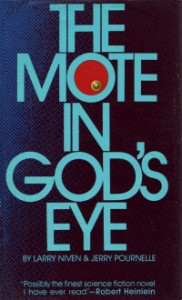
The Mote in God’s Eye

The Mote in God’s Eye is yet another book that I’ve been meaning to read for a long time. It’s co-authored by Larry Niven of Ringworld fame and is considered one of the finest examples in the sub-genre of alien first contact stories. I’ve been actively looking for stories of this type ever since I read Peter Watts’ Blindsight earlier this year. For the most part, it holds up surprisingly well for a book originally published in 1975 and the alien species at its center compares favorably even against the strangeness of today’s science-fiction.

The most dated aspect of the novel is the banality of its vision for the human civilization of the future. It basically amounts to aristocratic feudalism in space, with absolute loyalty to an emperor justified on the grounds that human unity must be upheld at all costs because of the horrific devastation interplanetary warfare can cause. To modern eyes, the novel’s glorification of military service looks positively quaint. Here the good guys are invariably the noble and hard-headed soldiers while the bad guys are the civilians, whether businessmen who are out to make a quick buck at the expense of humanity as a whole, or bleeding heart civilian scientists who are woefully naive about the harsh realities of survival.

Continue reading The Mote in God’s Eye

End of Introduction to Finance class by Kaul

I thought I should write a note on this course offered by the Ross Business School of the University of Michigan on the Coursera platform that also ended last week. It’s a ten-week course that I enrolled in out of a slight interest I have in the subject, due to my passing knowledge in accounting and economics.

As with Algorithms 1, I learned a great deal but the quality of this course is markedly lower. Most notably, there was a complete lack of instructor presence and oversight on the official forums. This lack of feedback left many students frustrated and encouraged students to freely discuss and share solutions to assignments with each other. With no moderators to rein in behavior, this left the forums a chaotic mess.

The problem was also exacerbated by the limited pool of questions available in the exercises. For these reasons despite that the fact that this course offers a certificate and Algorithms 1 doesn’t, I’d put more stock in the integrity of the grades in the latter. And yes, this even takes into account the fact that the final exam for the Finance course is timed while the one for Algorithms isn’t.

One excuse is that the enrollment for the Finance class was much, much higher than that for Algorithms, so much so that Professor Gautam Kaul might have been discouraged from the start from being able to intervene in any meaningful fashion in the forums. I believe that there were over 50k students in the class. But I also suspect that quality of the forums was also degraded by the fact that many students were motivated primarily by the offer of a certificate rather than the love of learning. I found the many posts in the forums begging the professor to let them have the certificate despite failing the final to be ridiculous and in extremely poor taste.

Finally, while finance is in many ways more practical than algorithms, after all I hold significant investments but don’t make any money from writing programs, I can’t help but feel that it is less relevant. Despite all that I’ve learned, I still can’t see how the models apply to the real world, given that the models are supposed to work only in an ideal environment (perfect market, frictionless transactions, no taxes etc.) It’s all very interesting in a theoretical sense, but I can’t help feeling that it’s all a bit bunk and that academic finance, at least at this introductory level, is pretty much useless in a real world context. I think I’ll stick to the computer courses from here on out.

Recent Interesting Science Articles (September 2012)

A little bit of everything this month and no less than five articles, so let’s get to it.

  •  You’ve probably heard about scientists making robots based on insects and small animals as models. This article with links and accompanying video is all about skipping the robot part and taking direct control of a live cockroach to perform tasks. It’s wireless too. I guess cockroaches are okay for this but I predict serious ethical concerns if they scale it up to larger animals.
  • The next article comes with the predictable still image from Planet of the Apes. It’s about scientists who trained a bunch of monkeys in a simple pattern matching exercise. They then selectively impaired the monkeys’ performance with cocaine and used a brain implant to restore their original performance. When this worked, they also tested the implant without the influence of cocaine and found improved performance beyond the original baseline. They’re lauding it as a primitive sort of implant to boost cognition, but I’m skeptical. The implant seems tailor designed just to stimulate the right parts of the brain needed for that specific part. It’s hard to see it as an device that can be generalized.
  • This one is even more deserving of skepticism, being firmly in the realm of pure theory, but it is all about a plausible way to create faster than light warp drives, so that’s enough to get it featured here. In principle, one way to cheat around the light speed limit would be not to move objects faster than light through spacetime, but to alter the geometry of spacetime itself around the objects we want to move. This is the famous warp bubble that we know of all the way back from Star Trek. But even apart from not knowing how to generate them, scientists have long calculated that the energy costs involved would be impossibly high. This latest finding claims that altering the shape of the ring around the spacecraft that generates the bubble would bring the energy costs down to a manageable level and allowing the intensity of the warping effect to oscillate would make it cheaper still.
  • So surgeons can transplant just about anything these days. The latest record broken is the transplant of the uterus from a mother to her daughter by a team of Swedish doctors to allow the recipient to become pregnant.
  • Finally a link to a research paper whose results any male could confirm for you for free. The Dutch team found that not only is the cognitive performance of heterosexual men impaired after an interaction with someone of the opposite sex, but mere anticipation of such interaction is sufficient to make males dumber. Furthermore these effects occur even when the males have no idea whether or not the women they believe they will be interacting with are physically attractive.

The Book of the New Sun

The Book of the New Sun is the insanely praised magnum opus of Gene Wolfe. It’s so well reviewed that it’s been called science-fiction’s Ulysses. Since the people praising it are fellow writers like Ursula K. Le Guin, George R.R. Martin and Alastair Reynolds, any serious science-fiction fan had better sit up and pay attention. The tetralogy is also notoriously difficult to make sense of, so much so that there are published analyses of its deeper meanings and themes, such as Michael Andre-Druissi’s Lexicon Urthus.

I found a copy of the hardcover Gollancz 50 edition of the first volume, comprising the first two books The Shadow of the Torturer and The Claw of the Conciliator in a local bookstore and promptly bought it, knowing it to be one of the classics of SF that I never got around to reading. Unfortunately the second volume, comprising the books The Sword of the Lictor and The Citadel of the Autarch doesn’t yet exist in that edition, and I ended up ordering a paperback copy online. That was many months ago. Yes, it took me that long to finish the series to my satisfaction.

Continue reading The Book of the New Sun

End of Algorithms 1 class by Sedgewick and Wayne

So the Algorithms 1 class by Professors Robert Sedgewick and Kevin Wayne of Princeton on the Coursera platform just ended. I just made my second of three attempts on the final exam, scoring 18.31 / 20.00. I may yet make another attempt next week as everything officially closes only on 30 September 2012. It’s been an amazing experience and I learned way more than I expected. Some thoughts:

  • I found that I’m pretty strong on practical programming. I could complete all of the programming assignments with not much trouble, and ended up spending a fair amount of time on the forums helping others out with their programs too. I only struggled somewhat when implementing the optional extra optimizations that the professors suggested which are not graded. This mostly involved doing the same thing with half the memory or less, or cutting running time down drastically. For example, the toughest timing trial of the collinear points assignment gave you a maximum of 10 seconds to solve the problem. My first attempt came in at just under 7 seconds, and after much agonizing I got it down to just under 3 seconds. The very best students were able to get it down to just under 2 seconds.
  • However I am terrible on the theory. I blame that on a lack of solid grounding in mathematics. I really suck at calculating things like the order of growth of running time for different algorithms or the minimum and maximum heights of different tree-like data structures. This calls for a good grasp of discrete mathematics. I’m also bad at internalizing geometrical principles, so assignments like collinear points gave me more trouble than the supposedly more sophisticated A* algorithm we used to solve the 15-puzzle. I’m currently signed up for Sedgewick’s Analytic Combinatorics class which runs next year but I’ll probably flunk that one.
  • This class really thought me how beautiful some algorithms are and how you can achieve so much in just a few lines of code. At heart, they’re all about pure logic so it’s possible to even describe them to people with no programming knowledge whatsoever. I also think I finally managed to get the hang of recursive functions while doing the Kd-Tree assignment. I’ve always had trouble visualizing them before.
  • I also learned how very limited even the powerful computers we have available to us today are. As a science-fiction fan, I’ve always taken it for granted that one day, perhaps sooner than we expect, we’ll be able to simulate sentient minds and even whole worlds inside computers. Unfortunately, even the lowly 15-puzzle is enough to make modern computers struggle. It’s pretty humbling. As Sedgewick likes to emphasize, while we can always look forward to ever faster computers in the future, it is even more certain that the size of the problems we need to solve in the future will grow faster than our computers will become more powerful. As we can’t rely on ever more powerful computers to do the work, we must instead design ever more clever algorithms.

Anyway, Algorithms II starts up in November so I’ll be back at it pretty soon. In the meantime, I should have a little extra free time.

The unexamined life is a life not worth living