What was Saddam thinking?

One of my personal habits is that I like to know how other people think. It’s not even the decision or idea itself that is necessarily interesting. What I’m constantly curious about is the chain of thought that led to a specific decision beginning from the person’s basic assumptions and observations to the step-by-step logic that they perform based on those assumptions. Most of the time, I end up being disappointed because people mostly do not make decisions through a conscious, deliberative process but act impulsively or instinctively instead.

Some of the most puzzling decisions on the world stage in recent history have been made by the late Saddam Hussein of Iraq. Why did he send contradictory signals over whether or not he actually possessed Weapons of Mass Destruction (WMDs)? Why was he so stubborn in not allowing weapons inspectors full access to Iraq when in fact he had no WMDs? Why did he even choose to invade Kuwait in the early 90s? This blog post answers some of these questions and illuminates some of the thought processes that were going on inside the dictator’s head.

For example, it turned out that he was so nonchalant about the prospect of being invaded by the U.S. because he believed that he had won against the U.S. and its allies in the First Gulf War. His reasoning was that the coalition of over 30 countries had tried to overthrow him in 1991 but he survived, therefore he had won and if the U.S. wanted to try again, history would just repeat itself. In reality, the U.S. deliberately left his regime in place because George Bush Sr. feared the chaos that deposing him would unleash.

Another example showing how out of sync with reality he was: he had WMDs in 1991 but was afraid to use them because he believed that if he did, the U.S. would unleash its own chemical weapons on Iraq. In 2003 he did not have WMDs but didn’t want to admit that because he was more afraid of an internal coup than of an invasion by foreign forces. The blog post is full of more examples of such convoluted thinking.

Once again, this shows that dictators, surrounded as they always are only by yes-men, quickly become delusional and lose all grasp of reality. But it’s also a reminder to everyone how important it is to constantly reassess your fundamental assumptions and beliefs to ensure that what you believe is indeed the truth.

The economics of prostitution

I’ve read a couple of interesting articles recently on the economics of prostitution so I thought I’d conflate them in a post. First of all, U.S. News & World Report wrote an editorial on a chapter in SuperFreakonomics about the subject. I enjoyed the earlier book, Freakonomics, by Steven Levitt and Stephen Dubner so I suppose I should pick up the sequel one of these days. Anyway it appears the authors have been getting some flak for that chapter because they asked the question: why don’t more women choose to become prostitutes?

According to their data, more women were prostitutes in the past, 1 out of 50 American women in the 1910s. This is because prostitution used to be much more lucrative. The wage premium for prostitutes however declined over time as society became less uptight about sex and men found it easier to find willing sexual partners without having to pay for it. This is straightforward demand and supply. The authors claim that during holidays, such as 4th of July weekends in the U.S., demand for prostitutes spikes and prices go up accordingly. This is apparently enough incentive for women who hold normal jobs to become prostitutes just for that particular time of year.

Similarly, The Economist reviewed a book last month on prostitution in Georgian London. The book, bearing an extremely long title The Secret History of Georgian London: How the Wages of Sin Shaped the Capital similarly claims that prostitution was much more prevalent in the past. In the case of 18th century London, up to 1 in 5 women were engaged in the sex trade and fornication in public was apparently commonplace.

This book points out a different, but related, reason why more women chose to become prostitutes in the past. Because widespread prejudice kept women out from many jobs that were available to men only. As women in the workplace became more readily accepted and young girls could gain a better education with the financial opportunities that entails, the relative premium of prostitution was reduced.

Both examples indicate that surprise, surprise, the flesh trade is as much subject to demand and supply as any other form of market transaction. This suggests that if government authorities around the world were really serious about reducing the numbers of women who choose to take up the profession, decriminalizing it, if not outright legalizing it, would be the way to go. As with drugs, the illegal status of prostitution merely serves to  inflate the market price of the “product”, thereby increasing the supply of women who are drawn to it. Meanwhile stricter social attitudes make young men more sexually frustrated, increasing the demand side of the equation.

Media censorship in Singapore

Working through my backlog of issues of The Economist, I’ve been amused by the spate in its pages between the government of Singapore and the press concerning the storied history of the Far Eastern Economic Review (FEER) in the country. To chronicle the story, the whole thing began when the newish Banyan column in The Economist published a piece on the recent demise of the FEER. It included a paragraph on the magazine’s legal troubles in Singapore and referred to bans imposed against the publication by the Singaporean government.

I’ve been a regular reader of The Economist long enough to know that the Singaporean government never misses an opportunity to rise to the bait whenever its name is disparaged in the press, so predictably enough a letter from the High Commissioner of Singapore in London was duly published in the next issue. In it, the High Commissioner claimed that the FEER has never been banned by the government. Instead, publication of the FEER in Singapore ceased because the magazine voluntarily declined to comply with local rules.

A week after that, The Economist published a letter by Philip Bowring, a former editor of the FEER. He claimed that while the Singaporean government never actually used the word “ban”, what happened was effectively the same thing. The usual circulation of about 10,000 copies a week was cut to only 500 copies to be circulated according to directions from government officials. The FEER declined to publish at all under such restrictions but the Singaporean government chose to create an advertisement-free pirate edition anyway to circulate as it saw fit.

Once again, the Singaporean government had to respond. This time, the High Commissioner claimed that the government acted to restrict the circulation of the FEER in the country because it had interfered with its domestic politics. The implication is that by allowing a limited circulation anyway, the government was extending a favour to the publication. He also claimed that there were further discussions about regularly circulating an advertisement-free edition of the FEER but as the government was only willing to approve a circulation of 2,000 copies a week, the FEER declined and voluntarily ceased publication in Singapore.

What’s more interesting is that at the same time, The Economist also published a letter from a reader who correctly pointed out that as the Singapore government demands a right of reply to criticism against it, The Economist would be forced to give it the last word or else have the argument drag on interminably. This however would have the unfortunate implication that The Economist agreed with the Singaporean government’s version of events. The reader therefore suggested that the newspaper publish his own letter alongside the reply from the Singaporean government to indicate that this was not so, which as can be seen, The Economist indeed did.

The reason I chose to relay all this is because I think it is a timely reminder that Singapore isn’t quite the clean-cut boy scout it likes to portray itself as being. Malaysians in particular seem too ready to hold up Singapore as an example of a country that gets it right. While the Singaporean government is unquestionably more competent at what it does, I believe it’s worth keeping in mind that they’re not necessarily any nobler or cleaner. Of course, Malaysians shouldn’t be too complacent as well. In 1999, the Malaysian government jailed Murray Hiebert, a correspondent of the FEER for criticizing the judiciary, becoming the first country in the Commonwealth to jail a journalist for what he wrote in more than 50 years. I have a particularly vivid memory of that episode because I was working as an intern for the New Straits Times when Hiebert was first charged.

Most self-indulgent film ever

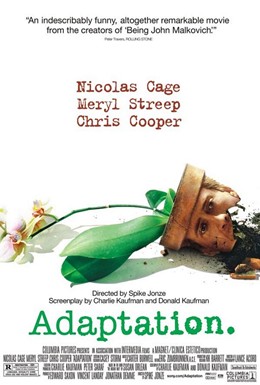
Adaptation._film

I must confess that I have an irrational attraction to all screenplays written by Charlie Kaufman. Being John Malkovich was weird and silly but a complete delight all the same. Eternal Sunshine of the Spotless Mind is nothing less than one of my favorite films ever. So it was inevitable that I would eventually get around to watching Adaptation, even though it isn’t generally considered to be one of his better efforts. Please note that this post will be chockful of spoilers because it simply isn’t possible to discuss the film in sufficient detail otherwise.

Adaptation is very generally a film whose story is about the story of the film itself as it is being created. As such it is intensely self-referential. The main character of the film is a fictionalized version of Charlie Kaufman himself, played by Nicolas Cage, trying to write the screenplay of the film that would become Adaptation. In the film, Kaufman, following the success of Being John Malkovich, has been hired to write the screenplay for a film adaptation of Susan Orlean’s novel The Orchid Thief.

Continue reading Most self-indulgent film ever

Dolphins are smart

I’m not sure why Marginal Revolution only just now linked to a Guardian article from 2003, but it’s still a seriously good read. The dolphin in the article was trained to help keep her pool clean by bringing any waste paper that falls into her pool to the keepers for a reward. Over time, one of the dolphins learned to trick the humans. Instead of immediately giving a big piece of litter to her keepers, she would hide it and only tear off small pieces to give to a keeper each time one passed, thereby earning more fish as a reward.

What’s even more impressive is that since she has also been trained to bring gulls (I’m not sure if they’re dead or alive at this point) that fly into her pool to the humans in return for a reward, she learned to keep some of the fish that she’d been given. Once the humans went away, she used the extra fish as bait to lure gulls to fly into her pool to catch them so that the humans would give her more fish for the gull. The rest of the article is filled with similarly fascinating anecdotes.

Science-fiction of course has long been full of stories about dolphins being intelligent, the entire plot of the fourth Star Trek film being the most obvious example. But this article lead me to thinking back to opinions of people like Australian SF author Greg Egan, who believes that our current treatment of some animals amount to human rights violations that will one day be recognized as a historically shameful era of our species.

Knights of the Cardboard Castle

After much vacillation, I have decided to split my gaming related content to a new blog, Knights of the Cardboard Castle. This makes the theme and subject matter of the two different blogs much clearer. This means that henceforth no new posts on games or gaming related subjects will be added to this blog. Calltoreason.org will continue to exist but as I don’t always have interesting things to say on more serious subjects, I expect that it will be updated less often. The old content isn’t going to be moved because after some experimentation, I’ve decided that it will be too much trouble.

Red Faction: Guerrilla

rfg 2009-10-28 23-02-05-75_reduced

Most shooters start the player off with some kind of assault rifle, maybe a sub-machine gun if the designers are feeling stingy, plus a dinky little side-arm that never actually sees any use. Not so Red Faction: Guerrilla. In this game, right after the introductory cutscene, you’re given a humongous sledgehammer and a satchel of remote-detonated explosives. Then you’re set loose on the Martian landscape to do as you will. That is a fair representation of this game is all about.

You’ll find that most of your time on Mars will be spent wrecking stuff. Of the two starter weapons, the sledgehammer is the more reliable but it’s always satisfying to bring down a building with lots of enemies inside with explosives, especially when you become skilled at identifying structurally weak spots to slap them on. But that’s just the tip of the iceberg that is your arsenal. You also get the grinder, a bulky machine that fires razor-edged metal disks, the thermobaric rocket launcher that is really good at filling an enclosed space with a big explosion, a nano-rifle which infects the target with nanites that dissolve it, and, if you’re lucky, the awe-inspiring singularity bomb, which creates a miniature black hole.

Continue reading Red Faction: Guerrilla

The unexamined life is a life not worth living