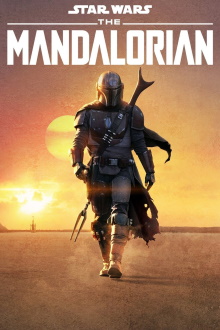
So it was inevitable that I would get around to watching this eventually even if it’s so much later than everyone else. I was amused that our cinephile hated this with uncommon intensity earlier this year. For my part, I love how it absolutely nails the Star Wars aesthetic, perhaps better than any of the new films, and it makes for a rather fun romp. However it is admittedly very shallow so it’s best to take this as light entertainment which is great as the episodes tend to be rather short.
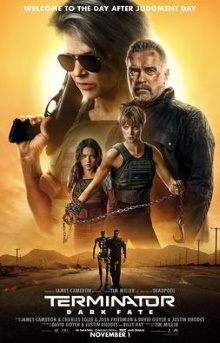
This has been a year without summer blockbusters and I’ve read plenty of accounts from people online about how it feels so weird that there hasn’t been a Marvel or Star Wars tentpole film this year. Anyway this one is from last year and I heard good things about it plus we do like to watch the occasional action movie. I have not of course watched any of recent ones in the franchise and have totally lost count of what number they’re up to now. Turns out that this film ignores the existence of anything past Terminator 2 as well, which is fine by me.
The spoken dialogue in this film is almost entirely in English but that doesn’t change the fact that it is essentially a French film. The title refers to a remote village in Switzerland where most of the scenes were shot and which provides plenty of spectacular scenery to serve as a backdrop. But however beautiful the cinematography is, the real draw remains the scintillating character analysis that is the heart of this film, written and directed by Olivier Assayas.
It’s embarrassing how late I am in playing games and in this case, it’s not even because I waited for it to go to discount. I was actually a Kickstarter backer on this one but kept putting off actually playing it, at first due to the many complaints and later balance changes, and later just because I had other games to get to first. It just goes to show that there really is no point to me buying new games at full price.
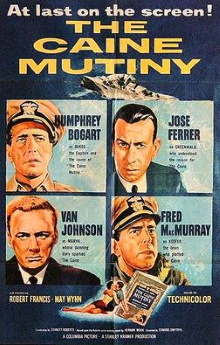
This seems to be a fairly notable film and was commercially successful at the time of its release. I don’t think it is all that good of a film and that’s because of the numerous compromises that it has to make in order to be allowed to exist at all. It’s fascinating in how it has to twist and moderate its narrative to navigate the sensibilities of the US military and probably the general public and would have been a far better film if it had not been required to hold back so much and take matters more seriously.
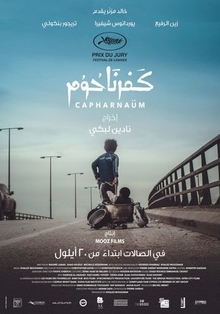
I’ve had in my list for a while now but the huge explosion that took place in Lebanon earlier this year sure added extra impetus to get around to watching it. This is a harrowing film, about a child who is forced to fend for himself on the streets of Beirut, was made by Nadine Labaki, a Lebanese director. That kind of matters because no foreigner could make a film like this with such moral authority. Also, this film was apparently a huge hit in China, of all places.
Our usual monthly feature cannot help but include one of the most hyped up announcements in years. Unfortunately I think they hyped it up too much especially with all of the intrigue behind a press embargo and when the official announcement came out, it didn’t actually make much of a splash with the general public.
This refers of course to the detection of phosphine gas in the atmosphere of Venus. This matters because phosphorus in gas form would be highly reactive and would be expected to exist primarily in oxidized forms. This means that some process on the planet must be continuously producing the gas and yet there are no known production routes that do not involve biological processes. So the upshot is that this is being as a very tentative sign of life on the planet. Still, it’s so speculative that it’s no wonder the general public isn’t very excited and there’s still a decent chance that the gas is produced by some abiotic process that is as yet unknown to us.
Our next article is also in the realm of astrophysics and again, it’s more about the excitement of a huge event than any new science being discovered. This is the detection of a merger between two massive black holes some seven billion years ago using laser interferometer instruments to listen to vibrations in space-time. It’s somewhat interesting to get evidence that such intermediate black holes massing between 65 and 120 solar masses can exist and that fuels the theory that black holes can become bigger by merging with one another. But it’s probably more exciting to think that we can, today, observe an event that occurred so far back in the past.
Moving on the biological sciences, here is a paper studying how mothers who rear their own offspring can confer lasting advantages. To me, it is especially convincing in that the subject of the study are actually Rhesus monkeys which I am guessing would result in cleaner, less controversial data. The result is that monkeys who are reared by their own mothers exclusively compared to those who are reared by humans for the first 40 days of their lives and then assigned to other adult monkeys have significantly better health and social rank outcomes. This might seem like an obvious finding but it’s an important one to make and we can derive lessons from it also for the bringing up of human children.
The last article is about the study of dreams in a scientific manner. The problem with this is that you need to collect a lot of data and the only way to do this is from the dreamer’s own recollection. But then the written reports need to be assessed by someone and that adds another layer of subjectivity. So this project instead uses a language processing algorithm to assess the dreams and from there draw conclusions. The actual results are almost less interesting than the methodology but broadly confirm that the content of dreams do match the quotidien experiences of the dreamers.