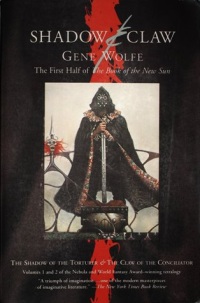
The Book of the New Sun

The Book of the New Sun is the insanely praised magnum opus of Gene Wolfe. It’s so well reviewed that it’s been called science-fiction’s Ulysses. Since the people praising it are fellow writers like Ursula K. Le Guin, George R.R. Martin and Alastair Reynolds, any serious science-fiction fan had better sit up and pay attention. The tetralogy is also notoriously difficult to make sense of, so much so that there are published analyses of its deeper meanings and themes, such as Michael Andre-Druissi’s Lexicon Urthus.

I found a copy of the hardcover Gollancz 50 edition of the first volume, comprising the first two books The Shadow of the Torturer and The Claw of the Conciliator in a local bookstore and promptly bought it, knowing it to be one of the classics of SF that I never got around to reading. Unfortunately the second volume, comprising the books The Sword of the Lictor and The Citadel of the Autarch doesn’t yet exist in that edition, and I ended up ordering a paperback copy online. That was many months ago. Yes, it took me that long to finish the series to my satisfaction.
Continue reading The Book of the New Sun

End of Algorithms 1 class by Sedgewick and Wayne

So the Algorithms 1 class by Professors Robert Sedgewick and Kevin Wayne of Princeton on the Coursera platform just ended. I just made my second of three attempts on the final exam, scoring 18.31 / 20.00. I may yet make another attempt next week as everything officially closes only on 30 September 2012. It’s been an amazing experience and I learned way more than I expected. Some thoughts:

  • I found that I’m pretty strong on practical programming. I could complete all of the programming assignments with not much trouble, and ended up spending a fair amount of time on the forums helping others out with their programs too. I only struggled somewhat when implementing the optional extra optimizations that the professors suggested which are not graded. This mostly involved doing the same thing with half the memory or less, or cutting running time down drastically. For example, the toughest timing trial of the collinear points assignment gave you a maximum of 10 seconds to solve the problem. My first attempt came in at just under 7 seconds, and after much agonizing I got it down to just under 3 seconds. The very best students were able to get it down to just under 2 seconds.
  • However I am terrible on the theory. I blame that on a lack of solid grounding in mathematics. I really suck at calculating things like the order of growth of running time for different algorithms or the minimum and maximum heights of different tree-like data structures. This calls for a good grasp of discrete mathematics. I’m also bad at internalizing geometrical principles, so assignments like collinear points gave me more trouble than the supposedly more sophisticated A* algorithm we used to solve the 15-puzzle. I’m currently signed up for Sedgewick’s Analytic Combinatorics class which runs next year but I’ll probably flunk that one.
  • This class really thought me how beautiful some algorithms are and how you can achieve so much in just a few lines of code. At heart, they’re all about pure logic so it’s possible to even describe them to people with no programming knowledge whatsoever. I also think I finally managed to get the hang of recursive functions while doing the Kd-Tree assignment. I’ve always had trouble visualizing them before.
  • I also learned how very limited even the powerful computers we have available to us today are. As a science-fiction fan, I’ve always taken it for granted that one day, perhaps sooner than we expect, we’ll be able to simulate sentient minds and even whole worlds inside computers. Unfortunately, even the lowly 15-puzzle is enough to make modern computers struggle. It’s pretty humbling. As Sedgewick likes to emphasize, while we can always look forward to ever faster computers in the future, it is even more certain that the size of the problems we need to solve in the future will grow faster than our computers will become more powerful. As we can’t rely on ever more powerful computers to do the work, we must instead design ever more clever algorithms.

Anyway, Algorithms II starts up in November so I’ll be back at it pretty soon. In the meantime, I should have a little extra free time.

Recent Interesting Science Articles (August 2012)

Participating in the Coursera online courses is keeping me busier than I’d first thought, but I still had time to read up on science-related stuff.

  • Ever wondered while on a journey why the return trip always feels like it passes more quickly than going there? According to this article in The Irish Times, this is due to how our psychological perception of time differs according to circumstances. The article calls this an act of retrospective timing. That is we try to estimate how much time an event took after it has already passed from memory. However, this is done by recalling the information we stored during the event, and the more information we stored, the longer the duration we perceive it to have taken. This means that when we’re first traveling to a new place, we have all sorts of new data to absorb and store, but during the return trip, most of it will have become familiar already. Hence we perceive the outbound trip to have taken longer than the return trip.
  • Along with video-gaming nerds, comic books fans have long been relegated to the depths of otaku social outcasts. But this article from The Pacific Standard talks about closely identifying with a superhero may have measurable positive effect on their bodies. A study invited undergraduates, male ones only, to state how familiar they were with Batman or Spiderman and went on to query the students about how they felt about their bodies. Those who did identify with one of the superheroes not only felt better about their bodies, they were also able to demonstrate measurably greater strength, especially when they were shown pictures of a more muscular version of the superhero in question.
  • This next link seems to be down frequently but it’s such an interesting article that I just had to link to it. It appears on the Psychology Today website and talks about the Baining, an indigenous group of Papua New Guinea, who have the distinction of being known as one of the dullest people on Earth. They apparently have nothing in the way of the usual cultural accoutrements such religious rites, myths, festivals etc. and discourage playful of any kind, even among their children. The only thing they have going for them is work and they value all products and activities that are associated with useful work.
  • Finally an article about the Curiosity rover currently on Mars. It’s from The Atlantic and it reveals how the engineers at Jet Propulsion Laboratory built in a little Easter Egg. Specifically the vehicle’s treads are designed to spell out in Morse code the initials J-P-L as the robot slowly makes its way across the red Martian soil. That is such a geeky thing to do I just had to include it here.

A logical puzzle

I’ve been remiss in writing for this blog because I’ve been busy with the courses I’ve been taking on Coursera.org. Currently I’m taking both Introduction to Finance and Algorithms. The Algorithms class is particularly challenging for me and involves significant work because there’s a programming assignment each week. It’s taught by Robert Sedgewick of Princeton, who is something of an authority in the subject. Interestingly, Sedgewick’s own doctoral thesis advisor was Donald Knuth, who is of course a legend in computer programming circles.

Anyway, just for fun, here’s a logical puzzle from a recent assignment for you to ponder over. I’ve converted it into a puzzle to make it more accessible, no actual programming necessary, but the essential logic of the problem remains the same.

Let’s say that you’re working at a booth of some sort and you have only one task. A client will come up to your booth and announce a number. Call this number k. This number represents how many items you will need to hand back to the client at the end of each task. The client then starts handing you items, let’s say they are beach balls, each of which are uniquely identifiable, one at a time. The client never tells you how many balls there are in total. He or she just starts handing them to you, one by one.

At some point, the client will announce that he or she has finished handing over balls. Now your job is to return k balls, selected with uniform randomness from the balls you were just given, back to the client. Sounds easy right? But here’s the constraint. Your booth can only store k balls at maximum. That is to say, you can only hold as many balls at a time as the number of balls you need to return to the client at the end of the task. You may choose to keep or discard any ball but once you choose to discard a ball it is gone forever and you can’t ever get it back.

So how do you ensure that you can select k number of items with uniform randomness, out of a pool of potentially many more items, while being restricted to only holding k items at a time?

“Curiosity has landed” video

Ok, this totally breaks this page’s formatting, but what the heck. Forget the Olympics. This is the greatest spectacle going on right now and it’s not even on Earth. Yes it’s a CGI rendition instead of real imagery but what do you expect about something going on on Mars? The landing procedure is the stuff of science-fiction.

Recent Interesting Science Articles (July 2012)

July 2012 has been a less awesome, insofar as science articles go. I guess things do slow down in the summer.

  • This isn’t the first article about empathy for humans as displayed in dogs that has appeared in this blog, and it won’t be the last! This article from The Economist covers experiments performed to see if dogs can really perform actions out of empathy for the perceived suffering in humans, as opposed to acting out of curiosity. This was done by observing the behavior of dogs when alternately encountering a human crying and exhibiting other signs of distress or merely humming. They also alternated between using a trusted human for the dogs and a complete stranger. The results were that the dogs could indeed recognize distress in humans and react by whining, nuzzling, licking, and fetching toys for the human perceived to be suffering. They did this to the suffering human even if he or she was a stranger and their master was in the same room, indicating that it was the comfort of the suffering human that they sought rather than their own comfort.
  • Just last month I had an article talking about how more modern pop music is getting sadder and sadder while becoming more emotionally ambiguous. This month I have a new article from Reuters making a different claim: that pop music is getting louder and louder, while at the same time becoming less diverse with a more limited variety of sounds. They’re not directly contradictory but they are odds enough that the two teams should probably have a good long discussion with each other about just what is going on.
  • This next one is cheating a bit as it’s more of a demonstration video than a science article. Its about the color shifting abilities of a species of cuttlefish in Australia, Sepia plangon. Nothing new, you say? Except that this one is not only capable of shifting its colors, it can apparently shift each side of its body to a different color scheme, in this case, mimicking a female with half of its body and a male with the other half. This demonstrates not only as astounding level of control over its own colors but also an awareness of just who is looking at it from each direction.
  • Ever wondered while walking in the rain if it would be more effective to run through the rain or walk steadily through it to minimize wetness. I did and judging by the contents of this Washington Post article, I’m not the only one. Intuitively, running is better to minimize your time spent in the rain but at the same as you travel fast, you run into more raindrops in your path. Walking steadily increases your exposure time, but you present a small target and you don’t walk into raindrops. The paper summarized in this article concludes that for most cases, running is best but the true answer really depends on your body shape, the direction of the rainfall (vertically or at a lateral angle), the angle of the path you are traveling across and so forth. It is truly a profound topic.
  • Finally, no rundown would be complete without the biggest scientific news of the month: the confirmation of existence of the Higgs boson at the Large Hadron Collider. There are many articles about it on the web but I’m partial to this one from the BBC. There are no practical applications for this but it is pretty solid confirmation of the Standard Model of physics.

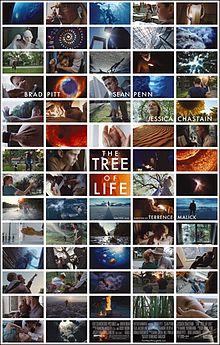
The Tree of Life

Back when I started my series of “Favorite Films” posts in 2007, I took extra pains to define what that title meant. It isn’t sufficient for a film to be merely entertaining and likeable. A film must pass that test, I thought, but more than that it must also aspire to be a work of art. Either by conveying a profound meaning or by expanding the vocabulary of cinema through innovation.

However I failed to consider that it might be possible for a film to fail the first test but completely blow the competition out of the water on the second. For this reason, Terrence Malick’s The Tree of Life is in a class of its own. I do not find it entertaining. Yes, it is utterly captivating to watch but it is also so intense that it is too mentally exhausting to be considered entertaining.

Continue reading The Tree of Life

The unexamined life is a life not worth living