Recent Interesting Science Articles (Nov ’10)

Three articles this month, one on an amazing new implant that allows the blind to see, albeit in low resolution, one on a way of treating auto-immune disorders that I’d long suspected would work, and one about which sorts of people think the most like an economist. Let’s start with the eye implant first.

Using technology to let the blind see again has long been one of the staples of science-fiction, perhaps one best exemplified by the character of Geordi LaForge of Star Trek: The Next Generation. I remember being amazed a few years back when scientists successfully gave a very crude form of sight to some blind people by essentially using feeding the input of cameras to nerve receptors on their chests. But as far as I know, this is the first example of an actual artificial eye implant.

Continue reading Recent Interesting Science Articles (Nov ’10)

The Wikileaks scandal

The biggest news this week, and likely something that will stay in the headlines for months to come, is of course the rolling release of over 250,000 cables from the US State Department by the whistle-blowing website Wikileaks. I have mixed feelings about the whole thing. On the one hand, many of the documents are of doubtful value. It’s clear for example that a significant percentage of the documents are gossipy nonsense. Salacious details like what kind of girls Libyan leader Muammar Gaddafi is into no doubt attracts plenty of eyeballs, but it’s hard to see what kind of public interest is being served by publishing them.

Of the rest, some are interesting but don’t really tell us anything that we didn’t already know. Should we be surprised that the US aggressively spies on top UN officials, or that half the countries in the Middle East are apparently more eager to bomb Iran than even the craziest American neo-con? As satisfying as it is to see these suspicions confirmed, that’s not worth the damage that making this all public will do to international diplomacy. Outing Saudi Arabia in this way for example will simply put more pressure on their government to cave in to their local Islamist factions and compel them to turn up the anti-American rhetoric. In the same way, China seems to be more open to a unified Korea under Seoul than they’d henceforth admitted but this public revelation will simply make them clam up again to appease their nationalist faction.

On the other hand, good can and has many times in the past been served by whistle-blowing. Western governments have certainly been happy to encourage workers to blow the whistle on employers who have broken laws and have recently made it much easier and safer to do so. Why should governments themselves be held as an exception? This editorial from The Economist for example argues that while such leaks damage the effectiveness of government, they also improve the quality of democracy by allowing voters to peer into the inner workings of the bureaucracy and to know what’s really going on. The example it cites, of the Bush administration pressuring Germany not to prosecute CIA operatives involved in the “extraordinary rendition” of somone who was ultimately proved to be innocent, is a solid case of government malfeasance that would not have come to light without leaks of this kind.

The conundrum therefore is that it is in the public interest that morally corrupt government wrongdoing be exposed and that the legitimate business of government that needs to be secret should remain so, but we trust no one to be an impartial and infallible judge of which category any particular case might fall into. Due to this, I guess Wikileaks is not such a bad compromise after all if it could live up to its mission statement of being open to everyone and of being impartial. Sadly, judging from the personal history of its founder Julian Assange and the anti-US editorial Wikileaks chose to attach to this round of leaks, this does not seem to be the case.

Why McDonald’s food rots so slowly

By now, I suspect that almost everyone will have seen the videos of burgers and fries from McDonald’s taking a suspiciously long time to rot. The suggestion is that McDonald’s packs tons of chemicals and artificial preservatives in their products to prolong their shelf life, incidentally also making them very harmful to eat. The Burger Lab, a food blog who was also behind a massive effort to deconstruct the precise composition of McDonald’s fries and make them at home, has punched a hole in this theory.

After an extensive series of tests, he finds that, yes, McDonald’s burgers do indeed take much longer to rot than other burgers, but the reason isn’t due to chemical preservatives. It is primarily due to the large surface area of the burger compared to its volume, causing it lose moisture rapidly. Since the meat is sterile to begin with, this makes it very hard for mold spores in the air to establish a foothold. To further prove his point, he performed another experiment in which the burger was stored in a plastic bag designed to retain moisture, and found that the McDonald’s burger does indeed rot normally in this case. Check out his extensive blog post for more details.

Zendegi

But was she conscious – as much as the women who’d help build her would have been conscious if, for a few seconds, they’d forgotten themselves and focused entirely on their simple tasks: thinking of a word, matching a picture?

Still, at most it could only be a transient form of consciousness – with no conception of itself to underpin a fear of extinction. Splicing Fariba, and a thousand variants of her, into narratives in which they played no active part wouldn’t bolster their fragmentary minds into something more substantial; that was just the illusion that human players would receive. The Faribas would still live – if they lived at all – in an eternal present, doing their simple tasks over and over again, remembering nothing.

– Greg Egan in Zendegi

Perhaps the best thing that can be said about Greg Egan’s newest novel, Zendegi, is that it’s the most grounded and hence approachable of any of his books. Inspired by the real-life events in Iran in 2009 and backed by a personal trip that the author made to the country, the book starts out being more of a spy thriller than a hard science-fiction novel. In 2012 as Iran readies itself for a fresh round of parliamentary elections, Australian journalist Martin Seymour makes a break with his previous life as he is sent to cover them. However the elections turn out to be more exciting than anticipated when a scandal involving a member of Iran’s Guardian Council is unearthed, with Martin right in the heart of the events, making news rather than just covering it. This leads to a massive uprising that eventually leads to the reinstatement of true democracy in the country.

Continue reading Zendegi

Google AI Challenge

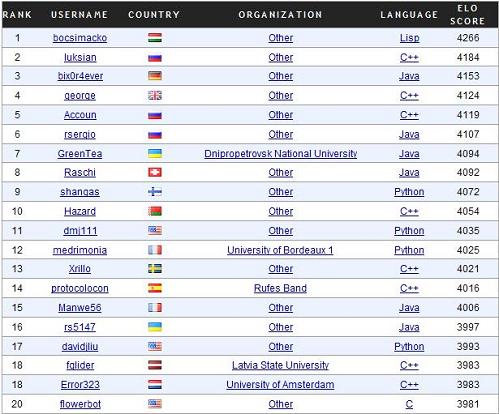
I’ve been very distracted recently due to my participation in the Google AI Challenge organized by the University of Waterloo and sponsored by Google. This is a programming contest in which participants each submit a bot that is capable of playing PlanetWars, a simple game based on the commercially-released game Galcon. I’ll probably confine the technical details and my own bot’s strategy to my Knights of the Cardboard Castle blog, but I thought it would interesting to look at some of the publicly available statistics.

Since I submitted my own entry, my wife and I have been scrutinizing the rankings on a fairly regular basis. It’s fun after all to see who’s doing the best and to know which countries they’re from. And seeing as how I’m Malaysian, it was only natural to want to know how well participants from neighboring countries might be doing. Keep in mind of course, that the contest only ends in December 2010, so the rankings are still in flux as new participants are still joining and entries are still being tweaked.

Continue reading Google AI Challenge

Recent Interesting Science Articles (Oct ’10)

Only a couple of articles this month as I’ve been distracted by other stuff. Both happen to be about biology and more specifically about females. The first one deals with the attraction of the color red. Psychologist Daniela Kayser of the University of Rochester and her team conducted a study in which heterosexual males were separately shown photos of the same moderately attractive woman. Half of the participants were shown a photo in which the model was wearing a red shirt. The other half were shown the same photo, except that this time her shirt was green. The men were then asked to select five questions out of a total of twenty four provided that they were told would be sent to the woman.

The team found that the men who saw the woman in red tended to choose more intimate questions. In a follow up study, another group of men were shown the same photos but this time they were tricked into believing that the woman would be coming into the room with them and they were instructed to arrange the two chairs in the room. The men who were shown the photo of the woman wearing red chose to put their own chair closer to where they thought the woman would be sitting. Apparently, it works for men too as the team has also found that men wearing red were rated by women as being more attractive and of higher status.

Continue reading Recent Interesting Science Articles (Oct ’10)

Why does the Malaysian government love a property bubble so much?

Even by the dismal standards of the Malaysian government, the recently announced plans to “help” first-time house buyers left my mouth agape in amazement. They propose to do this by allowing them to take loans of up to 100% of the purchase price for properties costing up to RM350,000, essentially doing away with any need to make a down-payment. Predictably enough, this prompted commentators to observe that this would make it even easier to speculate in real estate, causing prices to shoot up even more and taking them further out of reach of first-time buyers. But the government is firmly of the opinion that there is no bubble, meaning that price increases of fifty percent or more over the past two years in key areas of Kuala Lumpur and Selangor were perfectly normal.

You know how else the government plans to help people who can’t afford a house? It thinks that people should extend their house loans over longer periods and are encouraging the take-up of two-generation loans. This means loans that are so expensive that you have no hope of repaying them within one lifetime, so your kids must continue servicing the loan long after you are dead. Of course, this also means that your kids are in debt from the moment they are born. In the meantime, saner governments in Singapore and China are responding to the rapid increase in property prices in their respective countries by doing the exact opposite: severely restricting the amount of loans that can be taken out and insisting that buyers stump up ever higher down-payments for each additional property they buy.

I’m not alone in thinking that contrary to what the government is saying, there is a bubble. Take this columnist in The Star for example. As he notes, if prices rise so high that they are out of whack with rental rates and incomes, they will inevitably come crashing down again. Even the consensus on the Property Talk section of LYN, a place that is extremely bullish about making money from real estate deals, has come around to the idea that a popped bubble is a matter of when and not if, though the forum is still full of people who think that they can run and in out for a quick buck before the house of cards come crashing down.

And of course, all this when the world is still grappling with the fallout of the US-based subprime crisis. While the financiers certainly played their part in securitizing all the loans to hide the credit risks inside, the reason why these loans were possible in the first place was because the US government wanted to make it easier for people who had difficulty in proving that they had regular income to get loans to buy houses.

Note that I don’t claim to be an expert in these things and unlike the US, it’s hard to get good statistics on the situation in Malaysia. It’s certainly possible that the bubble is confined to a few key areas so that there’s little to fear on a wider scale and it’s equally possible that as a nation with a population that is still growing, Malaysia has a property market that is going to be able to absorb such price increases for a great deal longer. But it’s also worth noting that property prices in markets like Tokyo and Hong Kong still have not recovered the peaks they reached during their respective bubbles, more than ten years later.

Overall, I can’t imagine how anyone, beyond those directly poised to benefit from the higher prices and the enlargement of the already dominant construction industry, would think that these moves by the Malaysian government are wise. Perhaps this is just a bit of pump priming to jumpstart the economy so that the BN will have a better chance during the 2012 elections or perhaps this is a crass money grab by cronies. Either way, if this is the direction that the Malaysian wants to take for the property market, we’re in for some volatile times.

The unexamined life is a life not worth living