Wow, I haven’t done one of these in a while since my Economist subscription lapsed. I only renewed it fairly recently. Anyway, here are the three most interesting science related news items that I’ve seen in October, with one of them from The Economist. Let’s start with that one first.
The biological causes and effects of homosexuality is one of the perennial questions when you try to explain human nature in scientific terms. The most obvious of these questions is why homosexuality, since it can in large part be attributed to genetic causes, persists when common sense dictates that homosexuals shouldn’t be in a good position to pass along their genes to the next generation? A recent article highlights one possible answer: genes that make men more feminine and genes that make women more masculine confer a reproductive advantage to the person who possesses them, so long as they do not actually push them into homosexuality.
Four articles this month, though I have to admit that they’re more about technology than general science. The first and potentially most exciting of these is the news of Intel’s demonstration of technology to transmit power wirelessly. Personally I’ve always wondered when we would get around to accomplishing this. After all, in science-fiction shows like Star Trek, you never see long trails of wiring all over the place. Now that wireless transmission of data is easy, power cords are number one source of ugliness and mess with tech gadgets.
Anyone who’s watched Christopher Nolan’s The Prestige would also know that Nikola Tesla achieved this late in the 19th century. However, as the article explains, the trick isn’t in simply transmitting it, it’s in doing it safely and efficiently. The article talks about installing the system in airports and offices, but if it becomes cheap enough I can’t imagine why ordinary home users won’t want to be able to do away with pesky electrical wires as well. Still, our current troubles with neighbors stealing bandwidth from wireless networks are bad enough, just think about how troublesome it would be if your neighbors could steal your electricity supply as well!
I was amused to read Prince Charles’ rather hot-blooded diatribe against genetically modified crops earlier. Given how stupid his entire argument is, it isn’t very surprising how much criticism he has been getting over it. I don’t really feel like going into detail over it, so I’ll content myself with these two points:
The entire history of agriculture consists of genetically modifying crops and even livestock so that they are more suited for human purposes. Wild plants needed to be domesticated so that they could become the familiar crops that we know of today. The gigantic aurochs had to be domesticated into the docile cows we now have. Farmers regularly performed cross breeding experiments in order to try to get more desirable crops. Without these developments, there would be no civilization as we know it. Of course, I realize that what Prince Charles really means is that by manipulating the genetic structures of organisms directly rather than through selective breeding and cross breeding, there may be additional, unforeseen dangers. Even so, the correct thing to do is to monitor and control for those dangers, because in principle there is no difference. Both methods end up altering the genome.
As the article notes, this attack on GM crops comes during a global food crisis, when human populations all across the world need the higher and more reliable yields of the most advanced, genetically modified crops more than ever. Remember that the United States has been consuming these so-called GM crops for decades with no measurable ill effects, which helps to explain their lower food prices compared to Luddite Europe. So do you think poor Asians and Africans should follow the American or the European example?
Finally, I giggled at Prince Charles’ attack on intensive agriculture by large corporations. Maybe he thinks that everyone should grow their own food in their own backyard or something? It’s one thing for a rich royal to boast about his own organic farm, try selling that idea to densely populated and still relatively poor Asia.
I haven’t been as up to date as I should this month, but nonetheless I have three articles. The first and the most exciting one is the announcement by NASA confirming the presence of water on Mars. Now, we’ve had indirect evidence of water for a while now, but this is the first time that a robot, in this case the Phoenix, has actually tasted it by melting a piece of ice. The next step will be to bring it to even higher temperatures to try to find any traces of carbon-based compounds.
Wow, I haven’t done any updates for this in a while, so let’s make up for it by posting about four different articles, starting with the biggest science-related news this month. According to the U.S. National Snow and Ice Center, the North Pole may be, for a brief period, completely free of ice this summer. This is as alarming a symptom of global warming as anyone can imagine. While the scientists assure us that the melting of the polar ice cap should have no immediate ill effects, jokes about Santa Claus losing his home aside, it’s hard to deny that this should be seen as an extremely loud wake up call.
I have to admit that I was once a global warming skeptic myself but the scientific consensus now is that global warming is a real and human-induced phenomenon. What we should do about it is a different and complex matter of course, and I still reserve the right to mock greens for their conflicting rhetoric over it.
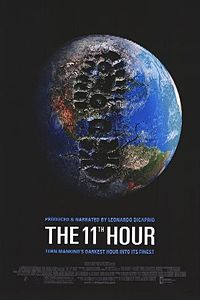
Courtesy of my friend Kien Boon of Boonuhkau, I had the opportunity of watching The 11th Hour at the KL Pac in Sentul on Sunday. It was my first visit to the KL Pac or even anywhere inside the new Sentul development zone and I have to admit that they did a great job in making the area look like an oasis of serenity in the middle of busy and dirty Kuala Lumpur. The price to pay of course is the prominent advertising everywhere on behalf of YTL Corporation, including brightly illuminated banners on both sides of the stage that remained lighted throughout the film and that we felt detracted from the experience of watching it. Nevertheless, it’s heartening to see a new addition to the cultural scene in Malaysia and my wife and I will be paying attention to what performances are going on there from time to time.
The film itself is a slickly produced documentary on environmentalism, focusing on global warming, that was apparently a personal project of Leonardo DiCaprio. As a long time skeptic on environmentalism, it shouldn’t be a surprise that I strongly disliked the film. Not only is it an example of hysterical scare-mongering of the worst sort, it ends up being inconsistent in its message and ultimately contributes nothing new to the subject. Worst of all, it preaches straight to the choir of the green movement, shying away from perspectives and solutions that could be beneficial but are controversial and unpopular among green groups.
Four articles this month, one on the extremely exciting findings by the Cassini-Huygens mission to Enceladus, one on a somewhat weird life form found inside the remains of the Chernobyl nuclear reactor and finally two somewhat similar cases of emerging risks to people with medical conditions, one due to the use of implanted medical devices and the other due to exploits on Internet web browsers.
The Cassini-Hugens mission to Enceladus, the sixth largest of Saturn’s moons, not only confirmed the presence of liquid water beneath the icy surface of the moon, but also discovered, from a sampling of the brew vented out by a geyser the spacecraft flew past, that the moon is extraordinarily active and contains a surprising mix of organic chemicals. As the press release notes, heat, water vapour and organic compounds are the basic building blocks for life. As a science geek, I’m also impressed by the technical achievement of flying so close by a small moon at extremely high speeds, successfully intersecting a venting geyser without crashing on the moon with the whole thing carefully planned and coordinated on Earth.