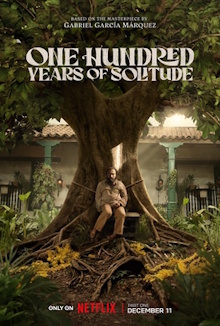
Netflix is getting serious into prestige television with lavish productions like this. Since I’d never read the actual novel by Gabriel García Márquez, this might the closest I can get to knowing its story. With its gorgeous visuals and huge cast of characters, it effortlessly drew me into the lives of the Buendia family and the founding of the town of Macondo. Yet the longer the story goes on the more bored I became. The series is like a very literal retelling of the novel but seems unable to impart any deeper meaning to the many dramatic twists and turns, making it feel like a soap opera. There will be a second part to the series but at this point I’m not terribly enthusiastic.
José Arcadio Buendía and Úrsula Iguarán are cousins who are in love with each other and decide to marry in spite of a prophecy that their children will be born with a pig’s tail. Ursula is reluctant to consummate the marriage and José kills a local for suggesting that he is impotent. After the couple starts seeing the ghost of the slain man, José decides to move away to found his own fortune, seeking a place beyond the mountains with a view of the sea. With some companions and their families, they undertake a grueling journey through the jungle. Along the way Úrsula gives birth to their firstborn, a son also named José Arcadio. Eventually they get lost in a swamp and lose morale. José lies down to sleep and after having a dream, decides to found a city then and there which he names Macondo. Cut off from the world, it prospers and becomes something like a peaceful utopia. The only visitors are a gypsy troupe led by Melquíades who becomes José best friend and introduces him to the mysteries of the universe. But strange occurrences plague the town and José becomes increasingly obsessed with esoteric pursuits. Úrsula is forced to provide for the family by running a business selling candy animals. As their children grow up, they develop passions of their own and soon begin exhibiting a tendency towards incestuous relations.
The series has everything that it takes to look great: huge sets, beautiful cinematography, costuming, action scenes. Macondo looks and feels like a real place that you could visit and all of the actors are at least decent. There’s action, plenty of sex and supernatural phenomena so it’s always entertaining. Even this first half of the full series takes place over a decent chunk of time, necessitating a change in the actors who play the characters. This does mean that there is an episodic feeling as the show time skips often to the most significant moments of their lives. At least they do allot enough time to let each new plot development play out so I found the pacing okay. But it still means that it feels more plot oriented than character oriented. One moment a character like Arcadio is a fervent revolutionary. The next he is a corrupt autocrat himself. Things happen but it’s hard to say that there’s any character development as we don’t get to go inside their heads.
The storytelling is extremely straightforward as the omniscient narrator simply tells us what is going on. It contributes to the sense that for all the drama and excitement in Macondo, it’s still just a soap opera of lives that go on and on. I’m actually very interested in the historical narrative about how a brand new settlement is founded, how the economy develops over time, how the government asserts its authority over it, how religion creeps in, how factions fight over who’s in charge and so on. But here all that is just background to the emotional turmoil of the Buendias. I couldn’t care less about their incestuous relations and I think it’s timid that they don’t explicitly point out that this is the consequence of José and Úrsula marrying despite being related by blood. I’m on record as disliking magical realism and this series makes for a pretty good case in point. Aureliano’s on-again, off-again power to foretell the future is a convenient device to foreshadow future events but makes no difference at all especially since the characters don’t change their behaviors or actions in response. The mysterious insomnia plague afflicts the entire town, then it is cured and life goes on as usual. José’s endless experimentation with photography, magnetism, alchemy and so on makes him a colorful personality but there’s no other payoff. I know that this storytelling style has its fans but as someone who enjoys reading rationalist fiction, it infuriates me.
I don’t doubt that the original novel is better and I’d ascribe many of the problems that the series has to attempting to too literally transcribe everything onto the screen. I suspect that it would have been more effective to capture the intent of the author and interpret what he wrote more metaphorically. This might be a beautiful and often entertaining show, but it’s also shallow and somewhat simplistic, making me not terribly keen about watching the second half when it gets done.