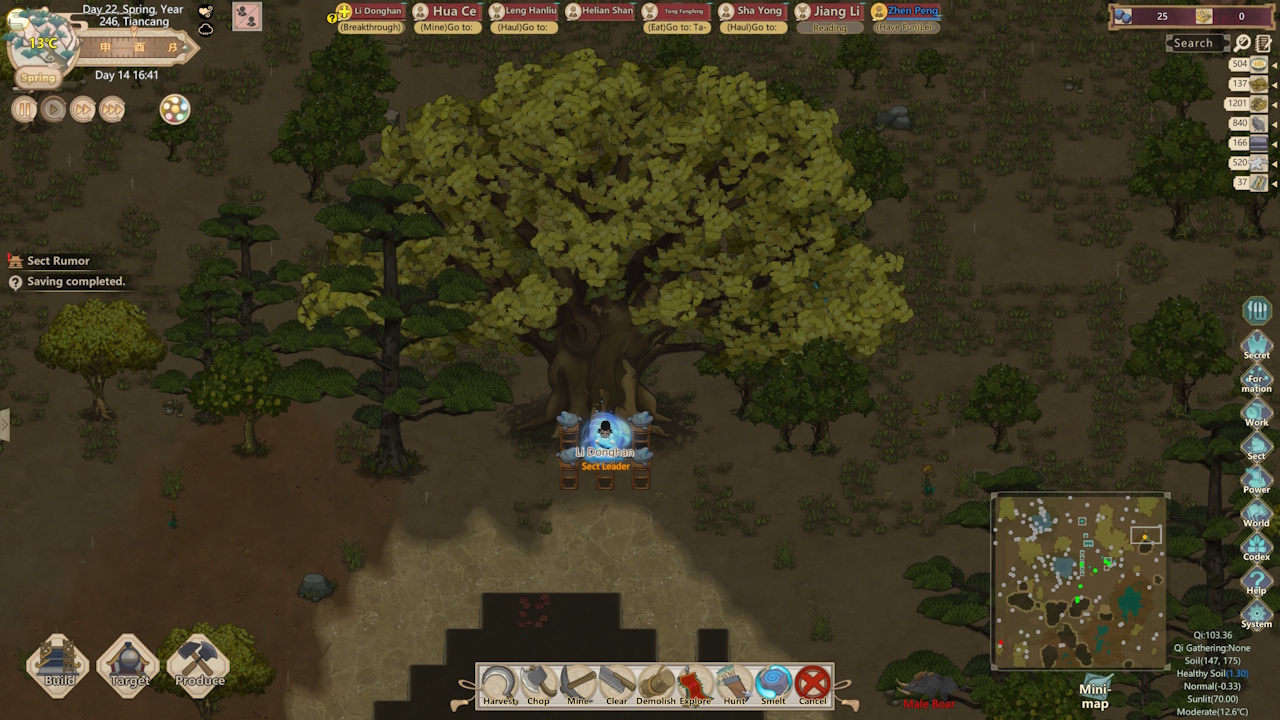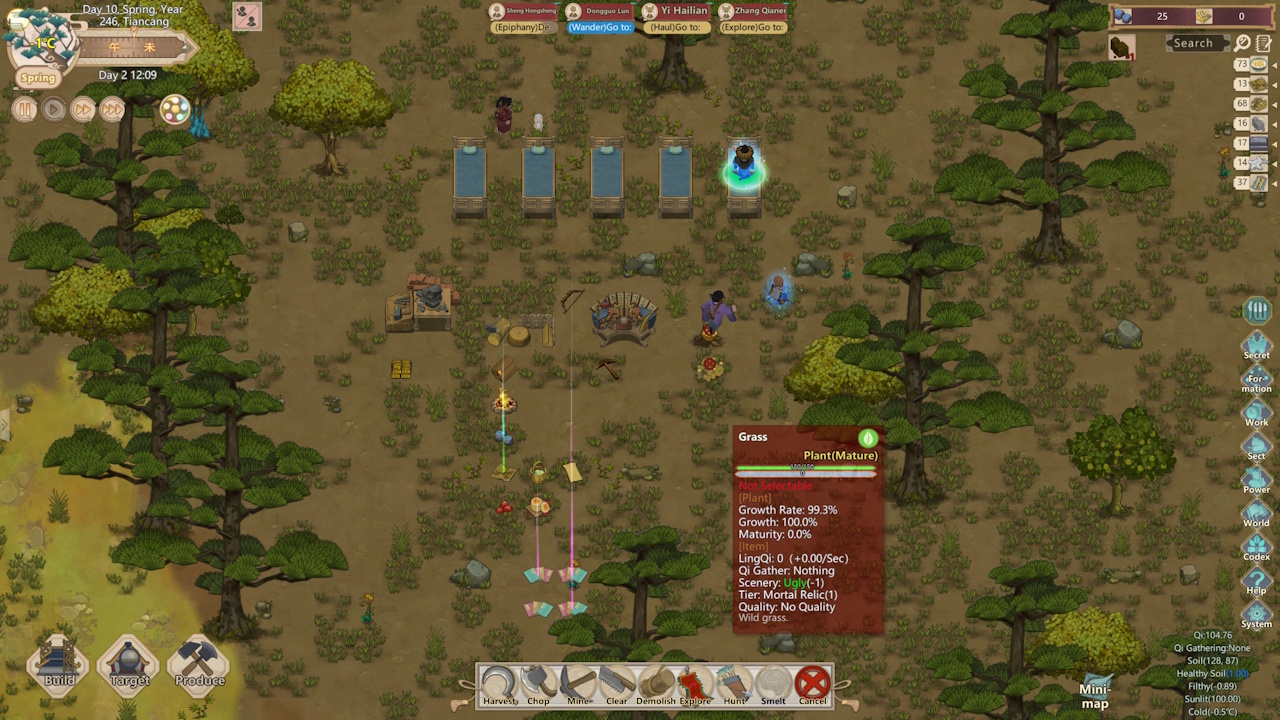
Ages and ages ago, I’d imagined how cool it would be if there existed some kind of strategy game about managing a xianxia sect. ‘Lo and behold, one now exists, made naturally by a Chinese company. It has mediocre graphics, very poorly explained mechanics and a bad user interface, but it does more or less let you run your own sect from the beginning up until you manage to nurture your cultivators into god-like beings. So it’s great, right? Well, maybe not. In between the bugs, intricate mechanics, challenge level and tendency to drop gotchas on the player, this can be a very time-consuming and frustrating experience. I already know I won’t be able to persevere all the way to the end but I’m still trying to see as much of the game as I can.
The story, such that exists anyway, is that you and your fellow disciples were formerly members of the Taiyi sect. One night, just as the leader of the sect is nearing the completion of forming a Golden Core in his cultivation, the sect is attacked by unknown assailants and destroyed. A handful of survivors flee and eventually settle down to start a new sect. You must rebuild from scratch with few resources and none of the survivors are even cultivators yet. Thankfully a mysterious cultivator shows up, claiming to be an old friend of the previous sect leader, and will protect your fledgling sect from threats for a time. You’ll have to build a safe place for your sect members to live in, secure a supply of food, scout out surrounding settlements and gather cultivation resources. You will also work to uncover the mystery of who attacked the Taiyi sect and their motivations and perhaps other secrets of the wider world.
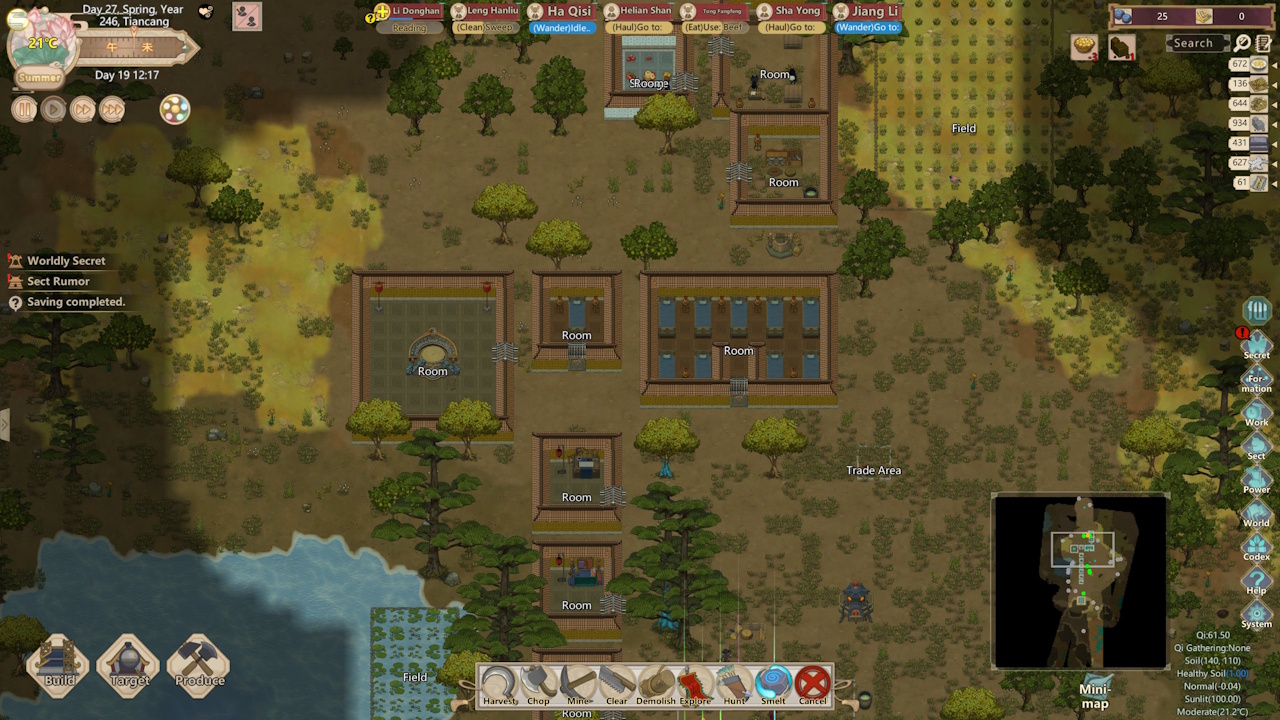
Superficially, the game resembles a base builder similar to Dwarf Fortress, but much more simplified. Your disciples need food, housing, industry, recreation and so on. But there’s not much to that layer and you can actually run out of things to build quite soon. That’s all early game stuff. The real game only begins once at least one your outer disciples establishes his or her foundation, to use the game’s lingo, and becomes a cultivator. You can then send the new inner disciple out into the world on adventures, to gather resources and recruit new followers. The cultivator also starts the very long climb to ascend to near godhood. You’d need to build specialized cultivation rooms matched to that cultivator’s law and that calls for obtaining ever rarer and more powerful materials. As your sect becomes better known, you’ll attract enemies who want what you have so you’ll need to have sufficient defenses to fend them off.
A key distinction between this and its Western-made counterparts is the importance of fengshui. The chart is always right there on the main screen so you can consult it to know which element feeds another and suppresses another element. This informs nearly every decision in the game, what materials a building is made out of and the furniture in it, which artefacts best suit a given cultivator, what kind of cultivation room he or she needs and so on. The placement of doors for rooms also matters and a bedroom with bad fengshui could kill the occupant. In addition, you need to pay attention to details like how far qi from an object travels and how different materials affect the temperature. For example, it’s good fengshui to make a furnace building out of igneocopper while the furnace itself is made out of stone. But the magically hot metal will raise the temperature and give anyone working inside for a prolonged period of time a heat stroke unless you take precautions. Apart from that, plenty of other mechanics are standard, such as farming on the tiles that appropriately fertile.
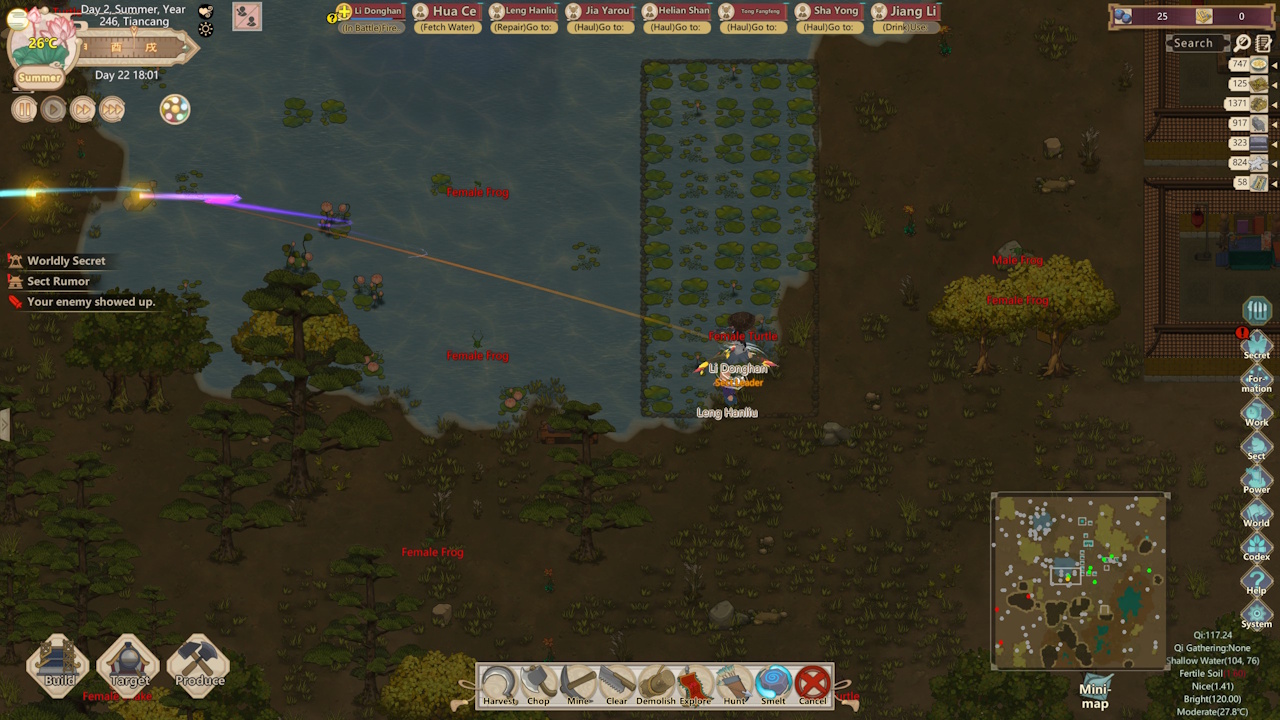
All this sounds good enough in theory, but the gameplay itself is kind of a slog to get through. The graphics are mediocre and I was surprised by how simple the in-game sounds. You mostly just hear the repetitive soundtrack. Cultivator combat mostly consists of them sending their artefacts, which could be flying swords but anything works, at each other. They automatically bash at each other until one breaks. It’s neither terribly exciting nor is there much strategy involved. Then there’s the fact that you can’t achieve much until you have more than one cultivator. You’ll likely need to need at least one cultivate at home for defense and send out the remaining ones on adventures and to recruit new disciples. In the meantime, you’re just waiting for your cultivators to, well, cultivate. This means that they’re either sitting down meditating or more likely doing leisure activities like playing go or making music on the zither to improve their mental state. Cultivation, you see, drains their mental state so they need to spend a lot of time keeping their morale up.
Another major annoyance is the many mini-games in it. Talismans are very useful tools as you can use them to improve your disciples resistance to heat, make them less noticeable while out in the world, increase their travelling speed and so on. Crafting them involves tracing out the symbols on paper and how accurately you do so influences the quality of the talisman. It’s fun the first few times, then tedious once you realize how many of these things you need to make. Then there’s the social mini-game which is used to get the people you talk to to like you. It’s useful for persuading people to visit and join your sect and getting information out of them but again very tedious to have to do it again and again. That’s why some of the most popular mods are for automating these mechanics. Later in the game, diplomacy with other sects becomes important so you enter their lands and gain access to their resources. While not exactly tedious, it can be grindy. Many of the later mechanics take place on a similarly abstracted level, including managing your agencies.
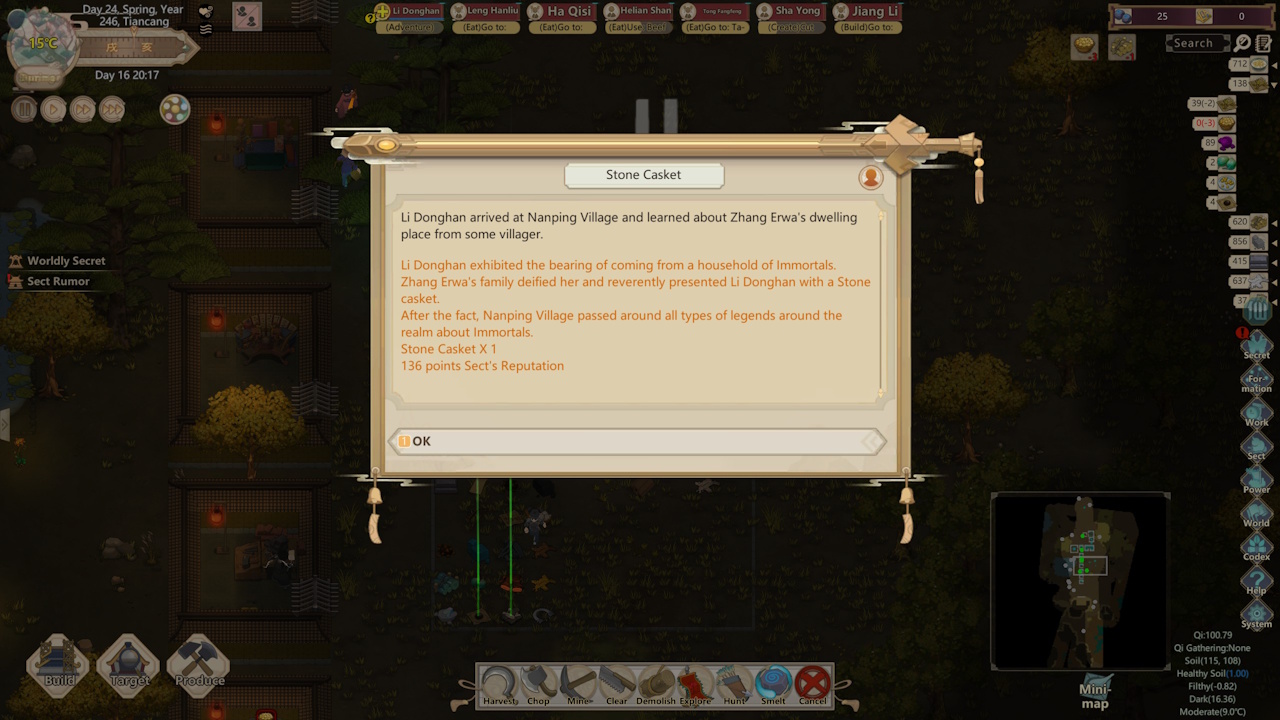
Perhaps worse of the all is the poor documentation and the many gotchas. The included tutorial is woefully inadequate and serves only as a prologue. The small snippets that you get with every new mechanic doesn’t tell you much either. You really do have to get a player-written guide to make sense of the game. That will also help you avoid the gotchas. During the character generation screen, the very first choice available will usually be the yaoguai, or human-animal hybrids. They have far better base stats than humans so they’re great, right? The catch is that they must face a tribulation a certain number of days after the game starts and newbie players will certainly not have the means to beat the tribulation. Another example is that many actions will increase the fame of your sect, including having adventures out in the world. But fame is also what determines the power of the enemies who attack you. At one point, my sect was attacked by two yaoguai cultivators who totally overwhelmed my one single cultivator. So experienced players are careful about managing how quickly their fame rises. These are many other obscure rules and mechanics contribute to the very high learning curve of this game.
There are several other things that irritate me, such as the world map and the other sects being fixed instead of randomized. Getting good at this game means knowing which resources to get from which part of the map at key points of the game. Finally there are the bugs. Sometimes a disciple will get stuck on doing an action. You can issue them a move action to break them out of the loop so they will get back to behaving properly. You can issue orders to a workstation to keep producing a certain item indefinitely but sometimes that’ll break too for no reason that I can see. I really wanted to like this game but in the end, it’s too much tedium and finnicky mechanics for not much of a payoff. I love that a game like this exists but unfortunately it’s just not a very good game. I do hear that the developers are making a sequel so who knows how good that is going to be.