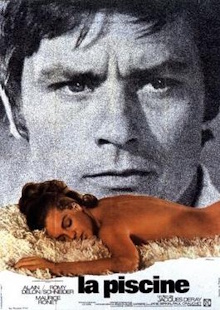
I’d mistakenly believed that this was the original version of the 2003 English-language film by François Ozon but it turns out the resemblance is only superficial. This one does feature major French star power and sizzles with erotic tension. It’s even more meaningful once you learn about the behind-the-scenes relationships and events during filming. Unfortunately I wouldn’t consider it a great film. It drags on just a little too much and the eroticism peaks at the beginning instead of ramping up as it should.
Jean-Paul and his girlfriend Marianne are enjoying a leisurely summer vacation at a friend’s villa on the Côte d’Azur, spending their days swimming in the pool and having sex. They are interrupted by the arrival of Harry, an old friend of both, who has brought along his 18-year-old daughter Penelope. As a successful record producer, Harry is immensely rich and shows off his new sports car. It emerges that he was once Marianne’s lover and Jean-Paul and her actually met one another at one his parties. After being invited to stay at the villa for several days, Harry not so subtly begins to denigrate Jean-Paul and get closer to Marianne. He comments about Jean-Paul’s failed attempt at being a writer for example and says that he is better off at his advertising job while praising Marianne for her own writing. One evening he organizes an impromptu party at the villa by bringing his many friends from Saint-Tropez. Jean-Paul is irritated by the way Harry keeps hovering around Marianne. Meanwhile Penelope confides that she dislikes her father as she has never known him growing up and was basically forced to come along with him on this trip.
Set in a beautiful villa with a wonderful view of the countryside and opening with gorgeous shots of the bodies of Alain Delon as Jean-Paul and Romy Schneider as Marianne, this film sizzles from the get-go. When Harry shows up with a sexily red sports car and the young ingénue Penelope played by Jane Birkin, surely the erotic tension can only ramp up. It does for a while but then it sort of peters out as the film drags on. The beautiful villa begins to feel confining as the group never wants to go out to do anything else and the film seems reluctant to actually portray much attraction between Jean-Paul and Marianne. When the jealousy peaks and inevitably results in violence, it comes too late, leaving too little screentime to cover the fallout. I especially dislike how little character development Penelope is given. She serves as an object of desire and something to be fought over but we only get one good piece of dialogue out of her about her relationship with her father. It would have been more meaningful if we got to know what she actually thinks about Jean-Luc and his relationship with Marianne.
Psychologically, the film hinges on Henry who clearly planned to get Marianne back from Jean-Paul right from the beginning. Jean-Paul’s eventual response seems impulsive and short-sighted but understandable. But then it’s not quite clear why he brought Penelope along and stupid that he didn’t expect her getting together with his rival. Then there’s how Marianne keeps affirming the strength of her relationship with Jean-Paul but is still overly friendly with Henry. Perhaps it’s very French to have everyone be caught up in uncontrollable passion but I think it’s just not a very psychologically complex film. It’s all about the chicness and the vibes and there’s just not that much depth to it.
That’s why I’d say this is worth watching for the French stars of the period and the sheer elegance that they exude but it falls well short of being a masterpiece. It’s too laid back and slow-moving to evoke any real horror and in the end neither the characters nor the plot are that complicated.