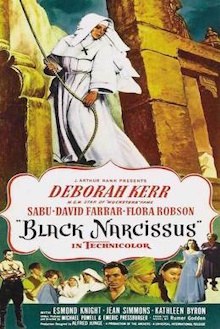
Here’s another film by the British duo Michael Powell and Emeric Pressburger, also known as the Archers, and it’s likely to be the last one in a while since the rest of their filmography isn’t as notable. This one is about a group of nuns who set out to establish a convent in a remote part of India near the Himalayas. Since there’s a dashing Englishman involved, it’s easy to guess that there might be some romance involved. But there is so much more to this film and it genuinely flummoxed me for a bit as to what it is trying to say. Multiple interpretations are plausible, yet it is undeniable that this is a unique film.
An order of nuns based in Calcutta are invited by General Toda Rai to establish a school and hospital in his domain. They are to be based in a palace on the edge of the cliff that once housed the harem of past rajahs. Sister Clodagh is to be the Sister Superior of the new convent together with several others nuns with the assistance of the general’s British agent Mr. Dean. Once they arrive, the nuns are discomfited by the erotic murals and paintings decorating the walls of the palace, its remote location and the exotism of the natives. The general seems enthusiastic and even pays the natives at first to come to attend their services but Mr. Dean is skeptical and believes that they will be forced to leave before the monsoon arrives. Soon the nuns feel obliged to take in Kanchi, an unmarried local girl with a poor reputation, and also admit the princely heir of the general as a student. As time passes, each of the nuns seem to experience a crisis of faith. Instead of planting vegetables, Sister Philippa switches to planting flowers. Clodagh recalls a past romance, the breakup of which led to her becoming a nun. Sister Ruth notices Clodagh getting close with Mr. Dean and becomes obsessively jealous.
I love the originality of the premise, but the production leaves much to be desired. It was filmed almost entirely on studio sets and the only lead to be played by an ethnic Indian is Sabu as the prince. Even the random extras picked up to play the natives are of the wrong composition, a completely wrong mix of Indians and Chinese. The interiors do look plausibly like a slowly decaying palace and though the scenery are all made of matte paintings, they work well enough to convey what the place is supposed to feel like. It’s annoying that so many of these details are wrong but I can forgive it for being a product of its time. That said, everything else is on point: the performances, the dialogue and the unexpectedness of how the story unfurls. Audiences expect a burgeoning romance involving Sister Clodagh and Mr. Dean and there is undeniably attraction between them. But this film is mature enough to acknowledge that Clodagh has left that part of her life behind her and this is neither the time nor the place for it.
So we’re left wondering what the Archers meant to express with this film. Obviously their faith is tested, but by what? The grandeur of the landscape? Some innate power of the Indian land so far removed from Britain? The cultural gulf between them and the natives? Perhaps it is a combination of all of these reasons as evidenced by the presence of the silent Holy Man who sits meditating within their compound. It’s no wonder that some audiences at the time interpreted it as the British Empire bidding farewell to the newly independent India. The film feels unique to my modern sensibilities but upon reflection, I believe that it harkens back to the older Gothic genre which we don’t see much of these days. So it has this mix of the blasphemous, eroticism and exoticism that feels so strange today but must have been quite natural at the time. But what elevates this to greatness is how comparatively restrained it is and how the Archers inject so much eroticism into it without even the slightest amount of nudity or sex.
Not every one of the work of the Archers I’ve seen so far has been exceptional even if they’re all worth watching but I do think this is one of the better ones. It’s unfortunate that the production is as inauthentic as it is as its portrayal of what is Indian and foreign is all wrong. Yet as in keeping with the rest of the body of work made by the duo, what it reveals about Britishness itself is both telling and fascinating.