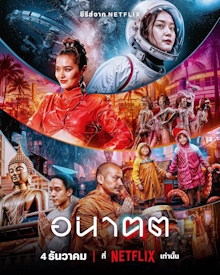
This is a made in Thailand short science-fiction anthology series that received wide release through Netflix. Similar to shows like Black Mirror, each episode is its own standalone story with a couple of them being almost films in their own right. None of the science-fiction ideas in here are particularly original and the plot seems meandering a lot of the time. But I will credit this for being a fantastic effort. It’s bold in challenging established moral values and norms, genuinely dares to imagine what Thailand might be like 20 to 30 years in the future and most of all boasts such high production values that I’m astounded. It’s doesn’t just look authentically futuristic, they have superb art direction as well.
The four episodes vary greatly in style and subject but all are set in a near future Thailand. Black Sheep is about a female scientist who works on 3D printing human hearts during an extended stay on the International Space Station. During the flight home, her shuttle crashes. Her aggrieved husband considers cloning her to get her back but discovers that she might not want to come back exactly the same way. Paradistopia recounts the travails of an ambitious female CEO who makes a line of life-like sex robots and wants to open a legal brothel using them. She is motivated by the suffering of her mother who used to be a prostitute but is opposed by conservative elements of society. In Buddha Data, traditional temples are losing popularity to an app that awards users points for performing meritorious deeds. The points can then be exchanged for goods and services. A monk who used to be an engineer in a tech company therefore comes up with a competing product, which he calls iBuddha. The last story Octopus Girl is set on Earth in which climate change has led to incessant rain for over two years now. In Thailand, the rich retreat to elevated condominiums while the poor are abandoned to the flooded slums. But scientists have invented a vaccine that will help humanity adapt to the changing conditions at cost of some strange mutations.
None of these ideas are especially novel and while the science is vaguely plausible, they’re also iffy at key points. In two of the stories, the technology to accurately read memories out of a human brain is assumed to be possible, a far more revolutionary development than what the main point of the stories. But I’d forgive these flaws because the stories are tightly integrated into the Thai setting. The best of the lot in this regard is the episode about the evolution of Buddhism as we can easily believe that a tech company really will implement such a point system. The story about sex robots covers familiar territory but I enjoyed how it is set in a fictionalized version of Pattaya and the central tension is about getting the Thai government to legalize them. The last story may have questionable science-fiction credentials but it is so quintessential Thai, showing a slum along a Bangkok khlong and the colorful people who live there, that it is probably my favorite of the lot. I do find that the main plot is usually weak, as if the writers put many creative elements in play but don’t quite know what to do with them. There’s also a certain elusiveness in moral judgment as the show refuses to definitively come down on one side or the other of the debate. The exception is the very first episode as it is obvious that the cloning was the right thing to do despite the opposition of the astronaut’s family and the government. In the story about sex robots, despite the CEO’s speech about sexual liberation, the writing still raises doubts that using them is psychological healthy over the long-term.
What I can extol without reservation is the high production values, resulting in a show that consistently looks great. The first episode sets the tone by depicting a slick high-tech future with a space station, skyscrapers and medical facilities that wouldn’t lose to a Hollywood production. They even make a fair attempt at creating a futuristic fashion style. Yet the later episodes are better as they show places that are plausibly twenty to thirty years in the future yet are still recognizably parts of Thailand. It’s amazing to see the familiar streets and canals of Bangkok gussied up with holographic billboards, robots directing traffic, drones and much more. The second episode is all about sex and so understandably refrains from being linked to any real Thai locales. But it makes the interesting artistic choice of showing not a straightforward version of the near future, but a retro-future. So advanced robotic technology exists alongside vintage car designs and the fashions of the 1960s and 1970s. I believe that it’s a reference to the rise of Pattaya as a sex tourism destination for American soldiers on leave from Vietnam. You can quibble with the originality and sophistication of the writing, but it’s undeniable that the series looks fantastic.
One major issue is the episodes could easily be edited for length. The sentimental moments drag on for too long when being concise would have been more impactful. Though shows like Black Mirror are the obvious inspiration, none of the episodes have real shock value. It’s laudable that they’re brave enough to directly decry the religious and conservative parts of society, but the show has a tendency to
“both-sides” issues. A stronger artistic statement would be to definitively say one thing or another. As a result, the episodes mostly peter to an uncertain ending rather than end with a bang. Well, except for the last episode which goes off the rails to achieve a shock ending. All the same, I’m impressed with the effort. It’s far better than anything I could imagine Malaysia being capable of and it truly is science-fiction, not just regular drama with some superficial genre trappings. Highly recommended.