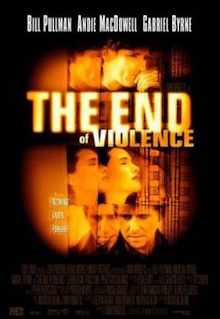
Wim Wenders has made many amazing films and I’ve covered quite a few of them here. Here’s one of his most critically planned films which I added to my list anyway because Scott Sumner had some nice things to say about it. This is strange film that will leave you in confusion much of the time yet it does have a comprehensible plot. It has a very cinematic feeling, but almost too much so until it feels like a caricature of Hollywood movies. Wenders has made excellent American films before so it’s not like he doesn’t have an excellent grasp of both the language and the setting. So it’s strange that he seems to be deliberately trying to be bad at times. It’s an interesting project but not a good film at all.
Mike Max is a high-flying Hollywood producer who needs multiple phones to handle the many demands on his attention. In between video calls, reading his emails and jumping between phones, he can hardly register his wife Paige telling him that he is leaving. Meanwhile Ray Bering is a computer scientist who works out of the Griffith Observatory but the cameras he controls isn’t pointed up at the sky. Instead they point down at the city of Los Angeles as part of a secret government surveillance project. One evening, Max is kidnapped by two men who were paid to kill him. The next morning it is the two men who are found dead by the police with large bullet wounds. Max goes on the run in order to find out who hired them and is taken in by the Mexican gardeners who works for him. Using his cameras, Ray notices the kidnapping but the feed cuts out just before the crucial moment of the kidnappers’ deaths. Meanwhile the police detective investigating Max’s kidnapping gets close to a stuntwoman who Max elevated to the role of the film’s star and Paige moves on with her life.
This is the kind of film that deliberately tries to be mysterious. At various points, characters ask one another to define what ‘violence’ means and usually get an incomplete, half-hearted answer. Mike’s internal monologue makes him come across as paranoid and delusional as he imagines himself being attacked by aliens and monsters. Ray has a god-like view of the entire city without any explanation of why or what he is doing. The dialogue is stilted and unnatural and the artistic references seem out of place. One scene has the stuntwoman Cat in a set that is a recreation of Edward Hopper’s Nighthawks, but because it is part of a movie, everything is brightly lit. The characters don’t seem like real people at all but familiar movie archetypes. The general atmosphere and the elusiveness of any central focus makes it feel like something David Lynch would have made.
Yet unlike Lynch’s body of work, the film does eventually explain everything so there’s no mystery left at the end. Mike’s wildest conspiracy theories are proven true. Never mind how insane or technically implausible it is, in this world the government really can kill whoever they want at the press of a button. Paradoxically by being forced out of his comfortable life as a powerful executive, Mike feel freer. Paige too appears to find renewed purpose in taking up his life. There are multiple ways to interpret what Winders might have been trying to say here. One might be that a full panopticon surveillance state as shown here would bring about the end of all crime and therefore violence at the cost of living in a dystopian police state. Another might be that there is freedom and safety to be found in living as the little people too small to be noticed by the state. As Sumner pointed out, this film does showcase Mexican immigrants whose lives seem more genuine than that of the Americans. This contrasts with the affected drama of the one-man acting performances interspersed throughout. Unfortunately the message isn’t very coherent so I don’t think the film really works as a whole.
This is definitely an odd film and I can’t help but wonder if Wenders was deliberately trying to make a Lynch-style film here especially since this is set in Los Angeles. But I’m forced to agree with most of the critics that this was a miss and it’s one Wenders film that can be safely skipped.