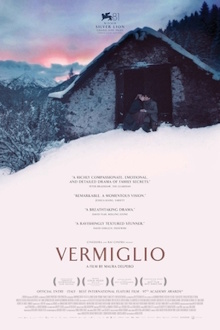
During the last years of the Second World War, the remote village in northern Italy boasts of gorgeous views of the surrounding mountains but its inhabitants are dirt poor. Centered around a large family led by stern teacher, this film does have a plot but mostly it serves as a way to remember their way of life. Director Maura Delpero says as much as her father was from the region and takes great care to depict their lives as authentically as possible. I don’t think the main story is anything special but I do love the film itself and its setting.
Two soldiers flee from the war and are hidden by the villagers of Vermiglio in barn. One of them Attillio is a local while the other Pietro is from Sicily. Cesare the local schoolteacher has a large brood of many children, all of whom are crammed under one roof. He is strong supporter of hiding the soldiers and is a patron of culture despite his family’s poverty. Meanwhile the eldest daughter Lucia starts flirting with Pietro, the second daughter Ada secretly learns to masturbate while being wracked by religious guilt over it and the eldest son Dino becomes rebellious, resenting Pietro’s presence as an outsider. As Lucia and Pietro’s relationship becomes more intimate, they seek and obtain Cesare’s permission to marry. The entire village is present for their wedding and Lucia’s aunt helps hide the fact that she is already pregnant. But then before she gives birth, the war ends. Free to travel once more, Pietro feels obliged to go home to his parents in Sicily, though he promises to write and return soon.
Lucia and Pietro’s tale is as old as the hills and plays out much as you’d expect. It does ring true for a remote village like this in the 1940s so it belongs here but I’d have wished that it wasn’t so central to the film. I much prefer the other subplots that are going on in the background. This includes Ada’s struggle with her sexual desires and religious beliefs, the fact that the family is only able to allow one child to extend their studies and this is the youngest and cleverest daughter Lucretia, the gradual realization among the older children that their strict father is after all a flawed man with feet of clay, Dino’s defiance against his father while being kind of his siblings and much more. The poverty is shocking to our sensibilities, the mother having to carefully dole out heated milk into their bowls, three girls having to share a bed, the fact that a white wedding dress is considered an unobtainable luxury reserved for the rich. Yet there’s joy in their lives too. The amazing scenery is a constant backdrop, some of the children genuinely enjoy their school lessons, one of the younger sons loves the wooden airplane he gets as a present and even Lucia and Pietro’s romance is sweet for a short while.
The film is perhaps at its most brutally honest in depicting the patriarch Cesare. On the one hand, he is unapologetic about harboring the deserters, forcefully arguing that Germany’s war is not their own. There’s something noble about him wanting to show the children the world beyond life in the village, teaching them how to appreciate Vivaldi’s Four Seasons. Yet we can also see for ourselves that he lives better than the rest of his family. He wears clothes that befits his status as an educated gentleman. He has a private study of his own while all of his children have to share a single room and enjoys little luxuries like smoking cigarettes. He has more children than his modest income seems able to comfortable support yet continues to have more despite his advanced age. His poor wife Adele comes close confronting him about it at one point but is too weak to stand up to him. There is so much more that is left unsaid about this character and I can only surmise that Delpero as the auteur has yet to fully work through her own complicated feelings for her own father. To me the treatment of this character is much more interesting that the main romantic plot.
I’ve always noted that films are great when the filmmaker obviously cares a great deal about their project and puts their heart in it. This is very much the case here as we can see how much the village of Vermiglio matters to Delpero. It can stand on its own even without any plot whatsoever as through it, we can step into the world of the villagers of the era and know a little of how they thought, how they lived and how they loved.