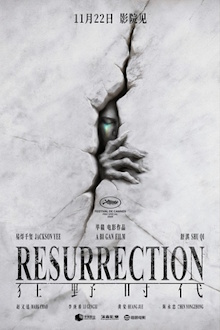
After the acclaim he won for his first two films, Bi Gan certainly isn’t lacking in choices when it comes to what to make next. His latest film takes full advantage of the expanded resources available to him to execute an extremely ambitious vision. He stretches beyond the city of Kaili to tell what seems like a fantastical story with possibly science-fiction elements. But it’s really about cinema itself and the director’s intent seems to be to experiment and show off his mastery of a large variety of different genres and styles. I tend to dislike films that are overly meta and this is the case here as well. It’s a riveting watch as you’re never sure what Bi Gan is going to show you next but it doesn’t seem to me that he has anything interesting to say here.
Interstice titles explain that in a world in which humans have given up on dreaming, one dreamer still continues, hiding within the world of old movies. A woman tracks down the dreamer and enters his dreams, perhaps seeking to understand him. Following this introduction are four separate dream sequences. The first one is in the style of a spy thriller in which the dreamer is pursued by the authorities for a secret. The second one takes place in an abandoned temple in which the dreamer is confronted by a spirit seeking enlightenment. In the third dream, the dreamer is a con artist who enlists an orphaned girl in a scheme to make money. The fourth dream is seemingly set in a city in which the dreamer meets a girl amidst the New Year celebrations of 1999. However she is connected to the gangster boss who runs the city and who turns out to be a vampire. A final sequence then depicts the dreamer’s final fate.
Bi Gan’s earlier films were already obtuse and this one is even more so, with the explanatory text only adding to the confusion. There are some hints that it might take place in some future in which humans who have given up on dreaming gain immortality in exchange but we never get to see this real world. What we do get are the different sequences which are plainly meant to represent eras and genres of film. The introductory sequence for example is silent and the appearance of the dreamer recalls the monsters of German expressionist cinema. The other dream sequences are similarly recognizable from old films. The monk and the temple one for example could be an old ghost story with a Buddhist lesson attached. The fourth dream is closest to what the director previously made, being a single long take that walks the audience through a port city. They’re certainly impressive in that no matter what he chooses to put onto the screen, it never fails to catch and hold attention even if you have no idea what is going on. Still, we must ask if there’s some underlying theme connecting these stories together.
On the face of it, that theme is rooted in Buddhist thought as each segment is named after a different sense. If I were to be charitable, I might interpret this as a melancholic lamentation of the loss of pure sensory experience in an increasingly sterile world. All of these stories seem to yearn for the past even when they are full of suffering. That’s stretching it however and I’m more inclined to believe that this is Bi Gan doing whatever he wants just because he can. Having established a name for himself by making arthouse films, he wants to demonstrate that he is capable of producing equally outstanding work in the more traditional genres. He’s right in that he’s technically proficient and anything that he makes never fails to hold your attention. Even when you have little idea of what is going on, the visuals and the way his characters navigate the spaces around them are enough to entrance you. Yet I don’t see any real coherence in this film as a whole nor any deeper meaning.
I’d still rate this as fascinating because it really is beautiful but I’d rate this as far below this earlier works. Having exhausted what he has to say about Kaili, he seems to want to turn to the magical power of cinema itself next. Unfortunately this is already well-trod territory and I’m not convinced that he has anything new to add in this regard. The good news is that Bi Gan is young and is still at the beginning of his career. So he has plenty of time to reinvent himself and come back with something truly novel and worth watching.