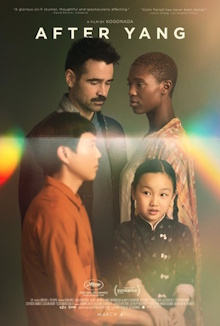
One would think that the subject of androids questioning what it means to be human is already oversaturated but Kogonada shows us here that it is not so. Similarly to his feature film debut Columbus, this one brims with a quiet, understated power set in a world that is far more fascinating that it initially seems. I have doubts about just why their android cannot be repaired and how it tries to introduce some conflict in a film that really doesn’t have any. But it is in all other ways a masterful film that I believe has been underrated.
Jake, Kyra, Mika and Yang are a family of four living in some unspecified far future. Jake is white and Kyra is black while Mika is Chinese, marking her as obviously being adopted. Yang is an android, called a techno-sapiens in this world. His physical form is Chinese and he has been bought by Mika’s parents to serve as her sibling and to connect her to her heritage using his knowledge base of Chinese culture. One day Yang becomes unresponsive, upsetting Mika. As the parents bought Yang second-hand, he is no longer under warranty and the reseller has gone out of business. With Jake’s tea shop not doing well, the family is apparently unable to afford to buy a new unit and Kyra suggests teaching Mika to accept that Yang is gone. Jake attempts to get others to repair Yang including going to a shady backstreet technician who believes in conspiracy theories and extracts Yang’s memory module. An expert at a museum helps him read the contents of the module and asks to buy Yang as they would like to have him on display. Looking through the memories, Jake discovers that Yang had a whole other life that the family was unaware of, including a relationship with a mysterious girl.
This story seems like it could be set in the near future at first but numerous clues such as Yang’s real age, point to this being much farther ahead. It seems to take place still in some unspecified Western country but Asian esthetics are everywhere and we can only speculate what might have happened in this alternative history. I don’t quite understand the rarity of a techno-sapiens like Yang. He is apparently rare enough to be wanted by the museum, yet inexpensive enough that an ordinary family can buy him. It seems to me that the family could have him repaired if they went to original manufacturer so that tension, along with Kyra being more accepting of him being gone for good, feels a little forced. The film’s answer to Yang’s humanity is excellent however. Yang is a person who lived and who mattered and asking if he was human is missing the point. As his memories reveal, he was worried more about being a good sibling or being inauthentic about being Chinese enough to teach Mika. It’s executed with a fine appreciation of subtle details and the fallibility of memory through quiet moments and sparse dialogue.
Beyond the familial story, this work is also a marvel of science-fiction worldbuilding. It is vanishingly rare to come across an utopic representation of the far future on film and this is exactly what this is. They live in a world that enjoys an extremely high level of material comfort, facilitated by very advanced technology. Yet that technology is unobtrusive and almost invisible. Despite professing to some financial insecurity, the family lives in what would be to most of us an unattainably luxurious house set amidst beautiful nature. The values of their society are similarly progressive in a way that we can barely imagine. I speculate that obtaining an android sibling for their child is to them a natural response to declining birth rates. Jake himself has some prejudice towards clones and is considered to be somewhat kooky for that. Certainly the pairing of the white Jake and the black Kyra isn’t worth mentioning in the slightest. It’s no wonder that there’s negligible conflict in the film as they live in the world that knows so little of privation or loss.
Even how Yang is presented here as an unalloyed positive influence in the lives of everyone he meets with is so refreshing when most filmmakers are unable to resist inserting at least some sinister element. This is a beautifully made film that presents a hopeful vision of the future. It’s too carefully considered and sophisticated to be easily dismissed as fluff, and plausible enough to represent our own future. It’s therefore the perfect counter to modern doomerism and that’s an excellent reason to like it.